
Introduction
A Post-Apocalyptic Sci-Fantasy TTRPG System
What Is Ashfall?
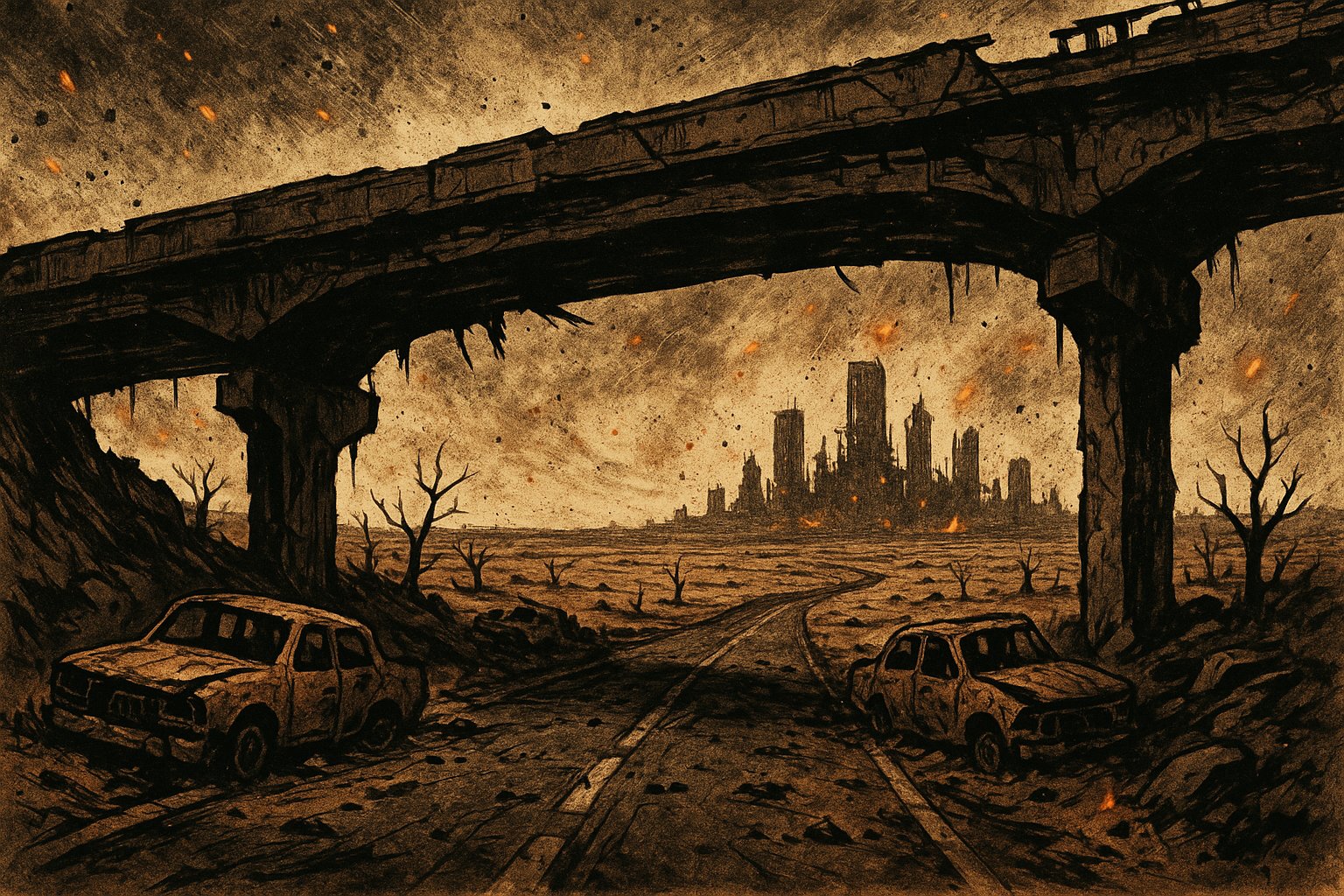
Ashfall is a gritty, dark, and grounded tabletop roleplaying game set 50-100 years after a series of cascading catastrophes destroyed galactic civilization. This system emphasizes:
- Tactical depth with adjustable lethality - GMs can dial encounters from cinematic to brutally realistic
- Meaningful progression - Characters grow from desperate survivors to legendary figures over 20 levels (with optional mythic tier content beyond level 20)
- Resource management - Equipment, augmentations, magic, and humanity are all finite resources
- Hybrid flexibility - Mix tech and magic, combine builds, but always at a cost
- Systematic balance - Clear rules for GMs to build encounters, distribute loot, and maintain challenge
Design Philosophy
Core Pillars
- Survival - Every resource matters in the wasteland
- Choice & Consequence - Power comes with trade-offs
- Emergence - Magic is new, alien, and unpredictable
- Rebuilding - Characters shape the future of scattered civilizations
- Grit - Healing is slow, death is real, victory is earned
Dice Mechanics
Primary Resolution Mechanic: d20 Roll
d20 + Attribute Modifier + Proficiency Bonus + Situational Modifiers
Target Numbers:
- Skill Checks: Roll vs. Difficulty Class (DC 5-30)
- Attacks: Roll vs. Target's Defense Value (DV)
- Saving Throws: Roll vs. Effect DC
Advantage and Disadvantage
- Advantage: Roll 2d20, take higher result
- Disadvantage: Roll 2d20, take lower result
- Multiple sources of advantage/disadvantage don't stack - you either have it or you don't
Critical Success and Failure
- Natural 20: Critical success - double damage on attacks, automatic success on checks (GM discretion for impossible tasks)
- Natural 1: Critical failure - automatic miss on attacks, automatic failure on checks with potential complication
Bounded Accuracy Framework
To maintain meaningful challenges across all levels, bonuses are intentionally limited:
Maximum Bonuses:
- Attribute Modifier: +5 (20 attribute score)
- Proficiency Bonus: +6 at level 20 (scales slowly)
- Equipment Bonus: +3 (legendary gear only)
- Core Category Ceiling: +14 — the sum of Attribute (+5) + Proficiency (+6) + Equipment (+3). These three categories are individually hard-capped at the values above.
- Total Roll Bonus Ceiling: +18 (core tier, Levels 1-20). Feature bonuses (tree milestones, talents, chassis abilities), temporary buffs (party abilities, consumables), and positional bonuses (flanking, high ground) stack on top of the core categories but the total bonus to any single roll cannot exceed +18. Excess above +18 is lost.
- Mythic Ceiling: +22 (mythic tier, Levels 21-30). The mythic proficiency scale (+7 to +9) raises the core category ceiling to +17, and Mythic Boons can push a single core category by +1 (see Mythic Tier below). The total roll bonus ceiling at mythic tier is +22.
This keeps level 1 characters relevant in certain scenarios while allowing high-level characters to perform legendary feats without breaking the math. The two-tier cap structure ensures that investment features (Master milestones, Weapon Bond) always provide value, while extreme party buff stacking cannot push hit rates to trivial levels.
Proficiency Bonus by Level:
Levels 1-4:   +2
Levels 5-8:   +3
Levels 9-12:  +4
Levels 13-16: +5
Levels 17-20: +6
Mythic Tier (Optional, Beyond Level 20):
Levels 21-24: +7
Levels 25-28: +8
Levels 29-30: +9
Mythic Tier Bonus Ceiling: The mythic proficiency cap of +9 (at Levels 29-30) produces a typical mythic maximum of +17 (Attribute +5, Proficiency +9, Equipment +3). The absolute ceiling of +18 requires a Mythic Boon — an exceptional power gain available to mythic-tier characters who complete specific legendary achievements. Without a Mythic Boon, +17 is the practical mythic ceiling.
Mythic Boons are GM-granted narrative rewards, not purchasable with Character Points (CP). A character can benefit from at most one Mythic Boon, and each Boon grants +1 to a single bonus category (attribute, proficiency, or equipment), pushing the total to +18. Examples include:
- Slaying a World-Shaping Entity: Defeating a being of world-shaping mythic power — not a powerful beast, but a creature whose existence reshapes the world around it. The character absorbs a fragment of its essence, granting +1 to their primary attribute.
- Completing a Mythic Ritual: Performing a civilization-scale working — sealing a permanent rift, rewriting the laws of magic for a region, or binding a god's aspect — that fundamentally alters the world. The sustained channel of power leaves the character permanently attuned, granting +1 to proficiency.
- Earning a Deity's Favor: Receiving direct investment of divine or cosmic will from an active god, primordial, or world-shaping intelligence — not mere blessing, but a permanent marking that elevates the character's potential. This grants +1 to equipment bonuses as the character's gear responds to their elevated status.
Reaching +18 is a story milestone, not a mechanical transaction. The GM determines whether an achievement qualifies — the examples above are guidance, not an exhaustive list.
Difficulty Classes
Standard DC Scale:
DC 5:   Trivial (nearly automatic)
DC 10:  Easy (trained individuals succeed regularly)
DC 15:  Moderate (requires focus and skill)
DC 20:  Hard (experts succeed more often than not)
DC 25:  Very Hard (only masters succeed reliably)
DC 30:  Near-Impossible (legendary difficulty)
DC 35+: Impossible for mortals (demigod+ only)
Contested Checks: When two characters oppose each other, both roll and highest total wins. Ties go to the defender/passive party.
Game Modes
Combat Mode
- Structured turn order (initiative)
- 6-second rounds
- 3 actions + 1 reaction per turn
- Precise positioning matters
Exploration Mode
- Fluid time (minutes to hours)
- Abstract movement
- Group checks common
- Environmental interaction focus
Downtime Mode
- Measured in days/weeks
- Training, crafting, research
- Recovery and base-building
- Narrative advancement