
Downtime
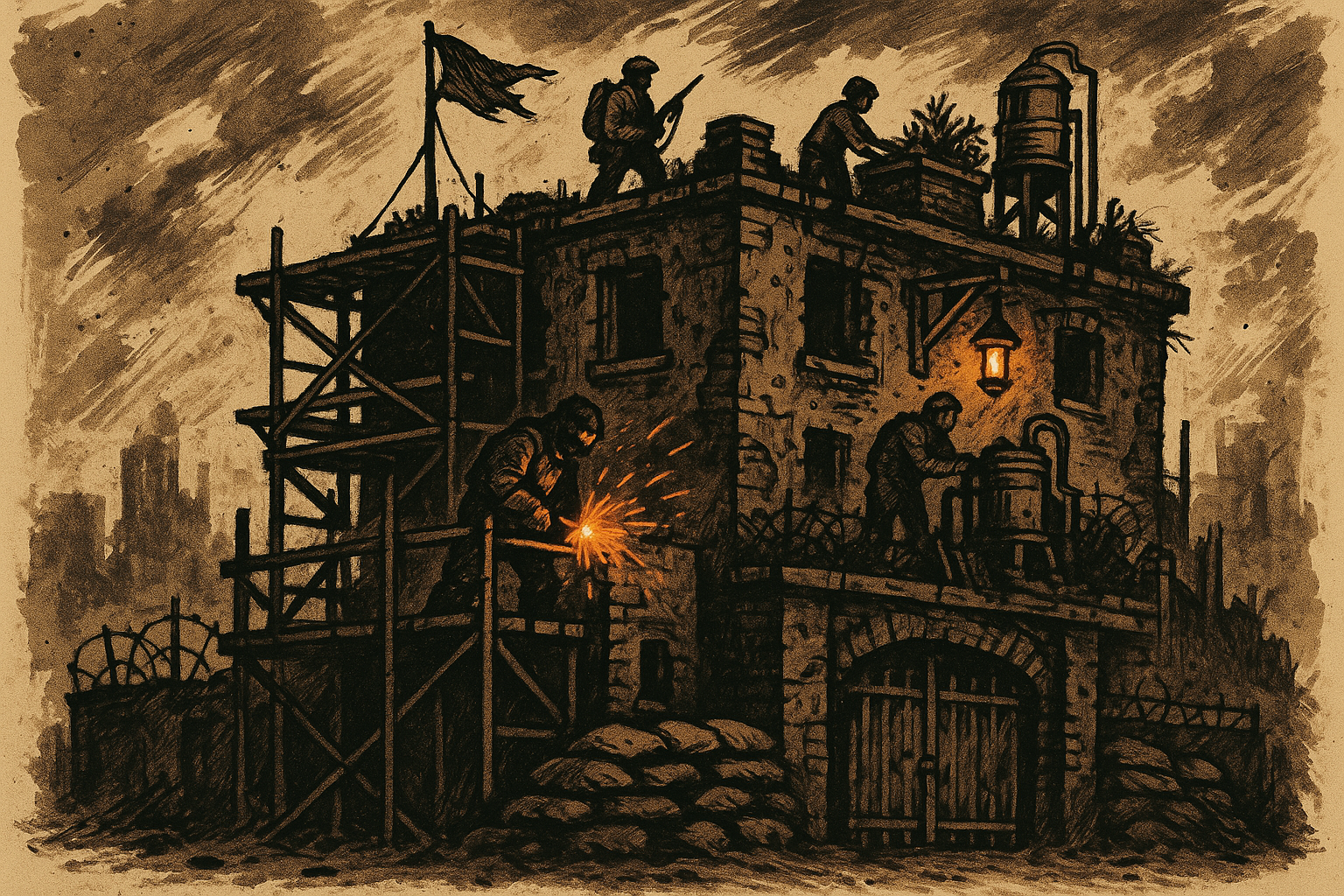
Why Downtime Matters
In the wasteland, the time between missions is just as important as the missions themselves. Long rests take a full week in a safe settlement — that's seven days of potential. Characters who spend that time wisely craft weapons, build alliances, fortify shelters, and gather intelligence. Characters who don't fall behind.
The downtime system gives every character meaningful choices during rest periods. It turns "I wait a week" into "I spend three days upgrading the workshop and two days gathering intel on the raider camp."
Downtime Phases
Each long rest week follows four phases in order:
- Upkeep — Pay maintenance costs for your base (if any)
- Activity — Spend your 5 downtime days on activities
- Income — Base upgrades generate passive resources
- Event — Roll for a random downtime event (if your party has a base)
You get 5 downtime days per long rest week. The remaining 2 days are consumed by actual rest, recovery, and basic survival needs. Each downtime activity lists how many days it costs. You can split days between multiple activities.
No Long Rest Required: The GM may also grant downtime days outside of long rests — a 3-day layover waiting for a caravan, a week of travel with nothing to do, etc. These "free" downtime days follow the same rules but don't include rest recovery benefits.
Capital
Capital represents abstract resources you accumulate and spend during downtime. There are four types:
| Capital | Purchase Cost | Represents | Primary Skills |
|---|---|---|---|
| Salvage | 20 cr per point | Scrap metal, raw materials, components, fuel | Survival, Technology |
| Influence | 30 cr per point | Favors, reputation, social connections, debts owed | Persuasion, Deception, Streetwise |
| Tech | 50 cr per point | Pre-Fall schematics, rare electronics, precision parts | Technology, Science, Engineering |
| Essence | 50 cr per point | Magical reagents, ley-line energy, ritual components | Arcana, Mysticism |
Earning Capital
You can acquire capital in three ways:
Purchase: Buy capital outright at the listed credit cost. This represents hiring laborers, buying materials from merchants, calling in favors, or purchasing rare components.
Earn (Downtime Activity): Spend 1 downtime day and make a skill check to earn capital. See the Earn Capital activity below.
Loot: The GM may award capital as mission rewards — a cache of salvageable parts (Salvage), a faction's gratitude (Influence), a recovered hard drive full of blueprints (Tech), or a vial of crystallized ley-energy (Essence).
Spending Capital
Capital can be spent in three ways:
- On downtime activities that list a capital cost (crafting, building, recruiting)
- As credits at the listed purchase cost (1 Salvage = 20 cr, 1 Influence = 30 cr, etc.)
- To boost skill checks during downtime activities (see Activity Boosts below)
Activity Boosts
When performing a downtime activity, you can spend capital to improve your chances:
- Spend 1 Salvage for +1 to Technology or Science checks (max +5)
- Spend 1 Influence for +2 to Persuasion, Deception, or Streetwise checks (max +6)
- Spend 1 Tech for +2 to Technology, Science, or Engineering checks (max +6)
- Spend 1 Essence for +2 to Arcana checks (max +6)
These bonuses represent using better materials, leveraging connections, referencing schematics, or channeling additional magical energy.
Tracking Capital
Record capital on your character sheet as a simple tally (e.g., Salvage: 3, Influence: 1, Tech: 0, Essence: 2). Capital doesn't expire and carries between rest periods. There's no maximum — hoard as much as you can get.
Downtime Activities
Each activity lists its time cost (in downtime days), skill check (if any), capital cost (if any), and effect. Unless stated otherwise, a character can only perform one instance of the same activity per downtime week.
Earning
Earn Capital
- Time: 1 day
- Skill: Any applicable skill (see Capital table)
- Effect: Make a skill check. The result determines how much capital you earn:
| Check Result | Capital Earned |
|---|---|
| 9 or lower | 0 (wasted day) |
| 10-14 | 1 point of chosen type |
| 15-19 | 2 points of chosen type |
| 20-24 | 3 points of chosen type |
| 25+ | 4 points of chosen type |
You choose the capital type before rolling. The skill used must match the capital type (Survival or Technology for Salvage, Persuasion or Streetwise for Influence, etc.). The GM may allow creative skill pairings — an Operative using Stealth to "earn" Salvage by stealing scrap, for instance.
Level Scaling: At level 6+, multiply capital earned by 2. At level 11+, multiply by 3. At level 16+, multiply by 4. This keeps capital earning competitive with Work for Credits at higher levels.
Work for Credits
- Time: 1 day
- Skill: Any Profession-adjacent skill
- Effect: Earn credits directly. Base pay is 10 credits per day for unskilled labor. With a relevant skill check:
| Check Result | Daily Pay |
|---|---|
| 9 or lower | 10 cr (unskilled rate) |
| 10-14 | 20 cr |
| 15-19 | 40 cr |
| 20-24 | 75 cr |
| 25+ | 125 cr |
Scaling: At level 6+, multiply daily pay by 2. At level 11+, multiply by 4. At level 16+, multiply by 8. Higher-level characters command premium rates.
Run a Business
- Time: 1 day
- Skill: Persuasion, Streetwise, or relevant craft skill
- Prerequisite: You must own a base with at least one income-generating upgrade
- Effect: Make a skill check with a +5 bonus. Use the Earn Capital table above. The capital type depends on the business (a workshop earns Salvage or Tech; a bar earns credits or Influence).
Crafting
For the full crafting system — including detailed DCs, modification lists, enchanting rules, formulas, and magical item crafting — see the Crafting chapter.
Craft Items
- Time: Varies by tier (see Crafting)
- Skill: Technology (mechanical/electronic) or Science (chemical/pharmaceutical)
- Capital Cost: Crafting materials can be paid in credits OR capital:
| Item Tier | Credit Cost | Or Capital Cost | Time | DC |
|---|---|---|---|---|
| Tier 1 | 5 cr | 1 Salvage | 1 hour | DC 10 |
| Tier 2 | 25 cr | 2 Salvage | 4 hours | DC 13 |
| Tier 3 | 100 cr | 5 Salvage + 1 Tech | 1 day | DC 16 |
| Tier 4 | 500 cr | 10 Salvage + 3 Tech | 3 days | DC 19 |
| Tier 5+ | 2,000+ cr | 20 Salvage + 8 Tech | 5+ days | DC 22+ |
Magical items require Essence instead of (or in addition to) Tech. See the Crafting chapter for the complete magical item crafting table with specific Essence costs by category (consumable, charged, permanent).
Formulas: Having a formula reduces the crafting DC (Tier 1-2: -1, Tier 3: -2). Tier 4+ items and all enchanted items require a formula. Formulas can be found as loot, purchased from merchants (see the Formula Purchase Cost table in Crafting), or created with the Research activity. See Crafting for full formula rules.
Outcomes: See Crafting for the expanded outcome table including Setback, Masterwork quality, and the Mishap table.
Craft Ammunition
- Time: 30 minutes per magazine (does not consume a full downtime day)
- Skill: Technology DC varies by type
- Cost: Half purchase price in credits, or 1 Salvage per 3 standard magazines
- Effect: See Special Ammunition in the Equipment chapter
Brew Stims
- Time: 1 hour per stim (does not consume a full downtime day)
- Skill: Science DC 12 (Tier 1), DC 15 (Tier 2), DC 18 (Tier 3)
- Cost: Half purchase price in credits, or 1 Salvage per Tier 1 stim, 2 Salvage per Tier 2, 1 Salvage + 1 Essence per Tier 3
- Effect: Produce one stim of the listed tier
Research
- Time: 1-3 days
- Skill: Science, Technology, or Arcana (DC varies)
- Capital Cost: 1 Tech (for schematics) or 1 Essence (for spell research)
- Effect: Create a blueprint for a specific item (reduces future crafting DC by 2), or research a new spell effect (see Magic for spell research rules). The DC equals the item's crafting DC + 2.
Networking
Gather Intelligence
- Time: 1 day
- Skill: Streetwise, Persuasion, or Investigation
- Capital Cost: Optional — spend 1 Influence for +2 to check (max +6)
- Effect: Learn information about a specific topic. The GM determines what you discover based on your check result:
| Check Result | Information Quality |
|---|---|
| 9 or lower | Rumors only (may be false) |
| 10-14 | General information (publicly known) |
| 15-19 | Specific details (requires digging) |
| 20-24 | Sensitive information (guarded secrets) |
| 25+ | Critical intelligence (faction plans, hidden locations, etc.) |
Recruit
- Time: 2 days
- Skill: Persuasion or Intimidation
- Capital Cost: 2 Influence + ongoing cost (see Base Upgrades)
- Effect: Recruit an NPC to work at your base or join your organization. The NPC's quality depends on your check:
| Check Result | Recruit Quality |
|---|---|
| 9 or lower | Nobody willing |
| 10-14 | Unskilled laborer (no proficiency bonus) |
| 15-19 | Skilled worker (+2 proficiency, one skill) |
| 20-24 | Specialist (+3 proficiency, two skills) |
| 25+ | Expert (+4 proficiency, three skills, may have class levels) |
Recruited NPCs can staff base upgrades, accompany you on missions (GM discretion), or perform downtime activities on your behalf (using their own skill modifiers, one activity per week).
Trade Favors
- Time: 1 day
- Skill: Persuasion or Deception
- Effect: Convert between capital types at a loss. Spend 3 points of one capital type to gain 2 points of another. A successful DC 15 check improves the rate to 2-for-2.
Promote
- Time: 1 day
- Skill: Persuasion or Streetwise DC 15
- Capital Cost: 1 Influence
- Prerequisite: You must own a base with income-generating upgrades
- Effect: On success, your base's passive income is doubled for the next downtime week. On failure, the Influence is still spent but you gain no benefit.
Training
Train Skill
- Time: 5 days (full downtime week)
- Skill: None (training check at end)
- Capital Cost: 2 Influence (finding a teacher) OR 1 Tech (self-study materials)
- Effect: At the end of the training period, make an INT or WIS check (your choice) DC 15. On success, you gain proficiency in one skill you are not already proficient in. On failure, you can try again next downtime week (capital must be spent again).
Prerequisite: You can only train skills that are narratively accessible — you can't learn Piloting without access to a vehicle, or Arcana without a magic user to teach you.
Retrain Feature
- Time: 5 days (full downtime week)
- Capital Cost: 2 of any single capital type
- Effect: Swap one of the following for a different option of the same type:
- One skill proficiency for another
- One talent for another you qualify for
- One class feature choice (e.g., swap a Warrior's combat style)
You cannot retrain core class features, attribute scores, or species traits.
Prepare for Adventure
- Time: 1 day
- Skill: Any relevant skill
- Capital Cost: 1 of any capital type per +1 bonus (max 3)
- Effect: Gain a bonus to one specific skill check during your next adventure. You must declare the skill and the anticipated situation (e.g., "I'm studying the compound's security — Technology check to bypass their locks"). The bonus equals the capital spent (max +3) and expires at the end of the next adventure or after one use, whichever comes first.
Building
See the Base System section below for full rules on constructing and upgrading a base of operations.
Construct Upgrade
- Time: Varies by upgrade (2-10 days)
- Skill: Technology (mechanical upgrades), Survival (structural), or relevant skill
- Capital Cost: Varies by upgrade
- Effect: Add a new upgrade to your base. See the Base Upgrades table.
Repair Base
- Time: 1 day per 10 points of damage
- Skill: Technology or Survival DC 13
- Capital Cost: 1 Salvage per 10 points of damage repaired
- Effect: Restore your base's Hit Points after an attack or disaster. On a failed check, the day is spent but no HP are restored (materials are not consumed on failure).
Recovery
These activities represent medical procedures, augmentation work, and personal recovery that go beyond standard long rest healing.
Install Augmentation
- Time: 1 day per augmentation
- Skill: Technology DC 15 (or Medicine DC 15 for biological augments)
- Capital Cost: 1 Tech per augmentation tier (Tier 1 = 1 Tech, Tier 2 = 2 Tech, etc.) in addition to the augmentation's credit cost
- Prerequisite: Medical facility or base with Clinic upgrade
- Effect: Install a cybernetic augmentation per the rules in Equipment. On a failed check, the augmentation is damaged (50% cost to repair) and the patient takes 2d6 damage.
Intensive Care
- Time: 5 days (full downtime week, concurrent with long rest)
- Skill: Medicine (DC varies by injury)
- Effect: Treat a lingering injury with full medical attention. This is the same as Long-Term Care in the Exploration chapter but with additional benefits if you have a Clinic upgrade at your base:
- Without Clinic: Standard long-term care rules
- With Clinic: +2 to Medicine checks, can treat two patients simultaneously, access to Tier 3 medical supplies
Therapy
- Time: 3 days
- Skill: Medicine (WIS) or Insight (WIS) DC 15
- Effect: Help a character recover from psychological trauma. On success, remove one mental condition (frightened, charmed effects that persist, stress-related penalties imposed by the GM). On failure, no effect but no harm done.
The Base System
A base is a persistent location your party controls — an abandoned factory turned fortress, a reclaimed bunker, a derelict ship grounded in the wastes. It's collaborative: the whole party invests in one base, and everyone benefits.
Establishing a Base
To claim a base, you need:
- A location — Found during play (an abandoned building, cave system, ruined settlement, etc.)
- Initial investment — 10 Salvage + 5 Influence to secure and make habitable
- Time — 5 downtime days of work to establish basic operations
Once established, a base starts with 50 Hit Points, DV 10, and enough space for the party plus a handful of NPCs. It provides the minimum requirements for a long rest (shelter, safety, basic resources).
Base Hit Points and Defense
Your base can be attacked by raiders, monsters, rival factions, or natural disasters.
| Base Level | Hit Points | DV |
|---|---|---|
| Basic (0-2 upgrades) | 50 | 10 |
| Established (3-5 upgrades) | 100 | 12 |
| Fortified (6-9 upgrades) | 150 | 14 |
| Stronghold (10+ upgrades) | 200 | 16 |
Defenses: Certain upgrades (Watchtower, Perimeter Wall, Armory) increase DV or add defensive capabilities. Staffed defenses (guards, automated turrets) can fight back during attacks.
Upkeep
During Phase 1 of each downtime week, you pay maintenance costs for your base:
- Basic (0-2 upgrades): 10 cr/week or 1 Salvage
- Established (3-5 upgrades): 25 cr/week or 2 Salvage
- Fortified (6-9 upgrades): 50 cr/week or 3 Salvage
- Stronghold (10+ upgrades): 100 cr/week or 5 Salvage
If you can't pay upkeep, one random upgrade becomes inactive until maintenance is paid. Inactive upgrades provide no benefits and generate no income.
Passive Income (Phase 3)
During Phase 3, each income-generating upgrade rolls automatically:
Income Roll: d20 + upgrade's income modifier
| Roll Result | Income Generated |
|---|---|
| 9 or lower | Nothing this week |
| 10-14 | 1 point of the upgrade's capital type |
| 15-19 | 2 points or 30 cr |
| 20-24 | 3 points or 50 cr |
| 25+ | 4 points or 75 cr |
A character who uses the Run a Business activity adds their skill modifier to one upgrade's income roll.
Base Upgrades
Each upgrade has a cost (in capital), construction time (in downtime days), effect, and income (if any). Upgrades also list any staff that come included — NPCs who operate the facility.
Shelter & Structure
| Upgrade | Cost | Time | Effect |
|---|---|---|---|
| Bunkhouse | 5 Salvage, 1 Influence | 3 days | Houses up to 12 people. Meets long rest shelter requirements. |
| Perimeter Wall | 8 Salvage | 5 days | Base DV +2. Enemies must breach wall (HP 30) before attacking base interior. |
| Watchtower | 4 Salvage, 1 Tech | 3 days | +5 to Perception checks to detect approaching threats. Staff: 1 lookout. |
| Hidden Entrance | 3 Salvage, 2 Tech | 2 days | Base is harder to find. DC 20 Perception/Investigation to locate from outside. |
| Reinforced Structure | 10 Salvage, 2 Tech | 5 days | Base HP +50. Resistant to fire and explosive damage. |
Production & Crafting
| Upgrade | Cost | Time | Effect | Income |
|---|---|---|---|---|
| Workshop | 6 Salvage, 2 Tech | 4 days | Craft Tier 1-3 items. +2 to Technology checks for crafting. Staff: 1 apprentice. | Salvage +3 |
| Forge | 8 Salvage, 3 Tech | 5 days | Craft Tier 1-4 melee weapons and armor. Requires Workshop. | Salvage +5 |
| Laboratory | 5 Salvage, 4 Tech, 1 Essence | 5 days | Craft Tier 1-4 chemicals, stims, and explosives. +2 to Science checks. Staff: 1 lab assistant. | Tech +3 |
| Arcane Sanctum | 3 Salvage, 2 Influence, 4 Essence | 5 days | Craft magical items. Ritual casting takes half time. +2 to Arcana checks. | Essence +3 |
| Armory | 6 Salvage, 2 Tech | 3 days | Store weapons/armor safely. Quick-equip: change loadout as a free action when leaving base. Base DV +1 (armed defenders). | — |
Services & Social
| Upgrade | Cost | Time | Effect | Income |
|---|---|---|---|---|
| Clinic | 4 Salvage, 3 Tech | 4 days | +2 to Medicine checks at base. Install Tier 1-2 augmentations. Treat two patients simultaneously. Staff: 1 medic. | — |
| Surgery Suite | 6 Salvage, 5 Tech | 5 days | Install Tier 1-4 augmentations. Requires Clinic. +2 to augmentation installation checks (stacks with Clinic bonus). | Tech +2 |
| Comms Array | 3 Salvage, 3 Tech | 3 days | Long-range communication (50-mile radius). +2 to Gather Intelligence checks. Can contact allied settlements. | Influence +2 |
| Bar / Common Room | 5 Salvage, 2 Influence | 3 days | Attract visitors and traders. +2 to Persuasion and Streetwise checks at base. Staff: 1 bartender. | Influence +4 |
| Market Stall | 4 Salvage, 3 Influence | 2 days | Buy and sell goods at base. Reduces purchase costs by 10%. Attracts traders weekly. | Credits: +20 cr/week (flat) |
| Barracks | 6 Salvage, 3 Influence | 4 days | House up to 8 armed guards. Guards defend base during attacks (use Guard stat block). Staff: 4 guards. | — |
Specialized
| Upgrade | Cost | Time | Effect | Income |
|---|---|---|---|---|
| Training Ground | 5 Salvage, 2 Influence | 3 days | Train Skill activity takes 3 days instead of 5. Sparring partner: +2 to Train Skill checks. | — |
| Stable / Garage | 6 Salvage, 1 Tech | 3 days | House mounts or vehicles. Maintain up to 4 vehicles. Repair vehicles at half cost. | — |
| Archive | 2 Salvage, 3 Tech, 1 Essence | 4 days | +2 to Research activities. Store blueprints and schematics. Recovered data can be studied here. | Tech +2 |
| Generator | 5 Salvage, 4 Tech | 3 days | Power other upgrades. Required for Surgery Suite, Comms Array, and Laboratory to function at full capacity. Without a Generator, those upgrades operate at -2 to all checks. | — |
| Greenhouse | 4 Salvage, 1 Tech | 3 days | Grow food. Reduces upkeep cost by 1 Salvage (minimum 0). Party gains advantage on Fortitude saves vs starvation/dehydration while at base. | Salvage +2 |
Upgrade Dependencies
Some upgrades require others to function:
- Forge requires Workshop
- Surgery Suite requires Clinic
- Generator is required for Surgery Suite, Comms Array, and Laboratory to operate at full capacity (they function at -2 without it)
Losing a Base
If your base is destroyed (reduced to 0 HP) or overrun, you lose access to all upgrades. Upgrades are not destroyed — they're damaged. If you reclaim the base, you can repair it (see Repair Base activity). If the base is permanently lost, you salvage what you can: recover capital equal to 25% of the total invested.
Downtime Events
During Phase 4, if your party has a base, roll d20 on the event table. On a 1-4, an event occurs. Roll d12 to determine which:
| d12 | Event | Effect |
|---|---|---|
| 1 | Raider Scout | A raider band has spotted your base. If not dealt with (Stealth DC 15 to hide, Intimidation DC 15 to scare off, or combat), raiders attack next downtime week with a force equal to the party's level. |
| 2 | Trader Caravan | A merchant caravan passes nearby. You can buy or sell goods at standard prices. They carry 1d4 items of Tier equal to your base level (Basic=1, Established=2, Fortified=3, Stronghold=4). |
| 3 | Refugee Arrival | 1d6 refugees seek shelter. If accepted: gain 1 Influence and 1 unskilled laborer for your base. If turned away: lose 1 Influence (word spreads). Refugees consume 5 cr/week in supplies. |
| 4 | Equipment Failure | One random upgrade malfunctions. It becomes inactive until repaired (Technology DC 13, 1 day, 1 Salvage). |
| 5 | Resource Discovery | A party member stumbles onto a cache. Gain 1d4 points of a random capital type (roll d4: 1=Salvage, 2=Influence, 3=Tech, 4=Essence). |
| 6 | Faction Attention | A local faction takes notice of your base. The GM chooses which faction. They send an envoy to discuss terms: trade agreement, protection racket, alliance offer, or territorial demand. |
| 7 | Infestation | Vermin, mutant creatures, or hostile flora infest the base. One upgrade is inactive until the infestation is cleared (Survival DC 15, 1 day). If ignored, it spreads: another upgrade goes inactive each week. |
| 8 | Storm / Natural Disaster | Severe weather or geological event. Base takes 2d10 damage (ignores DV). Exposed upgrades (Watchtower, Greenhouse, Market Stall) take double damage. |
| 9 | Mysterious Stranger | A skilled individual offers their services. They'll work for free for 1 week in exchange for shelter. They have +4 in one random skill. After the week, they leave unless recruited (Persuasion DC 18, no Influence cost). |
| 10 | Salvage Opportunity | A pre-Fall ruin, crashed vehicle, or abandoned camp is discovered nearby. Send a party to investigate: 1 day expedition, potential loot (GM determines), possible danger (50% chance of encounter). |
| 11 | Reputation Spreads | Word of your base reaches a wider audience. Gain 1 Influence. If your base has a Bar/Common Room, gain 2 Influence instead. Future Recruit checks at this base gain +1 (cumulative, max +3). |
| 12 | Quiet Week | Nothing happens. The peace is almost unsettling. All characters gain advantage on their first downtime activity check next week. |
Event Frequency: The GM can adjust event frequency. For a more eventful campaign, events occur on 1-6 instead of 1-4. For a quieter game, events occur only on a natural 1.
Collaborative Downtime
Downtime works best when the whole party participates simultaneously. Here's how to run it efficiently at the table:
Quick Resolution (Recommended)
- Declare: Each player states what their character does for the week (e.g., "I spend 3 days crafting and 2 days earning Salvage")
- Roll: Everyone rolls their checks at once
- Resolve: The GM resolves outcomes, describes events, and moves on
A full downtime week should take 10-15 minutes of real time. If it's taking longer, simplify: skip the event roll, use average income, or let players resolve activities between sessions.
Helping
Characters can assist each other during downtime:
- Aid Another: Spend 1 downtime day to give an ally advantage on one downtime skill check. You must be proficient in the relevant skill.
- Group Projects: Multiple characters can contribute downtime days toward the same construction project. Each character beyond the first reduces construction time by 1 day (minimum 1 day).
Downtime at Different Levels
The system scales with character progression:
Levels 1-5 (Survival): Capital is scarce. Characters focus on earning basic resources, crafting Tier 1-2 gear, and establishing a base. Every point of Salvage matters.
Levels 6-10 (Establishment): The base grows. Characters have enough capital flow to maintain upgrades, recruit staff, and craft Tier 3 gear. Passive income begins to matter. Work for Credits pays double.
Levels 11-15 (Influence): The party's base becomes a regional landmark. Faction events dominate. Characters craft Tier 4 gear, install advanced augmentations, and their reputation precedes them. Work for Credits pays quadruple.
Levels 16+ (Legacy): The base is a stronghold. Characters shape the political landscape through downtime — brokering alliances, funding expeditions, and developing experimental technology. Work for Credits pays eight times base rate.
Quick Reference
Capital Costs at a Glance
| Capital | Buy | Sell | Boost |
|---|---|---|---|
| Salvage | 20 cr | 20 cr | +1 per point to Tech/Science checks (max +5) |
| Influence | 30 cr | 30 cr | +2 per point to Social checks (max +6) |
| Tech | 50 cr | 50 cr | +2 per point to Tech/Science/Engineering checks (max +6) |
| Essence | 50 cr | 50 cr | +2 per point to Arcana checks (max +6) |
Activity Summary
| Activity | Time | Key Skill | Cost |
|---|---|---|---|
| Earn Capital | 1 day | Varies | — |
| Work for Credits | 1 day | Varies | — |
| Run a Business | 1 day | Persuasion/Streetwise | Requires base |
| Craft Items | Varies | Technology/Science | Materials (see tier) |
| Craft Ammunition | 30 min | Technology | Half purchase price |
| Brew Stims | 1 hr | Science | Half purchase price |
| Research | 1-3 days | Science/Technology/Arcana | 1 Tech or 1 Essence |
| Gather Intelligence | 1 day | Streetwise/Persuasion | Optional Influence |
| Recruit | 2 days | Persuasion/Intimidation | 2 Influence |
| Trade Favors | 1 day | Persuasion/Deception | 3 capital → 2 capital |
| Promote | 1 day | Persuasion/Streetwise | 1 Influence |
| Train Skill | 5 days | INT/WIS check | 2 Influence or 1 Tech |
| Retrain Feature | 5 days | — | 2 of any capital |
| Prepare for Adventure | 1 day | Relevant skill | 1-3 of any capital |
| Construct Upgrade | 2-10 days | Technology/Survival | Varies |
| Repair Base | 1 day/10 HP | Technology/Survival | 1 Salvage per 10 HP |
| Install Augmentation | 1 day | Technology/Medicine | 1 Tech per tier |
| Intensive Care | 5 days | Medicine | — |
| Therapy | 3 days | Medicine/Insight | — |
Hire (Temporary Help)
Not every job needs a permanent recruit. You can hire temporary specialists:
- Time: 1 day to find and negotiate
- Cost: 2 Influence + daily rate in credits (10 cr/day unskilled, 30 cr/day skilled, 75 cr/day specialist, 150 cr/day expert)
- Duration: Hired help stays for one specific job or mission, then leaves
- Effect: The hired NPC performs a specific task using their skills. Common hires: a guide through dangerous territory, a demolitions expert for a specific breach, a translator for alien negotiations, a courier for sensitive messages
The GM determines availability based on location. A remote outpost won't have expert hackers for hire.