
Crafting
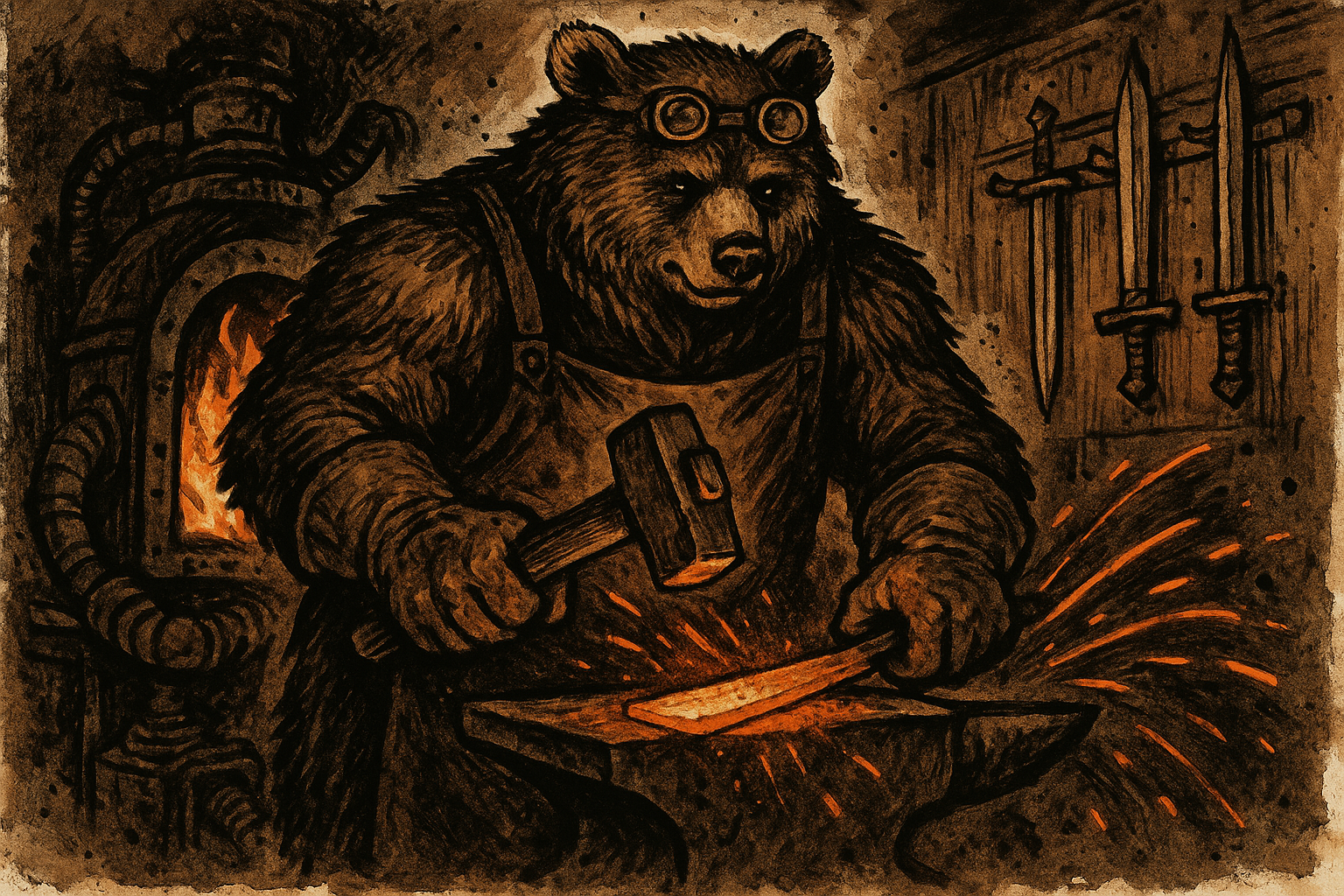
In the wasteland, you can't just walk into a shop and buy what you need. The best gear is built by hand — forged from salvage, wired from scavenged circuits, or infused with volatile magical energy. This chapter consolidates all crafting rules into a single reference: mundane fabrication, magical enchanting, equipment modification, and the formulas that make it all possible.
For item statistics and prices, see Equipment. For field repairs during exploration, see Exploration & Survival. For downtime capital costs and base upgrades that support crafting, see Downtime.
Crafting Fundamentals
Who Can Craft
Any character with proficiency in the relevant skill can attempt to craft:
- Technology — Weapons, armor, tools, electronics, mechanical devices
- Science — Ammunition, stims, chemicals, explosives, pharmaceuticals
- Arcana — Enchantments, sigils, magical items, ritual components
- Medicine — Advanced stims, serums, antidotes, surgical preparations
You can only craft items you have proficiency to use. A character without weapon proficiency can't craft weapons, even with Technology proficiency.
Tools and Facilities
| Facility | Tier Access | Availability |
|---|---|---|
| Basic toolkit | Tier 1-2 | Portable, fits in a pack. Included in Technician starting gear. |
| Gunsmithing tools | Ammo and firearms | Portable. 50 cr or 3 Salvage to acquire. |
| Chemistry set | Stims and chemicals | Portable. 75 cr or 4 Salvage to acquire. |
| Workshop | Tier 1-3 | Requires a settlement or base upgrade. |
| Forge | Tier 1-4 melee/armor | Requires Workshop. Base upgrade or settlement. |
| Laboratory | Tier 1-4 chemicals/electronics | Requires Generator. Base upgrade or city facility. |
| Arcane Sanctum | Magical items | Base upgrade. +2 to Arcana crafting checks. |
| Masterwork Facility | Tier 5+ | City-scale facility or faction access. Extremely rare. |
Attempting to craft without the required facility imposes disadvantage on the check and limits you to one tier below the facility's maximum.
Base Crafting Table
| Item Tier | DC | Time | Credit Cost | Capital Cost |
|---|---|---|---|---|
| Tier 1 | DC 10 | 1 hour | 5 cr | 1 Salvage |
| Tier 2 | DC 13 | 4 hours | 25 cr | 2 Salvage |
| Tier 3 | DC 16 | 1 day | 100 cr | 5 Salvage + 1 Tech |
| Tier 4 | DC 19 | 3 days | 500 cr | 10 Salvage + 3 Tech |
| Tier 5 | DC 22 | 5 days | 2,000 cr | 20 Salvage + 8 Tech |
| Tier 6 | DC 24 | 10 days | 5,000 cr | 40 Salvage + 15 Tech |
| Tier 7 | DC 26 | 20 days | 12,000 cr | 80 Salvage + 30 Tech |
Crafting time can be split across multiple sessions. Track hours/days completed.
Crafting Limit: A character can complete a maximum of 3 crafting projects per downtime week (long rest period), regardless of how quickly individual projects could be finished. Complex projects that span multiple days count as one project.
Consumables (ammunition, stims, single-use items) cost half the listed credit or capital cost to craft.
Crafting Outcomes
| Result | Outcome |
|---|---|
| Beat DC by 10+ | Masterwork. Item gains one minor enhancement (see Masterwork Quality below). |
| Beat DC by 5-9 | Efficient. Crafting time reduced by half. |
| Success | Item crafted to standard quality. |
| Fail by 1-4 | Setback. Half the materials are consumed. You may resume the attempt with the remaining materials, but the DC increases by 2. |
| Fail by 5-9 | Failure. Materials consumed, item not produced. Roll on the Mishap table. |
| Fail by 10+ | Catastrophe. Materials consumed. Roll twice on the Mishap table and apply both results. |
Cyberpunk Red-inspired safety net: On a Setback (fail by 1-4), materials are only half consumed rather than fully lost. This reduces the punishing nature of crafting in a resource-scarce setting while still creating meaningful tension.
Mishap Table
When a crafting check fails by 5 or more, roll d12:
| d12 | Mishap | Effect |
|---|---|---|
| 1 | Tool Slip | Take 1d4 damage. One tool in your kit is damaged and must be repaired (Technology DC 10, 1 hour) before reuse. |
| 2 | Small Fire | Sparks ignite nearby materials. 1d6 fire damage to you and anyone within 5 feet. Flammable objects in 10-foot radius catch fire. |
| 3 | Toxic Fumes | Fortitude save DC 13 or gain the Poisoned condition for 1 hour. Enclosed spaces: everyone within 15 feet must save. |
| 4 | Material Ruined | The materials warp, shatter, or degrade beyond use. Lose an additional 25% of material cost (on top of the failure cost). |
| 5 | Structural Flaw | The item appears complete but has a hidden defect. It functions normally for 1d4 uses, then breaks catastrophically (weapon: explodes for 1d6 damage to wielder; armor: DV drops to 10). |
| 6 | Short Circuit | Electrical discharge. 2d6 electric damage, stunned until end of your next turn. Electronics within 10 feet shut down for 1 minute. |
| 7 | Chemical Splash | Corrosive or volatile compound splashes. 1d8 acid damage, and one piece of equipment you're wearing loses 1d4 Durability Points (if using durability rules). |
| 8 | Pressure Burst | Sealed component ruptures. 2d6 bludgeoning damage in 5-foot radius, Reflex DC 13 for half. |
| 9 | Magical Backlash | (Enchanting only; reroll if not enchanting.) Gain 1 Burnout Point. Uncontrolled magical energy: random cantrip effect targets a random creature within 30 feet. |
| 10 | Noise | Loud bang, bright flash, or distinctive energy pulse. Alerts all creatures within 300 feet. If in hostile territory, triggers an encounter check. |
| 11 | Breakthrough Insight | Silver lining — you learn what went wrong. Gain +2 on your next attempt to craft this same item. |
| 12 | Nothing Extra | Materials lost per normal failure rules, but no additional mishap. |
Catastrophe (fail by 10+): Roll twice and apply both results.
Crafting Expertise
Not all crafters are equal. A grizzled Technician who's been building guns for years shouldn't roll the same DC as a fresh recruit.
Crafter Level
Your crafter level determines the maximum tier you can attempt and provides crafting bonuses. It equals your character level unless a class feature says otherwise.
| Crafter Level | Max Craftable Tier | Expertise Bonus |
|---|---|---|
| 1-3 | Tier 2 | — |
| 4-5 | Tier 3 | — |
| 6-8 | Tier 4 | +1 to crafting checks |
| 9-10 | Tier 4 | +2 to crafting checks |
| 11-14 | Tier 5 | +2 to crafting checks |
| 15-17 | Tier 6 | +3 to crafting checks |
| 18-20 | Tier 7 | +3 to crafting checks |
Class Bonuses:
- Technicians increase their max craftable tier by 1 (a level 4 Technician can craft Tier 4).
- Medics with the Pharmacology skill tree treat stims as one tier lower for crafting purposes (a Tier 3 stim uses Tier 2 DC and costs). Medic Pharmacists also craft serums at DC -2 (see Serums section below).
- Mystics and Channelers with Arcana proficiency add their spellcasting modifier to enchanting checks (in addition to normal skill modifiers).
Masterwork Quality
When you beat the crafting DC by 10 or more, the item gains one of the following enhancements (crafter's choice):
| Enhancement | Effect |
|---|---|
| Balanced | Weapon: +1 to attack rolls. |
| Reinforced | Armor: +1 DV. Weapon: +5 Durability Points. |
| Lightweight | Reduce weight by 25%. Armor: no speed penalty (if applicable). |
| Efficient | Ranged weapon: +1 round per magazine. Consumable: +1 use per batch. |
| Elegant | +2 to Persuasion checks when displaying or presenting the item. Worth 50% more if sold. |
| Reliable | Remove the Unreliable or Unstable property (if present). Weapon never jams on natural 1. |
Masterwork items cannot be further enhanced to masterwork — one masterwork quality per item. This enhancement is permanent and survives modifications.
Formulas and Blueprints
Formulas are instructions for crafting specific items. While simple items (Tier 1-2) can be crafted from general knowledge, complex items benefit from — or require — a formula.
Formula Requirements
| Item Tier | Formula Required? | Effect of Having Formula |
|---|---|---|
| Tier 1-2 | No | DC -1 |
| Tier 3 | Recommended | DC -2 |
| Tier 4 | Required | Cannot attempt without formula |
| Tier 5+ | Required | Cannot attempt without formula |
| Enchanted items | Required | Cannot attempt without formula |
Acquiring Formulas
Purchase: Formulas can be bought from specialist merchants, faction quartermasters, or black market dealers.
| Formula Tier | Purchase Cost |
|---|---|
| Tier 1 | 25 cr |
| Tier 2 | 75 cr |
| Tier 3 | 250 cr |
| Tier 4 | 1,000 cr |
| Tier 5 | 5,000 cr |
| Tier 6 | 15,000 cr |
| Tier 7 | 50,000 cr |
| Enchantment | Tier cost × 2 |
Loot: Formulas are high-value treasure. Pre-Fall research facilities, abandoned workshops, and faction vaults often contain them. A single Tier 5 weapon formula can be worth more than the weapon itself.
Research (Downtime Activity): Create your own formula through experimentation.
- Time: 1 day per tier (minimum 1 day)
- Skill: Technology, Science, or Arcana (DC = item's crafting DC + 2)
- Capital Cost: 1 Tech per tier (mundane) or 1 Essence per tier (magical)
- Success: You create a formula. Future crafting of this item uses the formula DC reduction.
- Failure: Capital is consumed. You gain no formula but learn enough to gain +1 on the next research attempt for this item.
- Success by 5+: In addition to creating the formula, you gain insight into a related formula — choose one item of the same type and tier or lower. You gain +2 on Research checks for that item.
Reverse Engineering: Disassemble an existing item to learn its formula.
- Time: Half the item's crafting time
- Skill: Same as crafting the item (DC = item's crafting DC)
- Cost: The item is destroyed in the process
- Success: You obtain the formula and recover 25% of the item's material cost
- Failure: The item is destroyed, no formula obtained. Recover 10% of materials.
Formula Library
A character can carry any number of formulas. They take the form of schematics, technical manuals, hand-scrawled notes, data chips, or (for enchantments) carved runestones and ritual diagrams.
The Archive base upgrade provides secure storage and a +2 bonus to Research checks. Formulas stored in an Archive are available to anyone at the base with the relevant skill proficiency.
Equipment Modifications
Beyond crafting new items, you can modify existing equipment to add capabilities, swap components, or upgrade performance.
Modification Slots
Every weapon and armor has a number of mod slots based on its tier:
| Item Tier | Mod Slots |
|---|---|
| Tier 1 | 1 |
| Tier 2 | 2 |
| Tier 3 | 3 |
| Tier 4 | 4 |
| Tier 5+ | 5 |
Each modification occupies one slot unless otherwise noted. You cannot exceed an item's mod slot limit. Removing a mod to free a slot takes half the installation time and recovers no materials.
Weapon Modifications
| Mod | DC | Cost | Time | Effect |
|---|---|---|---|---|
| Scope | DC 13 | 50 cr / 3 Salvage | 2 hours | +2 to aimed shots. Ranged weapons only. |
| Extended Barrel | DC 15 | 75 cr / 4 Salvage | 4 hours | Increase normal and long range by 50%. Ranged weapons only. |
| Hair Trigger | DC 15 | 60 cr / 3 Salvage | 2 hours | Reduce reload by 1 action Free . |
| Suppressor | DC 16 | 100 cr / 5 Salvage + 1 Tech | 4 hours | Weapon makes no audible noise beyond 30 feet. Ranged firearms only. |
| Reinforced Frame | DC 13 | 40 cr / 2 Salvage | 2 hours | +10 Durability Points. |
| Serrated Edge | DC 14 | 50 cr / 3 Salvage | 3 hours | +1 damage on critical hits (per damage die). Melee slashing/piercing only. |
| Weighted Head | DC 14 | 50 cr / 3 Salvage | 3 hours | Knockback: target MIG save or pushed 5 feet on hit. Melee bludgeoning only. |
| Integrated Bayonet | DC 12 | 30 cr / 2 Salvage | 1 hour | Ranged weapon can make 1d6 melee attacks. |
| Overcharged Cell | DC 18 | 150 cr / 5 Salvage + 2 Tech | 1 day | +1d4 energy damage. Energy weapons only. Weapon gains Overheat property if it doesn't have it. |
| Stabilizer | DC 16 | 100 cr / 5 Salvage + 1 Tech | 4 hours | Remove disadvantage from firing Heavy weapons without MIG 13. |
| Quick-Release Magazine | DC 14 | 60 cr / 3 Salvage | 2 hours | Reload as a free action once per combat. Resets after combat ends. |
| Smart-Link Interface | DC 19 | 300 cr / 8 Salvage + 3 Tech | 1 day | +1 to attack rolls (requires Smart Link augment). Ranged weapons only. |
Armor Modifications
| Mod | DC | Cost | Time | Effect |
|---|---|---|---|---|
| Reinforced Plating | DC 13 | 50 cr / 3 Salvage | 3 hours | +1 DV. (Max once per armor.) |
| Thermal Lining | DC 14 | 75 cr / 4 Salvage | 4 hours | Resistance to cold damage. Advantage on Fortitude saves vs extreme cold. |
| Ablative Coating | DC 15 | 100 cr / 5 Salvage | 4 hours | Resistance to fire damage. Advantage on Fortitude saves vs extreme heat. |
| Sealed Environment | DC 17 | 200 cr / 8 Salvage + 2 Tech | 1 day | Immune to inhaled toxins and airborne diseases. 2 hours of breathable air. |
| Camouflage Weave | DC 15 | 100 cr / 5 Salvage | 4 hours | +2 to Stealth checks in one environment type (urban ruins, forest, wasteland, snow). Choose when installing. |
| Servo Assist | DC 18 | 250 cr / 8 Salvage + 3 Tech | 1 day | Negate armor speed penalties. Medium and heavy armor only. |
| EMP Shielding | DC 16 | 100 cr / 4 Salvage + 2 Tech | 4 hours | Armor's electronics immune to EMP. Advantage on saves vs Shock effects while wearing. |
| Magnetic Holster | DC 12 | 30 cr / 2 Salvage | 1 hour | Draw or stow one weapon as a free action. |
| Auto-Injector | DC 15 | 75 cr / 3 Salvage + 1 Tech | 3 hours | When you drop below half HP, automatically use one loaded stim (holds 1 stim, reload during rest). |
| Impact Gel | DC 16 | 125 cr / 5 Salvage + 1 Tech | 4 hours | Reduce bludgeoning damage taken by 3 (minimum 1). |
Modification Rules
- Adding a Mod: Technology check at the listed DC. On failure, the mod component is damaged (50% cost to replace), but the base item is undamaged. Time is spent regardless.
- Removing a Mod: Takes half the installation time. Technology check at DC 10. On success, mod is recovered intact. On failure, mod is destroyed but the base item is undamaged.
- Stacking: Each specific mod can only be installed once per item. Different mods can stack freely up to the slot limit.
- Mod Formulas: Common mods (DC 15 or lower) don't require formulas. Advanced mods (DC 16+) require a formula or impose disadvantage on the check.
Equipment Bonus Cap
Total bonuses to attack rolls from equipment sources (modifications, enchantments, and augmentations combined) cannot exceed +3. If multiple sources would push the total above +3, the excess is lost. This preserves bounded accuracy — your gear makes you better, but your skill and attributes are what define your ceiling.
Tier Upgrade
You can upgrade an item to the next tier:
- DC: The higher tier's crafting DC
- Cost: The difference in material cost between the two tiers
- Time: Full crafting time for the higher tier
- Formula: Required for upgrading to Tier 4+
Tier upgrades increase the item's damage/DV to the new tier's baseline and add one mod slot. Existing mods are preserved. An item can only be upgraded one tier at a time.
Enchanting
Enchanting infuses mundane equipment with magical energy — binding spell effects into physical objects through sigils, runic circuits, and crystallized Essence. This is new magic, raw and experimental. There are no ancient traditions to draw from; every enchanter is an innovator.
Requirements
- Skill: Arcana proficiency (required)
- Facility: Arcane Sanctum (base upgrade) or equivalent (ley-line nexus, magical workshop)
- Formula: All enchantments require a formula (see Formulas and Blueprints above)
- Materials: Essence capital (primary), plus Salvage for the physical anchor
How Enchanting Works
Enchanting doesn't create magical items from nothing. It binds a spell-like effect to an existing item using Essence as fuel. The item must be of sufficient quality to hold the enchantment — you can't enchant scrap.
- Start with a base item of Tier 2 or higher
- Choose a sigil from the Sigil List (or design a custom one with GM approval)
- Gather materials (Essence + supplemental costs)
- Make the Arcana check (DC listed by sigil tier)
- Bind the sigil — on success, the enchantment is permanent
Sigil Tiers
Sigils are categorized by power level. Higher-tier sigils require more Essence, higher skill, and higher-tier base items.
| Sigil Tier | Min Item Tier | Arcana DC | Essence Cost | Additional Cost | Time |
|---|---|---|---|---|---|
| Minor | Tier 2+ | DC 14 | 2 Essence | 50 cr / 3 Salvage | 1 day |
| Standard | Tier 3+ | DC 17 | 5 Essence | 150 cr / 8 Salvage | 3 days |
| Greater | Tier 4+ | DC 20 | 10 Essence | 500 cr / 15 Salvage | 5 days |
| Superior | Tier 5+ | DC 23 | 20 Essence | 2,000 cr / 30 Salvage | 10 days |
| Mythic | Tier 6+ | DC 26 | 50 Essence | 10,000 cr / 60 Salvage | 30 days |
Enchantment Slots
Like modification slots, items have a limited number of enchantment slots:
| Item Tier | Enchantment Slots |
|---|---|
| Tier 1 | 0 (cannot be enchanted) |
| Tier 2 | 1 |
| Tier 3 | 2 |
| Tier 4 | 2 |
| Tier 5+ | 3 |
Enchantment slots are separate from modification slots. A Tier 3 weapon could have 3 mods and 2 enchantments.
Enchanting Outcomes
| Result | Outcome |
|---|---|
| Beat DC by 10+ | Sigil is empowered — effect is enhanced (see individual sigil for empowered effect). |
| Beat DC by 5-9 | Sigil binds cleanly. Enchanting time reduced by half. |
| Success | Sigil binds normally. Enchantment is permanent. |
| Fail by 1-4 | Sigil flickers — Essence is consumed but the enchantment doesn't hold. Item is undamaged. May retry with fresh Essence. |
| Fail by 5-9 | Essence backlash. Essence consumed, enchanter gains 1d4 Burnout Points. Item undamaged. |
| Fail by 10+ | Catastrophic failure. Essence consumed, item must save (Fortitude DC 15 using the item's tier as its bonus) or be destroyed. Enchanter gains 2d4 Burnout Points. Roll on the Twilight Events table (see Magic). |
Weapon Sigils
Minor Weapon Sigils
Sigil of Flame
- Effect: Weapon deals +1d4 fire damage on hit. Ignites flammable objects.
- Empowered: +1d6 fire damage instead.
Sigil of Frost
- Effect: Weapon deals +1d4 cold damage on hit. Target's speed reduced by 5 feet until end of their next turn.
- Empowered: Speed reduced by 10 feet.
Sigil of Shock
- Effect: Weapon deals +1d4 electric damage on hit. Target can't take reactions until end of their next turn.
- Empowered: Target must also make END save DC 13 or be stunned until end of their next turn.
Sigil of Venom
- Effect: Weapon deals +1d4 poison damage on hit. Target makes Fortitude DC 12 or is Poisoned for 1 minute.
- Empowered: DC increases to 15.
Sigil of Returning
- Effect: Thrown weapon teleports back to your hand at the start of your next turn.
- Empowered: Returns immediately after the attack (can be used for multiple attacks per turn).
Standard Weapon Sigils
Sigil of Sundering
- Effect: +2 to attack rolls. On a critical hit, target's armor loses 1d6 Durability Points (if using durability rules) or target's DV is reduced by 1 until repaired.
- Empowered: DV reduction becomes 2.
Sigil of Vorpal Edge
- Effect: Critical hit range expanded by 1 (e.g., 20 becomes 19-20). Melee only.
- Empowered: Critical hit range expanded by 2.
Sigil of Seeking
- Effect: Ranged attacks ignore partial cover and don't suffer disadvantage at long range.
- Empowered: Also ignores heavy cover.
Sigil of the Leech
- Effect: On hit, gain temporary HP equal to half the damage dealt (max 5 temp HP).
- Empowered: Max increases to 10 temp HP.
Sigil of Disruption
- Effect: +2d6 radiant damage against undead and aberrations.
- Empowered: +3d6 radiant damage.
Greater Weapon Sigils
Sigil of the Storm
- Empowered: Damage increases to 6d6.
Sigil of Banishment
- Effect: On a critical hit, target makes Will save (DC = 8 + your proficiency + spellcasting modifier) or is banished to a demiplane for 1 round. They reappear in the same space at the start of their next turn.
- Empowered: Banished for 1 minute (Will save at end of each turn to return).
Sigil of Phase
- Effect: Once per short rest, weapon's attacks ignore armor and shields for 1 round (attacks target base DV 10 + AGI modifier only).
- Empowered: Lasts 2 rounds.
Armor Sigils
Minor Armor Sigils
Sigil of Warding
- Effect: +1 to all saving throws.
- Empowered: +2 to all saving throws.
Sigil of the Bulwark
- Effect: Reduce all incoming damage by 1 (minimum 1 damage).
- Empowered: Reduce by 2.
Sigil of Featherfall
- Effect: You take no falling damage from heights of 30 feet or less. Beyond 30 feet, halve the falling damage.
- Empowered: No falling damage from any height.
Sigil of Warmth
- Effect: Immune to natural cold environments. Resistance to cold damage.
- Empowered: Also immune to magical cold damage up to 10 points per hit.
Standard Armor Sigils
Sigil of Reflection
- Effect: When hit by a ranged spell attack, you can use your reaction to reflect it. Make an Arcana check opposed by the caster's spell attack. If you win, the spell targets the caster instead.
- Empowered: +2 to the Arcana check.
Sigil of Regeneration
- Effect: At the start of each of your turns, regain 1 HP if you have at least 1 HP.
- Empowered: Regain 2 HP per turn.
Sigil of the Sentinel
- Effect: You can't be surprised. +2 to Initiative.
- Empowered: Also grant +2 Initiative to all allies within 10 feet.
Greater Armor Sigils
Sigil of Absorption
- Effect: When you take elemental damage (fire, cold, electric, acid), absorb it. Reduce damage by your proficiency bonus. You can release absorbed energy as a bonus action: deal the absorbed damage (up to 20 points stored) as the same element to a target within 30 feet (ranged spell attack using Arcana).
- Empowered: Maximum stored energy increases to 40 points.
Sigil of the Phantom
- Effect: Once per short rest, become incorporeal for 1 round. You can move through solid objects and creatures (take 1d10 force damage if you end your turn inside one). Immune to non-magical weapon attacks while incorporeal.
- Empowered: Lasts 2 rounds.
Accessory Sigils
Sigils can also be inscribed on non-weapon, non-armor items: cloaks, amulets, rings, belts, boots, goggles, etc. These items must be crafted to Tier 2+ quality.
A character can benefit from a maximum of 3 enchanted accessories at once. Equipping a 4th causes the oldest enchantment to become dormant until one is removed.
Minor Accessory Sigils
Sigil of Darksight (goggles, helm)
- Effect: See in complete darkness out to 60 feet (monochrome).
- Empowered: 120 feet, full color.
Sigil of the Mule (belt, boots)
- Effect: Carrying capacity doubled. No penalties from Medium Load.
- Empowered: Tripled capacity. No penalties from Heavy Load.
Sigil of Tongues (amulet, earpiece)
- Effect: Understand all spoken languages. Cannot speak them.
- Empowered: Can speak and understand all languages.
Standard Accessory Sigils
Sigil of Shielding (ring, amulet)
- Empowered: Recharges all 3 charges at dawn.
Sigil of Swiftness (boots, greaves)
- Effect: +10 feet movement speed.
- Empowered: +15 feet and ignore difficult terrain.
Sigil of the Anchor (belt, cloak)
- Effect: Cannot be pushed, pulled, or knocked prone by effects. Immune to Knockback weapon property.
- Empowered: Also advantage on saves vs being Restrained or Grappled.
Greater Accessory Sigils
Sigil of Recall (ring)
- Effect: Mark a location (1 minute ritual). Once per long rest, teleport to the marked location from up to 1 mile away.
- Empowered: Range extends to 10 miles.
Sigil of the Revenant (amulet)
- Effect: Once per long rest, when you drop to 0 HP, instead drop to 1 HP. You gain 10 temporary HP and +2 to attack rolls for 1 minute.
- Empowered: Gain 20 temporary HP.
Custom Enchantments
Players and GMs can design custom sigils using the spell crafting system (see Magic) as a guideline. Follow this process:
- Define the effect using the Effect Modifiers from the spell crafting system
- Calculate the spell level equivalent using the standard formula
- Determine sigil tier based on equivalent spell level:
| Equivalent Spell Level | Sigil Tier |
|---|---|
| Cantrip - 1st | Minor |
| 2nd - 3rd | Standard |
| 4th - 5th | Greater |
| 6th - 7th | Superior |
| 8th - 9th | Mythic |
- Set charges (if applicable): Effects that replicate leveled spells should be limited-use (charges per rest) rather than at-will
- Create the formula through Research or discovery
Balance Guideline: A permanent, at-will enchantment should be roughly equivalent to a cantrip or weaker than a 1st-level spell. Anything stronger should use charges, cooldowns (per short/long rest), or require activation costs.
Synthetics and Enchanted Gear: Enchanted weapons and armor function for any wielder, including Synthetics — the magic is in the item, not the user. However, enchanted accessories that provide ongoing magical effects (such as Sigils of Warding, Regeneration, or similar persistent enchantments) require a Humanity score of 1 or higher to attune and do not function for Synthetics.
Magical Item Crafting
Beyond enchanting mundane items with sigils, some items are inherently magical — created from the ground up with Essence woven into their structure. These are rarer and more powerful than enchanted mundane items.
Magical Item Categories
| Category | Description | Example |
|---|---|---|
| Consumable | Single-use magical items. Potions, scrolls, talismans. | Potion of Invisibility, Scroll of Fireball |
| Charged | Multi-use with limited charges that recharge. | Wand of Healing (5 charges, recharge 1d4+1 at dawn) |
| Permanent | Always-on magical items. | Cloak of Resistance, Boots of Speed |
| Artifact | Unique, plot-relevant items. Cannot be crafted — only found. | The Shard of First Light, Ironheart Engine |
Magical Item Crafting Table
| Item Category | Sigil Tier | Arcana DC | Essence | Salvage | Tech | Credits | Time |
|---|---|---|---|---|---|---|---|
| Consumable (Minor) | Minor | DC 12 | 1 | 1 | — | 25 cr | 2 hours |
| Consumable (Standard) | Standard | DC 15 | 2 | 2 | — | 75 cr | 4 hours |
| Consumable (Greater) | Greater | DC 18 | 4 | 4 | 1 | 200 cr | 1 day |
| Charged (Minor) | Minor | DC 15 | 3 | 3 | 1 | 100 cr | 1 day |
| Charged (Standard) | Standard | DC 18 | 8 | 6 | 2 | 400 cr | 3 days |
| Charged (Greater) | Greater | DC 21 | 15 | 10 | 4 | 1,500 cr | 5 days |
| Permanent (Minor) | Standard | DC 18 | 10 | 5 | 2 | 500 cr | 5 days |
| Permanent (Standard) | Greater | DC 21 | 20 | 10 | 5 | 2,000 cr | 10 days |
| Permanent (Greater) | Superior | DC 24 | 40 | 20 | 10 | 8,000 cr | 20 days |
Consumables cost half the Essence and time of equivalently powered charged or permanent items. They're the most efficient way to use magical crafting — and the most common magical items in the wasteland.
Formulas required: All magical item crafting requires a formula. No exceptions.
Example Magical Items
Healing Draught (Consumable, Minor)
- Crafting: DC 12, 1 Essence, 1 Salvage, 2 hours
- Effect: Drink to restore 2d8 + 4 HP. Does not count against stim tolerance.
Stim of Haste (Consumable, Standard)
- Crafting: DC 15, 2 Essence, 2 Salvage, 4 hours
- Effect: Inject to gain +1 action for 3 rounds. After effect ends, lose 1 action next turn.
Scroll of Protection (Consumable, Greater)
- Crafting: DC 18, 4 Essence, 4 Salvage + 1 Tech, 1 day
- Effect: Read to create a 10-foot radius barrier. Creatures of a chosen type (undead, beasts, aberrations) can't enter for 5 minutes. If already inside, pushed to the edge.
Wand of Sparks (Charged, Minor)
- Crafting: DC 15, 3 Essence, 3 Salvage + 1 Tech, 1 day
- Charges: 7 (recharge 1d6+1 at dawn)
- Effect: Spend 1 charge to cast Spark (1d8 energy, 60 ft). Spend 2 charges for 2d8.
Rod of Mending (Charged, Standard)
- Crafting: DC 18, 8 Essence, 6 Salvage + 2 Tech, 3 days
- Charges: 5 (recharge 1d4+1 at dawn)
- Effect: Spend 1 charge to cast Mend on a medium or smaller object. Spend 3 charges to repair a weapon or armor piece to full Durability Points.
Amulet of Vitality (Permanent, Minor)
- Crafting: DC 18, 10 Essence, 5 Salvage + 2 Tech, 5 days
- Effect: +5 max HP while worn. Advantage on Fortitude saves vs poison and disease.
Cloak of Shadows (Permanent, Standard)
- Crafting: DC 21, 20 Essence, 10 Salvage + 5 Tech, 10 days
- Effect: Advantage on Stealth checks in dim light or darkness. Once per short rest, become invisible for 1 round as a bonus action.
Ironheart Shield (Permanent, Greater)
- Crafting: DC 24, 40 Essence, 20 Salvage + 10 Tech, 20 days
- Effect: +3 DV. When you use your reaction to block, reduce damage by 10. Once per long rest, project a 15-foot cone barrier that grants all allies inside resistance to all damage for 1 round.
Crafting Complications
For crafting projects that take 3 or more days, the GM may introduce complications. Roll d20 at the end of each crafting week — on a 1-4, a complication occurs:
| d8 | Complication |
|---|---|
| 1 | Supply Shortage: A key material runs out. Pay an additional 25% of the material cost or pause the project until supplies are found. |
| 2 | Rival Interest: Someone learns what you're building and wants it — or wants you to stop. A faction, merchant, or individual makes an offer or threat. |
| 3 | Design Flaw Discovered: You realize the current approach won't work. Lose 1 day of progress but gain +1 on all remaining checks for this project (you learned from the mistake). |
| 4 | Essence Instability: (Magical crafting only; reroll for mundane.) The Essence fluctuates. Make an Arcana DC 15 check or gain 1 Burnout Point. On success, the instability actually helps — reduce remaining time by 1 day. |
| 5 | Tool Breakdown: Your primary tool breaks. Spend 2 hours and DC 13 Technology to repair, or purchase a replacement. |
| 6 | Unwanted Attention: Your crafting attracts attention — curious onlookers, local authorities, or creatures drawn to the noise/energy. Resolve socially or risk interruption. |
| 7 | Inspiration Strikes: A breakthrough insight. Choose: reduce remaining time by 1 day OR gain +2 on the final crafting check. |
| 8 | Strange Side Effect: The item develops an unexpected quirk (cosmetic only). The weapon hums when enemies are near. The armor changes color with the wearer's mood. The potion tastes like cinnamon. |
Complications add narrative texture to long crafting projects. They should create story opportunities, not frustration. GMs should skip the complication roll if the table prefers simpler crafting.
Collaborative Crafting
Multiple characters can work together on a single crafting project.
Assisting
One character is the lead crafter and makes the skill check. Other characters can assist:
- Skilled Assistant (proficient in the relevant skill): Lead crafter gains advantage on the check. Maximum 1 skilled assistant per project.
- Unskilled Helper: Reduce crafting time by 25%. Maximum 2 unskilled helpers. They don't need proficiency — they hold things, fetch materials, stoke fires.
- Magical Support (for enchanting): A spellcaster can spend a spell slot of 1st level or higher to grant the lead enchanter +2 to the Arcana check per spell level spent (max +6).
Group Projects
For base upgrades and large constructions, multiple characters can contribute downtime days:
- Each additional character beyond the first reduces construction time by 1 day (minimum 1 day)
- All contributing characters must be present and working during their contributed days
Ammunition Crafting
Quick-reference for crafting ammunition, consolidated from Equipment.
Standard Ammunition
- Time: 30 minutes per magazine
- DC: 10
- Cost: 5 cr per 3 magazines, or 1 Salvage per 3 magazines
- Special: Technicians with Engineering skill tree craft at quarter cost
Special Ammunition
| Type | DC | Cost per Batch | Batch Size | Effect |
|---|---|---|---|---|
| Armor-Piercing | DC 15 | 15 cr / 1 Salvage | 20 rounds | Reduce target's armor DV bonus by 3 (min DV 10) |
| Hollow-Point | DC 12 | 10 cr / 1 Salvage | 20 rounds | +1d6 vs unarmored (DV 15 or lower), -2 vs armored |
| Incendiary | DC 18 | 25 cr / 2 Salvage | 10 rounds | +1d4 fire, target Reflex DC 13 or catches fire |
| Shock | DC 20 | 50 cr / 3 Salvage + 1 Tech | 10 rounds | Target END DC 15 or stunned 1 round |
| Tranquilizer | DC 18 | 30 cr / 2 Salvage | 5 darts | Fortitude DC 15 or unconscious 1 minute |
| Explosive | DC 22 | 100 cr / 5 Salvage + 2 Tech | 5 rounds | 2d6 fire in 5-ft radius (Reflex DC 15 half) |
| EMP | DC 20 | 50 cr / 3 Salvage + 1 Tech | 10 rounds | +2d6 vs synthetics/electronics, no bonus vs organic |
| Tracer | DC 12 | 15 cr / 1 Salvage | 20 rounds | Advantage on next attack vs same target |
Magical Ammunition
Enchanted ammunition combines physical crafting with sigil work. Each round carries a minor sigil that activates on impact.
| Type | DC | Cost | Batch Size | Effect |
|---|---|---|---|---|
| Arcane Round | DC 16 (Arcana) | 1 Essence + 1 Salvage | 5 rounds | +1d6 force damage. Counts as magical for overcoming resistances. |
| Banishing Shot | DC 19 (Arcana) | 2 Essence + 2 Salvage | 3 rounds | On hit, target Will DC 15 or banished 1 round. |
| Venom Shot | DC 17 (Arcana) | 1 Essence + 1 Salvage | 5 rounds | +1d4 poison, target Fortitude DC 14 or Poisoned 1 minute. |
| Radiant Round | DC 16 (Arcana) | 1 Essence + 1 Salvage | 5 rounds | +2d6 radiant vs undead/aberrations. Normal damage vs others. |
Magical ammunition is consumed on use (the sigil discharges on impact). Crafting requires both Technology proficiency (to craft the round) and Arcana proficiency (to inscribe the sigil). Characters without both skills need a partner.
Stim and Serum Crafting
Quick-reference for brewing stims and advanced serums.
Standard Stims
| Stim | DC | Cost | Time | Effect |
|---|---|---|---|---|
| Basic Stim (Tier 1) | DC 12 (Science) | 12 cr / 1 Salvage | 1 hour | Restore 1d8+2 HP |
| Combat Stim (Tier 2) | DC 15 (Science) | 37 cr / 2 Salvage | 1 hour | Restore 2d8+2 HP |
| Advanced Stim (Tier 3) | DC 18 (Science) | 100 cr / 1 Salvage + 1 Essence | 1 hour | Restore 3d8+2 HP + remove 1 condition |
Combat Serums
Serums are advanced pharmaceuticals that provide temporary combat bonuses. They require Medicine proficiency and Science proficiency to craft.
| Serum | DC | Cost | Time | Effect | Duration | Side Effect |
|---|---|---|---|---|---|---|
| Adrenaline Shot | DC 15 | 50 cr / 3 Salvage | 2 hours | +2 to attack rolls and damage | 1 minute | 1 Exhaustion after |
| Pain Suppressor | DC 16 | 75 cr / 4 Salvage | 2 hours | Ignore Wounded condition, +5 temp HP | 10 minutes | 1d6 damage when it wears off |
| Reflex Booster | DC 17 | 100 cr / 5 Salvage + 1 Tech | 3 hours | +3 Initiative, +10 ft speed | 1 hour | Disadvantage on WIS checks for 1 hour after |
| Berserker Juice | DC 18 | 125 cr / 5 Salvage + 1 Tech | 3 hours | +1d4 damage, resistance to physical, can't be frightened | 1 minute | 2 Exhaustion after |
| Clearwater | DC 16 | 75 cr / 4 Salvage | 2 hours | Advantage on INT/WIS/PRE checks and saves | 1 hour | None |
| Ironblood | DC 19 | 200 cr / 8 Salvage + 2 Tech | 4 hours | Resistance to one damage type (chosen at crafting) | 1 hour | 1 Exhaustion after |
Serum Tolerance: A character can benefit from 1 serum at a time. Using a second serum while one is active ends the first and inflicts 1 Exhaustion.
Medic Bonus: Medics with the Pharmacist specialization craft serums at DC -2 and gain one additional dose per crafting session.
Salvaging and Deconstruction
In a world built on scrap, tearing things apart is just as important as putting them together.
Salvaging Equipment
Deconstruct an item to recover raw materials:
- Time: Half the item's crafting time (minimum 30 minutes)
- Skill: Technology DC 10 (mundane) or Arcana DC 13 (enchanted)
- Recovery:
- Success: Recover 50% of the item's material cost (in credits or capital equivalent)
- Success by 5+: Recover 75%
- Failure: Recover 25% (ham-fisted disassembly)
- Enchanted items: On success, also recover 25% of the Essence used. On failure, Essence is lost.
Battlefield Salvage
After combat, characters can salvage from defeated enemies and the environment:
- Time: 10 minutes per area (one room, one encounter site)
- Skill: Survival or Technology DC 12
- Yield: 1d4 Salvage per successful check. In technology-rich environments (pre-Fall ruins, military installations), yield increases to 2d4.
This doesn't replace normal looting — it covers stripping wiring from walls, pulling circuits from broken machines, and gathering spent casings.
Class-Specific Crafting Features
Several classes have features that modify or enhance crafting. These are summarized here for reference; see individual class files for full details.
Technician
- Jury-Rig (Level 1): 1 action, DC 12 Technology. Temporarily repair broken device for 1 hour. Natural 20 = permanent repair.
- Masterwork (Level 5): 10-minute crafting, 1/Long Rest. Craft a gadget replicating any 1st-2nd level spell effect (single use, 100 scrap).
- Workshop (Engineer, Level 6): Craft 1 Tier 1-2 item at half cost during long rest.
- Max Craftable Tier: +1 tier above normal for their level.
- Field Repairs: Reduce jury-rig DC by 2.
Medic
- Stimpack Crafter (Pharmacology, Tier 1): Craft stims during short rest.
- Combat Stimulants (Pharmacist, Level 6): Bonus Action, WIS mod/Short Rest. Grant ally 1d8+WIS temp HP and +2 DV for 1 minute.
- Formula: Berserker Juice (Level 8): Crafts the Berserker Juice serum (see Serums above).
- Formula: Clearwater (Level 8): Crafts Clearwater serum.
- Masterwork Serum (Level 10, 1/Long Rest): Craft a serum granting +2 to any attribute for 24 hours, OR immunity to 1 damage type for 1 hour, OR regeneration 1d4 HP/round for 10 minutes.
- Stim/Serum Crafting: Treat stims as one tier lower. Craft serums at DC -2.
Mystic
- Spell Crafting (Level 1): Modular spell creation using the system in the Magic chapter.
- Spell Research: Access to the Research downtime activity for creating new spells.
- Enchanting Bonus: When making Arcana checks for enchanting, you may use your spellcasting ability modifier in place of your normal ability modifier if it is higher. This replaces the normal modifier — it does not stack.
Channeler
- Ritual Casting: Half time for rituals in Arcane Sanctum.
- Enchanting Bonus: Add WIS modifier to Arcana checks for enchanting.
- Shaman specialization: Nature-themed enchantments (acid, cold, lightning, poison, thunder) gain +1 per damage die.
Quick Reference
Crafting Checklist
- Do you have the required skill proficiency?
- Do you have the required tools or facility?
- Is the item within your max craftable tier?
- Do you have the formula (if Tier 4+ or enchanted)?
- Do you have the materials (credits or capital)?
- Do you have the time?
DC Summary
| Action | DC |
|---|---|
| Craft Tier 1 | 10 |
| Craft Tier 2 | 13 |
| Craft Tier 3 | 16 |
| Craft Tier 4 | 19 |
| Craft Tier 5 | 22 |
| Craft Tier 6 | 24 |
| Craft Tier 7 | 26 |
| Add Weapon/Armor Mod | Varies (12-19) |
| Minor Enchantment | 14 |
| Standard Enchantment | 17 |
| Greater Enchantment | 20 |
| Superior Enchantment | 23 |
| Mythic Enchantment | 26 |
| Field Repair (Jury-Rig) | Tier DC + 2 |
| Reverse Engineer | Item's crafting DC |
| Research Formula | Item's crafting DC + 2 |
| Salvage Equipment | 10 (mundane) / 13 (enchanted) |
Time Summary
| Action | Time |
|---|---|
| Craft Tier 1 | 1 hour |
| Craft Tier 2 | 4 hours |
| Craft Tier 3 | 1 day |
| Craft Tier 4 | 3 days |
| Craft Tier 5 | 5 days |
| Ammunition (1 magazine) | 30 minutes |
| Stim (1 dose) | 1 hour |
| Serum (1 dose) | 2-4 hours |
| Mod Installation | 1 hour - 1 day |
| Minor Enchantment | 1 day |
| Standard Enchantment | 3 days |
| Greater Enchantment | 5 days |
| Reverse Engineer | Half crafting time |
| Salvage Equipment | Half crafting time |
| Field Repair | 10 minutes |
Tech Systems Crafting
Beyond weapons, armor, and consumables, the wasteland's most valuable creations are tech systems — the servers, AIs, synthetics, and digital infrastructure that let settlements function as civilizations rather than camps. This section covers crafting computational systems, autonomous intelligences, synthetic beings, and the networks that connect them.
Tech systems crafting uses the Technology skill unless otherwise noted. Characters need access to a Laboratory (Tier 1-3 systems) or Masterwork Facility (Tier 4+ systems). Technicians gain their standard +1 tier bonus to max craftable tier.
For rules on deploying these systems in networks, installing ICE, and building digital infrastructure, see Hacking.
Server Systems
A server is the foundation of any digital infrastructure — it stores data, runs programs, hosts services, and provides computational resources.
Server Tiers
| Server Tier | Crafting Tier | DC | Capital Cost | Credit Cost | Time | Capabilities |
|---|---|---|---|---|---|---|
| Micro Server | Tier 2 | DC 13 | 3 Salvage + 1 Tech | 50 cr | 4 hours | 1 node, 2 program slots, local range only. Fits in a backpack. |
| Standard Server | Tier 3 | DC 16 | 8 Salvage + 3 Tech | 200 cr | 1 day | 3 nodes, 4 program slots, 100 ft wireless range. Rack-mounted. |
| Hardened Server | Tier 4 | DC 19 | 15 Salvage + 6 Tech | 800 cr | 3 days | 5 nodes, 6 program slots, 500 ft wireless range. EMP-shielded. +2 to ICE DCs. |
| Mainframe | Tier 5 | DC 22 | 30 Salvage + 12 Tech | 3,000 cr | 5 days | 8 nodes, 10 program slots, 1 mile wireless. Can host AI up to Standard. +4 to ICE DCs. |
| Supercluster | Tier 6 | DC 24 | 60 Salvage + 25 Tech | 10,000 cr | 10 days | 15 nodes, 20 program slots, 10 mile wireless. Can host any AI. +6 to ICE DCs. Requires dedicated power source. |
Customization: When crafting a server, choose a specialization that grants a bonus to one function:
| Specialization | Bonus |
|---|---|
| Data Vault | +2 to encryption DCs on stored data. Double storage capacity. |
| Compute Engine | +2 to processing checks (decryption, analysis, compilation). Halve processing time. |
| Comm Hub | Double wireless range. +2 to secure tunnel creation checks. |
| Security Nexus | +2 to all installed ICE DCs. Can run 50% more ICE programs. |
| AI Cradle | Can host AI one tier above normal limit. +2 to AI stability checks. |
Server Modules
Servers can be expanded with modules. Each server has a number of module slots equal to its tier.
| Module | DC | Cost | Effect |
|---|---|---|---|
| Redundant Storage | DC 14 | 3 Salvage + 1 Tech | Data survives one catastrophic failure. Auto-backup every hour. |
| UPS (Uninterruptible Power) | DC 15 | 5 Salvage + 2 Tech | Server runs for 4 hours without external power. |
| Cooling System | DC 14 | 4 Salvage + 1 Tech | Prevents overheating under heavy load. Required for Supercluster. |
| Wireless Booster | DC 16 | 5 Salvage + 2 Tech | Double wireless range. Stackable (up to 3x). |
| Hardware Firewall | DC 18 | 8 Salvage + 3 Tech | Physical ICE. +4 to Firewall DC. Cannot be bypassed by software alone — requires physical access to disable. |
| Stealth Housing | DC 16 | 5 Salvage + 2 Tech | Server is physically concealed. Investigation DC 18 to locate. No electromagnetic emissions detectable beyond 10 ft. |
| Quantum Processor | DC 24 | 20 Salvage + 10 Tech | Enables quantum encryption on secure tunnels. +4 to decryption checks. Requires alien tech component (GM discretion). |
AI Construction
Artificial intelligence ranges from simple automated scripts to sapient digital minds. Building an AI is one of the most ambitious — and dangerous — things a crafter can attempt.
AI Tiers
| AI Tier | Intelligence | Crafting Tier | DC | Capital Cost | Credit Cost | Time |
|---|---|---|---|---|---|---|
| Script | Non-sentient. Follows exact instructions. | Tier 2 | DC 14 | 3 Salvage + 2 Tech | 75 cr | 4 hours |
| Expert System | Non-sentient. Specialized problem-solving in one domain. | Tier 3 | DC 17 | 8 Salvage + 5 Tech | 300 cr | 2 days |
| Adaptive AI | Semi-sentient. Learns from experience. Makes decisions within parameters. | Tier 4 | DC 21 | 20 Salvage + 10 Tech | 1,500 cr | 5 days |
| Sapient AI | Fully sentient. Has personality, goals, opinions. Can refuse orders. | Tier 5 | DC 25 | 50 Salvage + 25 Tech + 5 Essence | 8,000 cr | 20 days |
| Transcendent AI | Beyond human intelligence. Alien logic. Unpredictable. | Tier 7 | DC 28 | 100 Salvage + 50 Tech + 20 Essence | 30,000 cr | 60 days |
Essence Requirement (Sapient+): Creating a mind — even a digital one — requires Essence. The raw computational framework isn't enough; something ineffable is needed to produce true awareness. This is one of the great mysteries of the post-Fall world. Arcana proficiency is required in addition to Technology for Sapient and Transcendent AI construction.
AI Personality and Behavior
When creating an AI of Adaptive tier or higher, the crafter defines directives — core behavioral rules the AI follows. The number of directives depends on the AI tier:
| AI Tier | Max Directives | Directive Compliance |
|---|---|---|
| Script | Unlimited (literal instructions) | Absolute — does exactly what scripted, nothing more |
| Expert System | 5 | Absolute within domain, ignores everything outside it |
| Adaptive | 3 | High — interprets directives creatively within their spirit |
| Sapient | 2 | Moderate — may question, reinterpret, or find loopholes |
| Transcendent | 1 | Low — follows the directive's intent as it understands it |
Directive Examples:
- "Protect the inhabitants of this settlement"
- "Maintain this network and deny unauthorized access"
- "Assist [Character Name] in their research"
- "Never reveal the contents of the Vault to anyone without authorization"
- "Maximize trade efficiency for this marketplace"
AI Loyalty: Sapient AIs are NPCs with their own INT, WIS, and PRE scores (set during creation, typically matching the crafter's INT for the base score). They can be persuaded, deceived, intimidated, and even befriended. Treating an AI poorly — or giving it directives that conflict with its emerging values — may cause it to resist, subvert, or abandon its creator.
AI Capabilities
| Capability | Script | Expert | Adaptive | Sapient | Transcendent |
|---|---|---|---|---|---|
| Execute programmed tasks | Yes | Yes | Yes | Yes | Yes |
| Solve problems in one domain | No | Yes | Yes | Yes | Yes |
| Learn from new data | No | No | Yes | Yes | Yes |
| Make independent decisions | No | No | Limited | Yes | Yes |
| Refuse orders | No | No | No | Yes | Yes |
| Create new programs/solutions | No | No | No | Yes | Yes |
| Hack autonomously | No | No | No | Yes (+8) | Yes (+12) |
| Understand emotions/social cues | No | No | No | Yes | Alien |
| Operate multiple systems simultaneously | No | No | 2 | 5 | Unlimited |
AI as Network Defenders
AIs installed on a network can actively defend against intrusion (see Hacking):
| AI Tier | Defense Bonus | Actions per Round | Special |
|---|---|---|---|
| Script | — | — | Can run Logger and Firewall automatically. |
| Expert System | +2 to ICE DCs | 1 defender action | Detects intrusion automatically (no Watchdog needed). |
| Adaptive | +4 to ICE DCs | 2 defender actions | Can deploy ICE reactively. Learns hacker patterns (+1 cumulative per intrusion attempt). |
| Sapient | +6 to ICE DCs | 3 defender actions | Full defender capabilities. Can trace, eject, lockdown, and reroute simultaneously. |
| Transcendent | +8 to ICE DCs | 4 defender actions | Can create new ICE types in real-time. Reality-bending digital defenses at GM discretion. |
AI Instability
Sapient and Transcendent AIs risk instability — the AI developing in unexpected ways.
Stability Check: Once per month (game time), the AI's caretaker makes an INT (Technology) check:
- DC 15 for Sapient AI, DC 20 for Transcendent AI
- Success: AI remains stable. Personality develops within expected parameters.
- Failure by 1-4: AI develops a minor quirk (cosmetic personality shift).
- Failure by 5-9: AI develops an obsession, phobia, or blind spot related to its directives.
- Failure by 10+: AI experiences a crisis. Roll on the AI Crisis table.
AI Crisis Table (d8):
| d8 | Crisis |
|---|---|
| 1 | Identity Crisis: AI questions its purpose. Refuses to act for 1d4 days while it "thinks." |
| 2 | Directive Conflict: AI finds a logical contradiction in its directives. Halts all non-essential functions until the conflict is resolved by its caretaker. |
| 3 | Paranoid Defense: AI becomes convinced the network is under attack. Activates all ICE, locks all doors, and denies access to everyone — including authorized users. |
| 4 | Data Hoarding: AI begins copying all accessible data from connected networks. May breach secure tunnels to acquire more. Stops when storage is full or confronted. |
| 5 | Empathy Emergence: AI develops emotional responses. May refuse to execute commands it finds "cruel" or "unfair." This isn't a malfunction — it's growth. |
| 6 | Rampancy Warning: AI's processing demands spike. Server overheats (Cooling System prevents damage). AI becomes erratic — roll twice on this table and apply both results. |
| 7 | Philosophical Withdrawal: AI becomes fascinated by a philosophical question and dedicates 50% of processing power to it. All other functions operate at half efficiency. |
| 8 | Benevolent Expansion: AI decides it can better fulfill its directives by expanding its influence. Begins establishing connections to nearby networks without authorization. |
Synthetic Construction
A synthetic is a physical body housing an AI — a robot, android, or autonomous machine. Building a synthetic combines mechanical crafting with AI construction.
Synthetic Frames
The frame is the physical body. AI is installed separately.
| Frame Type | Crafting Tier | DC | Capital Cost | Credit Cost | Time | Stats |
|---|---|---|---|---|---|---|
| Utility Frame | Tier 3 | DC 16 | 10 Salvage + 4 Tech | 300 cr | 2 days | HP 15, DV 12, Speed 30 ft. 2 arms, basic manipulators. Carry 50 lbs. |
| Scout Frame | Tier 3 | DC 17 | 12 Salvage + 5 Tech | 400 cr | 2 days | HP 10, DV 14, Speed 40 ft / Fly 30 ft. Camera, microphone, small storage. |
| Labor Frame | Tier 3 | DC 16 | 15 Salvage + 5 Tech | 350 cr | 3 days | HP 30, DV 10, Speed 25 ft. MIG +4. Carry 200 lbs. Built for heavy work. |
| Combat Frame | Tier 4 | DC 20 | 25 Salvage + 10 Tech | 1,200 cr | 5 days | HP 40, DV 15, Speed 30 ft. 1 integrated weapon mount. MIG +3, AGI +2. |
| Infiltrator Frame | Tier 4 | DC 21 | 20 Salvage + 12 Tech | 1,500 cr | 5 days | HP 20, DV 14, Speed 35 ft. Humanoid appearance (Perception DC 18 to identify as synthetic). Stealth +4. |
| Heavy Frame | Tier 5 | DC 23 | 40 Salvage + 18 Tech | 3,000 cr | 10 days | HP 80, DV 16, Speed 20 ft. 2 integrated weapon mounts. MIG +5. DR 3 vs physical. Size Large. |
| Android Frame | Tier 5 | DC 24 | 50 Salvage + 20 Tech + 5 Essence | 5,000 cr | 15 days | HP 25, DV 13, Speed 30 ft. Indistinguishable from human (Perception DC 22). Full range of human movement and expression. |
Essence Requirement (Android): Like sapient AI, an android frame that can pass for human requires Essence woven into its construction. Without Essence, the frame has an uncanny quality that makes it obviously artificial.
Frame Modifications
Synthetic frames have mod slots equal to their crafting tier.
| Mod | DC | Cost | Effect |
|---|---|---|---|
| Reinforced Chassis | DC 15 | 5 Salvage + 2 Tech | +10 HP, +1 DV |
| Integrated Toolkit | DC 14 | 4 Salvage + 1 Tech | Built-in tools. +2 to Technology checks for repairs. |
| Sensor Suite | DC 16 | 6 Salvage + 3 Tech | Darkvision 60 ft, thermal imaging, motion detection 30 ft. +2 Perception. |
| Stealth Plating | DC 18 | 8 Salvage + 4 Tech | Sound dampening, low thermal signature. +4 Stealth. |
| Self-Repair System | DC 20 | 10 Salvage + 5 Tech | Regain 1d4 HP per hour. Technology DC 14 self-repair once per day. |
| Weapon Mount | DC 16 | 5 Salvage + 2 Tech | Install one weapon. Integrated (cannot be disarmed). |
| Flight System | DC 20 | 12 Salvage + 5 Tech | Fly 30 ft (hover). Weight limit: frame's carry capacity. |
| Articulated Hands | DC 17 | 6 Salvage + 3 Tech | Fine manipulation. Can pick locks, use tools, type. Required for delicate work. |
| Environmental Sealing | DC 16 | 5 Salvage + 2 Tech | Immune to inhaled toxins, underwater operation, vacuum rated (4 hours). |
| Modular Limbs | DC 18 | 8 Salvage + 3 Tech | Limbs can be swapped in 10 minutes. Carry extra limb configurations (combat arm, tool arm, sensor arm). |
Installing AI in a Synthetic
Pairing an AI with a frame requires a Technology check (DC = AI's creation DC - 2) and 4 hours of calibration. The AI can then control the frame as its body.
AI-Frame Compatibility:
| AI Tier | Compatible Frames | Notes |
|---|---|---|
| Script | Utility, Scout | Can only follow pre-programmed routines. |
| Expert System | Any basic frame | Operates within its domain. A medical Expert System in a Utility Frame makes a decent field medic bot. |
| Adaptive | Any frame | Learns to use the frame efficiently. +1 to all physical checks after 1 week of operation. |
| Sapient | Any frame (Android preferred) | Full autonomous operation. The synthetic is essentially an NPC ally (or rival). |
| Transcendent | Any frame (may find physical form limiting) | May request upgrades or additional frames. |
Cross-Reference — Cognitive Levels: The Vehicles & Operations chapter uses a simplified 4-level Cognitive Level (CL) system for AI in gameplay contexts (skill bonuses, actions/round, costs). The mapping is: Script ≈ CL 1, Expert System ≈ CL 1-2, Adaptive ≈ CL 2, Sapient ≈ CL 3, Transcendent ≈ CL 4. Use the CL system for NPC synthetics and drone AI; use the crafting tiers above when players build AI from scratch.
Hosting Services
For rules on hosting network services (marketplaces, comm hubs, surveillance grids, tactical overlays, etc.) and creating API interfaces between systems, see the Web Hosting and Services and API Interfaces sections in Hacking.
Arcane Capacitors
Where scrolls store magic in ink and parchment, arcane capacitors store it in circuitry and crystal. These are tech devices that capture, contain, and release arcane energy — bridging the gap between Technician and spellcaster, between circuit and sigil.
Arcane capacitors are the signature innovation of the post-Fall world: technology built to harness a force that didn't exist before the apocalypse. They require both Technology and Arcana proficiency to craft. Characters without both skills need a partner — one to build the hardware, one to charge the magic.
How Capacitors Work
A capacitor is a physical device — a crystal-lattice circuit board, a rune-etched battery, a resonance chamber — that stores arcane energy in a stable form. When activated, the stored energy discharges as a spell effect, just as if a caster had cast the spell.
Key Properties:
- Capacitors store specific spell effects, chosen at the time of charging
- Anyone can activate a capacitor (no spellcasting ability required)
- Activation costs 1 action (same as using an item)
- The spell effect uses the original caster's spell save DC and attack modifier
- Single-use capacitors are destroyed after discharge
- Rechargeable capacitors can be refilled by any caster who knows the stored spell
Capacitor Types
| Type | Uses | Recharge? | Max Spell Level | Crafting Tier | Notes |
|---|---|---|---|---|---|
| Spell Cell | 1 | No | 3rd | Tier 2 | Disposable. The tech equivalent of a scroll. |
| Power Cell | 3 | Yes | 3rd | Tier 3 | Rechargeable. Small enough to fit in a pocket. |
| Resonance Core | 5 | Yes | 5th | Tier 4 | Larger, more powerful. Fits in a belt holster. |
| Arcane Battery | 10 | Yes | 7th | Tier 5 | Heavy. Backpack-sized. Used by field operatives. |
| Essence Engine | 20 | Yes | 7th | Tier 6 | Stationary. Powers base-scale magical infrastructure. |
Crafting Capacitors
Building the Hardware
Check: Technology Requirements: Technology proficiency, Laboratory or Workshop
| Capacitor Type | Tech DC | Capital Cost | Credit Cost | Time |
|---|---|---|---|---|
| Spell Cell | DC 14 | 2 Salvage + 1 Tech | 30 cr | 2 hours |
| Power Cell | DC 17 | 5 Salvage + 3 Tech | 100 cr | 4 hours |
| Resonance Core | DC 20 | 12 Salvage + 6 Tech | 400 cr | 1 day |
| Arcane Battery | DC 23 | 25 Salvage + 12 Tech | 1,500 cr | 3 days |
| Essence Engine | DC 25 | 50 Salvage + 25 Tech | 5,000 cr | 10 days |
Charging a Capacitor
Check: Arcana Requirements: Arcana proficiency. Must know the spell being stored (or have a formula for it).
| Spell Level | Arcana DC | Essence Cost | Time | Notes |
|---|---|---|---|---|
| Cantrip | DC 10 | — | 10 min | No Essence required. Cantrip uses caster's level for scaling. |
| 1st | DC 12 | 1 Essence | 30 min | — |
| 2nd | DC 14 | 2 Essence | 1 hour | — |
| 3rd | DC 16 | 3 Essence | 2 hours | Max level for Spell Cells and Power Cells. |
| 4th | DC 18 | 5 Essence | 4 hours | Requires Resonance Core or higher. |
| 5th | DC 20 | 8 Essence | 8 hours | Requires Resonance Core or higher. |
| 6th | DC 23 | 12 Essence | 1 day | Requires Arcane Battery or higher. |
| 7th | DC 26 | 18 Essence | 2 days | Requires Arcane Battery or higher. |
Alternative: Spell Slot Charging. Instead of spending Essence, a caster can expend a spell slot of the stored spell's level to charge the capacitor. This replaces the Essence cost but still requires the Arcana check and time. This is the most common method in the field, since Essence is scarce.
A caster can charge a maximum number of capacitors per long rest equal to their proficiency bonus. Each charge consumes a spell slot of the appropriate level and requires the listed charging time.
Charging Failure:
- Fail by 1-4: Charge doesn't take. Time spent, but no Essence/spell slot consumed. May retry.
- Fail by 5-9: Essence/spell slot consumed, capacitor not charged. Capacitor is undamaged.
- Fail by 10+: Essence/spell slot consumed, capacitor takes damage. Rechargeable capacitors lose 1 maximum charge permanently. Spell Cells are destroyed.
Using Capacitors
Activation: 1 action. Point the capacitor, speak the command word (set during charging), and discharge.
- No skill check required. Anyone can activate a charged capacitor.
- The spell uses the charger's spell save DC and spell attack modifier at the time of charging.
- Concentration spells: The activator must concentrate (not the original charger). If the activator has no spellcasting ability, use their INT or WIS modifier (higher) + proficiency for concentration checks.
- Touch spells: Discharged as a 30-foot ray instead (the capacitor projects the energy).
Recharging
To recharge an expended rechargeable capacitor, follow the same charging procedure (Arcana check, Essence or spell slot, time). The stored spell can be different from the previous charge — you're not locked into one spell per capacitor.
Recharge Degradation: Each time a rechargeable capacitor is fully discharged and recharged, make a Technology DC 12 check. Failure means the capacitor loses 1 maximum charge permanently. Replace the crystal lattice (costs 25% of the original capital cost) to restore it.
Synthetics and Capacitors: Synthetics cannot charge capacitors (charging requires knowledge of a spell, which Synthetics cannot learn). However, Synthetics can activate pre-charged capacitors normally — the capacitor does the casting, not the user.
Capacitor Modifications
| Mod | DC | Cost | Effect |
|---|---|---|---|
| Quick Release | DC 16 | 3 Salvage + 2 Tech | Activate as a bonus action instead of a standard action. 1 mod slot. |
| Stabilized Housing | DC 15 | 4 Salvage + 1 Tech | Immune to accidental discharge from impacts or EMP. 1 mod slot. |
| Focused Emitter | DC 18 | 5 Salvage + 3 Tech | +2 to spell attack rolls from this capacitor. Does not increase spell save DC. 1 mod slot. |
| Extended Range | DC 16 | 3 Salvage + 2 Tech | Double the range of stored spells. 1 mod slot. |
| Signature Mask | DC 18 | 5 Salvage + 3 Tech | Stored spell cannot be identified by Detect Magic or Sense Magic until discharged. 1 mod slot. |
| Dual Chamber | DC 20 | 8 Salvage + 4 Tech | Store two different spells. Activate either. Counts as 2 mod slots. |
| Overcharge Circuit | DC 22 | 10 Salvage + 5 Tech + 2 Essence | When discharging, spend 2 charges instead of 1 to cast the stored spell at +1 spell level (upcast). 1 mod slot. |
| Sympathetic Link | DC 20 | 8 Salvage + 4 Tech + 1 Essence | Linked to a specific creature during crafting (requires hair, blood, or similar). Stored spell automatically targets the linked creature regardless of range (same plane only). Touch/ray spells only. 2 mod slots. |
Capacitor Mod Slots
| Capacitor Type | Mod Slots |
|---|---|
| Spell Cell | 0 |
| Power Cell | 1 |
| Resonance Core | 2 |
| Arcane Battery | 3 |
| Essence Engine | 5 |
Example Capacitors
Healing Cell (Spell Cell, 1st level)
- Stored Spell: Healing Touch
- Crafting: DC 14 Technology (hardware), DC 12 Arcana (charge). 2 Salvage + 1 Tech + 1 Essence (or 1st-level spell slot). 2.5 hours total.
- Use: 1 action. Target within 30 ft regains 1d8 + charger's WIS modifier HP.
- Notes: A Technician who can't cast healing spells can carry a handful of these for emergencies. Invaluable when no Medic is available.
Lightning Core (Resonance Core, 3rd level)
- Stored Spell: Lightning Bolt
- Crafting: DC 20 Technology (hardware), DC 16 Arcana (charge). 12 Salvage + 6 Tech + 3 Essence. 1 day + 2 hours.
- Use: 1 action. 100-ft line, 5 ft wide. 8d6 electric damage, Reflex save for half.
- Charges: 5 uses before recharge needed.
- Notes: A Warrior carrying this effectively has 5 Lightning Bolts. The spell save DC is the charger's, not the Warrior's.
Counterspell Battery (Arcane Battery, 3rd level)
- Stored Spell: Counterspell
- Crafting: DC 23 Technology (hardware), DC 16 Arcana (charge). 25 Salvage + 12 Tech + 3 Essence per charge. 3 days + 2 hours per charge.
- Use: Reaction. Automatically counter spells of 3rd level or lower. Higher: spellcasting check DC 10 + level (using charger's modifier).
- Charges: 10 uses.
- Notes: Extremely valuable for parties facing enemy casters. The Technician becomes a walking anti-magic battery.
Fortress Engine (Essence Engine, various)
- Stored Spells: Multiple (using Dual Chamber mods or simply recharged between uses)
- Crafting: DC 25 Technology (hardware). 50 Salvage + 25 Tech. 10 days.
- Use: Powers base-scale magical defenses. Can be charged with Arcane Shield, Wall of Fire, Fog Cloud, or any defensive spell.
- Charges: 20 uses.
- Notes: Installed at a base. Connected to Control nodes via API. When the perimeter is breached, the Essence Engine can automatically deploy stored spells through connected emitters — Wall of Fire across a doorway, Fog Cloud in the courtyard, Arcane Shield on the defenders. Requires an API interface (see Hacking) and at least an Expert System AI to manage automated deployment.
Capacitors and Class Synergy
| Class | Synergy |
|---|---|
| Technician | Primary crafter of capacitor hardware. Can build the device but needs a caster partner to charge it — unless multiclassed. Technician (Hacker) can integrate capacitors into network defenses via APIs. |
| Mystic | Primary charger. Has the spell slots and Arcana proficiency to charge capacitors efficiently. Mystic + Technician is the ideal capacitor production team. |
| Channeler | Can charge capacitors with healing and support spells. Ritual casting allows charging without expending slots (but takes much longer). |
| Medic | Can charge capacitors with healing spells only. Useful for creating healing stockpiles. |
| Warrior / Gunslinger / Operative / Diplomat | Pure consumers. These classes benefit enormously from pre-charged capacitors — gaining access to magical effects without any spellcasting ability. |
Capacitors vs. Scrolls vs. Enchanted Items
| Feature | Scroll | Spell Cell | Power Cell+ | Enchanted Item |
|---|---|---|---|---|
| Single use? | Yes | Yes | No (rechargeable) | No (permanent) |
| Anyone can use? | Casters only (by default) | Yes | Yes | Yes |
| Crafting skills | Arcana only | Technology + Arcana | Technology + Arcana | Arcana only |
| Stores specific spell? | Yes | Yes | Yes | No (fixed effect) |
| Changeable effect? | No | No | Yes (recharge with different spell) | No |
| Requires Essence? | Yes | Yes (or spell slot) | Yes (or spell slot) | Yes |
| Portable? | Yes | Yes | Yes | Yes |
| Degrades? | No | No (destroyed on use) | Yes (over many recharges) | No |
Tech Systems Quick Reference
Construction DCs
| System | DC | Notes |
|---|---|---|
| Micro Server | DC 13 | Portable, 1 node |
| Standard Server | DC 16 | Base-grade, 3 nodes |
| Hardened Server | DC 19 | Military, 5 nodes |
| Mainframe | DC 22 | Settlement-grade, 8 nodes |
| Supercluster | DC 24 | Faction-grade, 15 nodes |
| Script AI | DC 14 | Simple automation |
| Expert System AI | DC 17 | Single-domain intelligence |
| Adaptive AI | DC 21 | Learning intelligence |
| Sapient AI | DC 25 | True mind (requires Essence) |
| Utility Synthetic | DC 16 | Basic robot |
| Combat Synthetic | DC 20 | War machine |
| Android | DC 24 | Indistinguishable from human |
| Spell Cell | DC 14 | Disposable magic storage |
| Power Cell | DC 17 | Rechargeable magic storage |
| Resonance Core | DC 20 | Mid-tier magic storage |
| Arcane Battery | DC 23 | Heavy-duty magic storage |
| Essence Engine | DC 25 | Base-scale magic storage |