
Undead & Arcane Beasts
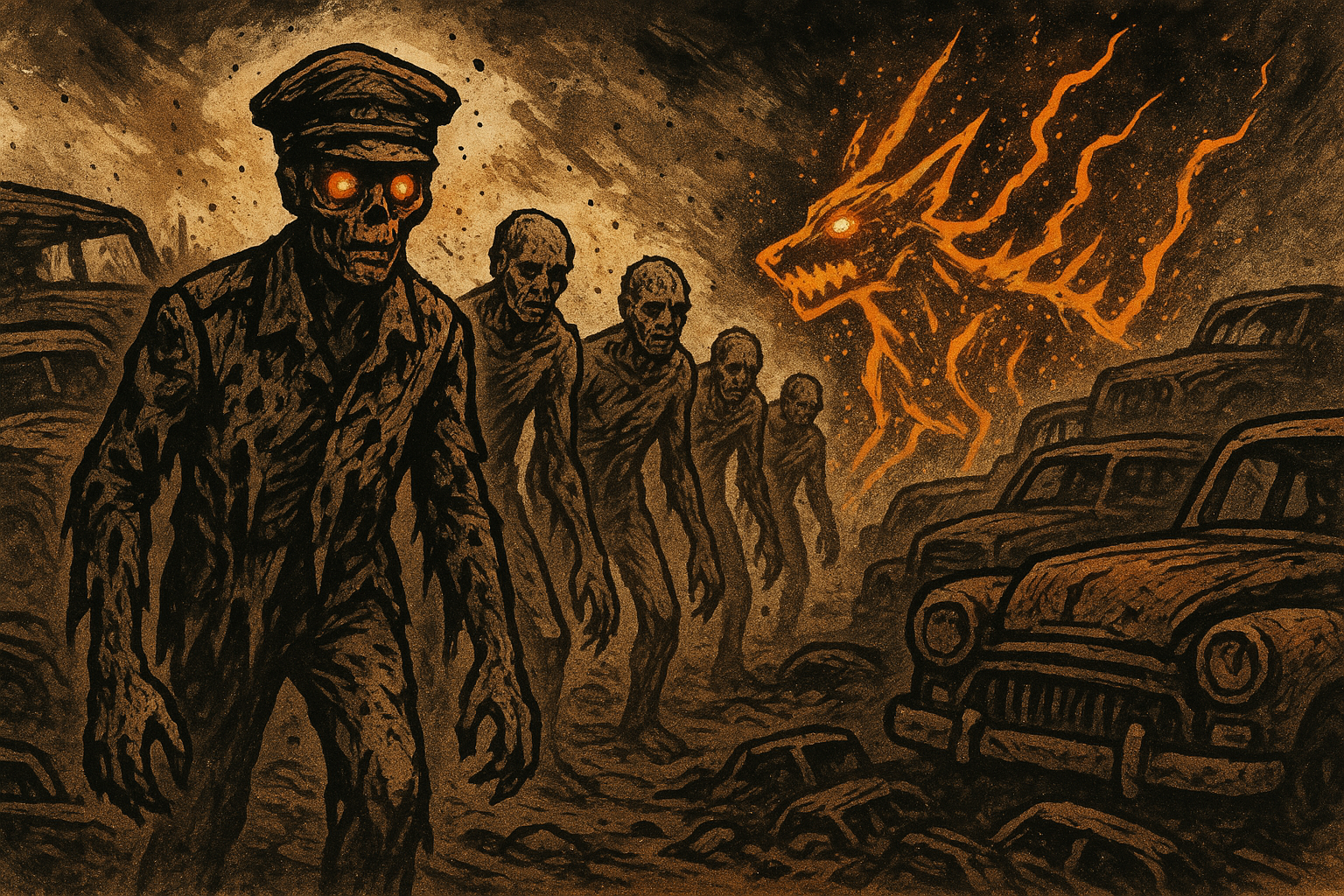
CATEGORY 7: UNDEAD & REVENANTS
The Breach broke death. Near dimensional rifts, corpses stir. Some are mindless shells, others retain fragments of who they were. Undead in this setting are NOT traditional fantasy undead — they're a consequence of dimensional contamination. Some are tragic. Some are horrifying.
Risen
Medium Undead, Unaligned (Mindless) Challenge Rating: 1/2
The most common aftermath of Breach exposure. When corpses lie too long in zones saturated with dimensional energy, they rise. No soul, no will — just a body that forgot how to stay dead. They shamble toward warmth and movement with the persistence of erosion. Towns near Breach zones build concrete crypts because graves no longer hold.
Hit Points: 22 (3d8+9) Defense Value: 11 Speed: 20 ft
| MIG | AGI | END | INT | WIS | PRE |
|---|---|---|---|---|---|
| 14(+2) | 6(-2) | 16(+3) | 3(-4) | 6(-2) | 5(-3) |
Saving Throws: FORT +5, WILL -2 Skills: None Resistances: Poison Condition Immunities: Charmed, Exhaustion, Frightened, Poisoned Senses: Passive Perception 8, darkvision 60 ft Languages: None
Traits
- Undead Fortitude. If damage reduces the Risen to 0 HP, it must make a Fortitude save with DC = 5 + damage taken, unless the damage is radiant or from a critical hit. On success, the Risen drops to 1 HP instead.
- Breach Tether. The Risen cannot willingly move more than 1 mile from the location it rose. If forcibly moved beyond this range, it takes 1d6 necrotic damage per hour until it returns or is destroyed.
Actions 3 Actions
- Slam. +4 to hit, reach 5 ft, one target. Hit: 5 (1d6+2) bludgeoning damage.
Reactions
- Death Grip. When a creature attempts to move away from the Risen while within 5 ft, the Risen can make a Slam attack. On hit, the target's speed becomes 0 until the start of its next turn.
Loot/Salvage: Clothing and personal items (often decayed), 10% chance of Breach crystal fragments (1d4 worth 25 credits each)
Encounter Notes: Risen travel in groups of 2-8. Slow but relentless. They don't tire, don't strategize, don't stop. Often found in rings around Breach sites. Fire and dismemberment are most effective. Some survivors report hearing whispered fragments of the corpse's last words, but scholars dismiss this as psychological projection.
Hollow
Medium Undead, Unaligned (Mindless) Challenge Rating: 1
Hollows are what happens when someone dies with their hands on a tool. The Breach preserves muscle memory while erasing everything else. They can reload guns, turn doorknobs, climb ladders — all the motor skills that become automatic in life persist in death. This makes them infinitely more dangerous than Risen. A Hollow with a fire axe remembers how to swing it.
Hit Points: 37 (5d8+15) Defense Value: 13 Speed: 30 ft
| MIG | AGI | END | INT | WIS | PRE |
|---|---|---|---|---|---|
| 15(+2) | 12(+1) | 16(+3) | 4(-3) | 8(-1) | 6(-2) |
Saving Throws: FORT +5, REF +3 Skills: None (but can perform trained actions it knew in life) Resistances: Poison Condition Immunities: Charmed, Exhaustion, Frightened, Poisoned Senses: Passive Perception 9, darkvision 60 ft Languages: None (but may mouth words it once knew)
Traits
- Muscle Memory. The Hollow can wield weapons, open doors, operate simple machines, and perform basic tasks it could do in life. It uses weapons with proficiency but cannot learn new skills or improvise.
- Eerie Mimicry. Creatures within 30 ft that can see the Hollow performing familiar human actions must succeed on a DC 11 WIS save or be unsettled, suffering disadvantage on attack rolls against it until the end of their next turn (once per creature per encounter).
- Undead Fortitude. As Risen.
Actions 3 Actions
- Weapon Strike. +4 to hit, reach 5 ft or range 20/60 ft (if ranged weapon), one target. Hit: 7 (1d8+2) damage (type depends on weapon). The Hollow can use simple or martial weapons it died holding.
Reactions
- Practiced Defense. When targeted by a melee attack, the Hollow can add +2 to its DV if it wields a melee weapon.
Loot/Salvage: Weapon or tool (often worn but functional), clothing, 20% chance of Breach crystal (50 credits), personal items that hint at who they were
Encounter Notes: Hollows appear alone or in small groups (1-4). They're found in places where people died doing something — guard posts, workshops, kitchens. The horror isn't their violence; it's their familiarity. They move like people. Some survivors report Hollows returning to their old homes, standing in kitchens, sitting at desks — motionless until approached. Mercy killings are common and emotionally devastating.
Screamer
Medium Undead, Chaotic Evil (Mindless) Challenge Rating: 2
Born from agony. When someone dies in excruciating pain near a Breach — torture, burning alive, prolonged suffering — the pain doesn't end. It amplifies. The corpse becomes a resonance chamber for psychic torment, broadcasting it as a constant scream. The sound isn't just noise; it's trauma made audible. Screamers draw other undead like a dinner bell. They're shepherds of the dead.
Hit Points: 45 (7d8+14) Defense Value: 12 Speed: 25 ft
| MIG | AGI | END | INT | WIS | PRE |
|---|---|---|---|---|---|
| 12(+1) | 10(+0) | 14(+2) | 5(-3) | 6(-2) | 16(+3) |
Saving Throws: FORT +4, WILL +3 Skills: None Resistances: Necrotic, Poison, Psychic Condition Immunities: Charmed, Exhaustion, Frightened, Poisoned Senses: Passive Perception 8, darkvision 60 ft, tremorsense 30 ft (detects living creatures) Languages: None
Traits
- Psychic Shriek (Aura). All creatures within 20 ft of the Screamer must succeed on a DC 12 WIS save at the start of their turn or take 4 (1d8) psychic damage and become frightened until the start of their next turn. Creatures that succeed are immune to this Screamer's shriek for 24 hours.
- Undead Beacon. Undead within 100 ft are drawn to the Screamer and become more aggressive. They gain advantage on attack rolls while within 30 ft of it.
- Undead Fortitude. As Risen.
Actions 3 Actions
- Anguished Claw. +4 to hit, reach 5 ft, one target. Hit: 6 (1d8+1) slashing damage plus 4 (1d8) psychic damage.
Reactions
- Echo Pain. When the Screamer takes damage, all creatures within 10 ft take 3 (1d6) psychic damage.
Loot/Salvage: Breach crystal (75 credits), scorched personal items, 25% chance of Psychic Residue (alchemical component, 100 credits)
Encounter Notes: Screamers are rarely alone. They accumulate undead like snow accumulates around a stone. Found in 1-2 per encounter, often surrounded by 3-12 Risen. Kill the Screamer first or the horde becomes unmanageable. Sonic dampeners reduce the shriek's range. Some Scavengers use earplugs, but those don't stop the psychic component — you feel it in your teeth and skull. Mercy is killing them fast.
Revenant
Medium Undead, Any Alignment (Sapient) Challenge Rating: 5
A Revenant is someone who died with a purpose unfulfilled — and the Breach won't let them rest until it's done. They remember everything: their name, their life, their goal. Vengeance is common, but so is protection, love, duty. They're lucid, articulate, and utterly fixated. They can't be permanently killed until their purpose is complete. Kill them, and they crawl back from wherever death tried to take them. Some Revenants become allies. Others are the worst kind of enemy: one that won't stop.
Hit Points: 110 (13d8+52) Defense Value: 15 (natural armor) Speed: 30 ft
| MIG | AGI | END | INT | WIS | PRE |
|---|---|---|---|---|---|
| 18(+4) | 14(+2) | 18(+4) | 12(+1) | 16(+3) | 14(+2) |
Saving Throws: FORT +7, REF +5, WILL +6 Skills: Intimidation +5, Perception +6, Survival +6 Resistances: Necrotic, Poison; bludgeoning, piercing, and slashing from nonmagical weapons Condition Immunities: Charmed, Exhaustion, Frightened, Paralyzed, Poisoned, Stunned Senses: Passive Perception 16, darkvision 60 ft Languages: Any languages it knew in life
Traits
- Relentless Purpose. The Revenant is bound to a specific goal. While that goal remains unfulfilled, it cannot be permanently destroyed. If reduced to 0 HP, it reforms after 1d4 days within 1 mile of the location tied to its purpose or the individual involved. Only fulfilling its purpose allows it to die.
- Vengeful Tracker. The Revenant knows the direction and approximate distance to the creature or location tied to its purpose, no matter the distance.
- Unyielding Regeneration. The Revenant regains 10 HP at the start of its turn if it has at least 1 HP.
Actions 3 Actions
- Purpose-Driven Strike. +7 to hit, reach 5 ft, one target. Hit: 11 (2d6+4) bludgeoning damage plus 7 (2d6) necrotic damage. Against the target of its purpose, this attack has advantage and deals an extra 10 (3d6) necrotic damage.
Reactions
- Undying Resolve. When reduced to 0 HP, the Revenant can make a DC 15 Fortitude save. On success, it instead drops to 1 HP (once per day).
Loot/Salvage: Personal belongings tied to its purpose (letters, weapons, photographs), Breach crystal (200 credits), 50% chance of Revenant's Essence (rare alchemical component, 500 credits)
Encounter Notes: Revenants are encountered alone and are highly intelligent. They can be reasoned with if you understand their purpose. Some become temporary allies; others are implacable foes. Combat is brutal — they don't retreat, don't negotiate once fighting starts. The only way to stop one permanently is to help or hinder its purpose's completion. Some have been "alive" for decades, their bodies decayed but held together by sheer will. A few run entire settlements, protecting loved ones who aged while they stayed frozen in death.
Ash Wraith
Medium Undead (Incorporeal), Neutral Evil Challenge Rating: 4
Ash Wraiths form in the aftermath of mass death — firebombed cities, nuclear flash zones, places where hundreds died instantly in flames. They're not individuals; they're the collective echo of a tragedy. Made from ash and grief, they drift through walls and air, leaving trails of gray dust. Their touch drains life to feed the cold void where warmth once existed. They don't hunt out of malice, but need. They're freezing, always.
Hit Points: 67 (9d8+27) Defense Value: 14 Speed: 0 ft, fly 40 ft (hover)
| MIG | AGI | END | INT | WIS | PRE |
|---|---|---|---|---|---|
| 6(-2) | 16(+3) | 16(+3) | 10(+0) | 14(+2) | 12(+1) |
Saving Throws: FORT +6, REF +6, WILL +5 Skills: Perception +5, Stealth +6 Resistances: Acid, Fire, Lightning, Thunder; bludgeoning, piercing, and slashing from nonmagical weapons Immunities: Cold, Necrotic, Poison Condition Immunities: Charmed, Exhaustion, Grappled, Paralyzed, Petrified, Poisoned, Prone, Restrained Senses: Passive Perception 15, darkvision 60 ft Languages: None (understands languages it knew in life but cannot speak)
Traits
- Incorporeal Movement. The Ash Wraith can move through creatures and objects as if they were difficult terrain. It takes 5 (1d10) force damage if it ends its turn inside an object.
- Ash Trail. The Wraith leaves a faint trail of ash wherever it moves. Creatures can track it with a DC 10 WIS (Survival) check. The ash is cold to the touch and slightly radioactive in some cases.
- Sunlight Weakness. In direct sunlight, the Ash Wraith has disadvantage on attack rolls and ability checks.
Actions 3 Actions
- Life Drain Touch. +6 to hit, reach 5 ft, one target. Hit: 18 (4d6+3) necrotic damage, and the target must succeed on a DC 14 Fortitude save or have its HP maximum reduced by the damage taken. This reduction lasts until the target finishes a long rest. The target dies if this reduces its HP maximum to 0. The Wraith regains HP equal to half the necrotic damage dealt.
Reactions
- Dispersal. When the Wraith takes radiant damage, it can teleport up to 30 ft to an unoccupied space it can see.
Loot/Salvage: Ash residue (alchemical component, 50 credits per ounce, 2d4 ounces), 30% chance of Memory Fragment (rare curio, contains psychic imprint of the tragedy, 300 credits)
Encounter Notes: Ash Wraiths haunt sites of mass death, rarely traveling more than a mile from where they formed. Encountered alone or in pairs (if the tragedy was catastrophic). They attack living creatures on sight, drawn to body heat. Fire is ineffective; radiant damage and force effects work best. Some can be communicated with through psychics — they're in constant pain, reliving their deaths. A few settlements have learned to appease them with heat sources (bonfires, thermal generators), buying uneasy coexistence.
Bone Amalgam
Large Undead, Unaligned (Mindless) Challenge Rating: 6
When a Breach surge hits a mass grave or battlefield, sometimes the bones don't rise individually — they fuse. Dozens of skeletons melt together into a spider-like horror, held together by congealed Breach energy that looks like black tar. It's fast, multi-limbed, and horrifying to watch skitter across broken terrain. Bone Amalgams are what happens when death loses all sense of anatomy. They can throw bone shards like javelins, and their limbs regenerate from the core mass.
Hit Points: 133 (14d10+56) Defense Value: 16 (natural armor) Speed: 40 ft, climb 30 ft
| MIG | AGI | END | INT | WIS | PRE |
|---|---|---|---|---|---|
| 18(+4) | 14(+2) | 18(+4) | 3(-4) | 8(-1) | 6(-2) |
Saving Throws: FORT +7, REF +5 Skills: None Resistances: Necrotic, Poison Immunities: Bludgeoning from nonmagical weapons Condition Immunities: Charmed, Exhaustion, Frightened, Paralyzed, Poisoned Senses: Passive Perception 9, darkvision 60 ft, tremorsense 30 ft Languages: None
Traits
- Spider Climb. The Amalgam can climb difficult surfaces, including upside down on ceilings, without needing to make an ability check.
- Multi-Limbed. The Amalgam has six to eight functional limbs. It can make opportunity attacks against creatures within 10 ft (instead of 5 ft).
- Bone Regeneration. The Amalgam regains 5 HP at the start of its turn if it has at least 1 HP. If the Amalgam takes fire or radiant damage, this trait doesn't function at the start of its next turn.
Actions 3 Actions
- Limb Strike. +7 to hit, reach 10 ft, one target. Hit: 13 (2d8+4) bludgeoning damage plus 4 (1d8) piercing damage (bone shards).
Reactions
Loot/Salvage: Bone shards (crafting material, 1d6 lbs worth 10 credits/lb), congealed Breach tar (alchemical component, 150 credits), 40% chance of intact human skull with Breach markings (curio, 200 credits)
Encounter Notes: Bone Amalgams are solitary hunters, found near old battlefields, cemeteries, or Breach-flooded catacombs. Fast and aggressive, they pursue prey relentlessly. Combat tactics: focus fire, use area effects to bypass regeneration, and avoid enclosed spaces where it can use walls and ceilings. Some have been observed "hibernating" in bone piles, indistinguishable from rubble until disturbed. The sound they make — bones scraping and clicking — is nightmare fuel.
The Remnant
Medium Undead (Incorporeal), Chaotic Neutral Challenge Rating: 3
Remnants aren't truly undead because their bodies are still alive — somewhere. They're fragments of a person's psyche torn loose when the Breach ripped through their mind. A piece of consciousness, wandering free. They remember fragments of their identity but can't reconcile what they are. Confused, desperate, sometimes enraged. They reach for things they can't hold. They scream names they can't remember. If you find the body, the Remnant vanishes. Until then, it's trapped in a half-existence, neither alive nor dead.
Hit Points: 58 (9d8+18) Defense Value: 13 Speed: 0 ft, fly 40 ft (hover)
| MIG | AGI | END | INT | WIS | PRE |
|---|---|---|---|---|---|
| 8(-1) | 16(+3) | 14(+2) | 11(+0) | 12(+1) | 15(+2) |
Saving Throws: REF +5, WILL +3 Skills: Perception +3, Stealth +5 Resistances: Acid, Fire, Lightning, Thunder; bludgeoning, piercing, and slashing from nonmagical weapons Immunities: Cold, Necrotic, Poison Condition Immunities: Charmed, Exhaustion, Grappled, Paralyzed, Petrified, Poisoned, Prone, Restrained Senses: Passive Perception 13, darkvision 60 ft Languages: Fragmented speech in any language it knew in life
Traits
- Incorporeal Movement. As Ash Wraith.
- Psychic Tether. The Remnant is drawn toward its original body. If within 1 mile of the body, it knows the direction. If reunited, the Remnant dissipates and the body wakes (if still alive).
- Fragmented Existence. The Remnant's appearance flickers between translucent human and abstract psychic energy. Creatures observing it for the first time must succeed on a DC 12 WIS save or be unsettled (disadvantage on the first attack roll or save against the Remnant).
Actions 3 Actions
- Desperate Touch. +5 to hit, reach 5 ft, one target. Hit: 10 (3d6) psychic damage, and the target must succeed on a DC 13 WIS save or be stunned until the end of its next turn as it's flooded with the Remnant's confused memories.
Reactions
- Flickering Retreat. When hit by an attack, the Remnant can impose disadvantage on the attack roll (once per round) as it briefly phases out of reality.
Loot/Salvage: Psychic residue (50 credits), personal item from their fragmented identity (varies), 20% chance of Tethered Token (leads toward the Remnant's body, 100 credits)
Encounter Notes: Remnants are encountered alone. They're unpredictable — sometimes they beg for help, sometimes they attack on sight. If players can locate the body (usually in a coma or vegetative state within a few miles), reuniting them ends the encounter peacefully. Combat is disorienting due to their phasing and psychic attacks. Some factions capture Remnants to torture information from their fragmented memories. It's considered deeply unethical.
Grave Titan
Huge Undead, Unaligned (Mindless) Challenge Rating: 8
A Grave Titan forms when an entire cemetery experiences a catastrophic Breach surge. Every corpse — hundreds, sometimes thousands — animates simultaneously and fuses into a single, walking mass of bodies. A hill of the dead that moves. It's slow, but unstoppable. Each step crushes stone. It absorbs new corpses as it walks, growing larger. Grave Titans are siege-scale threats. Towns in their path evacuate or die. Some have walked for years, accumulating so many bodies they resemble moving mountains.
Hit Points: 184 (16d12+80) Defense Value: 17 (natural armor) Speed: 20 ft
| MIG | AGI | END | INT | WIS | PRE |
|---|---|---|---|---|---|
| 22(+6) | 6(-2) | 20(+5) | 3(-4) | 8(-1) | 7(-2) |
Saving Throws: FORT +9, WILL +3 Skills: None Resistances: Necrotic, Poison; bludgeoning, piercing, and slashing from nonmagical weapons Condition Immunities: Charmed, Exhaustion, Frightened, Paralyzed, Poisoned, Prone Senses: Passive Perception 9, darkvision 120 ft, tremorsense 60 ft Languages: None
Traits
- Siege Monster. The Grave Titan deals double damage to objects and structures.
- Corpse Absorption. If the Titan moves through a space containing a corpse (Medium or larger), it absorbs it and regains 10 HP. It can absorb up to 5 corpses per turn.
- Aura of Death. Living creatures that start their turn within 10 ft of the Titan must succeed on a DC 15 Fortitude save or take 7 (2d6) necrotic damage and have their speed reduced by 10 ft until the start of their next turn.
- Massive. The Titan occupies a 15x15 ft space and can move through spaces occupied by Large or smaller creatures. Creatures in its path must make a DC 17 Reflex save or be knocked prone and take 14 (4d6) bludgeoning damage.
Actions 3 Actions
- Crushing Slam. +10 to hit, reach 10 ft, one target. Hit: 28 (4d10+6) bludgeoning damage, and the target must succeed on a DC 17 MIG save or be knocked prone.
Reactions
- Grabbing Dead. When a creature within 10 ft tries to move away, dozens of grasping limbs reach out. The creature must succeed on a DC 15 MIG save or have its speed reduced to 0 until the end of its turn.
Loot/Salvage: Hundreds of corpses (salvageable gear, personal items), Breach crystals (500 credits total), 60% chance of Grave Titan's Core (rare alchemical component, 1,000 credits, found in the central mass)
Encounter Notes: Grave Titans are world-level threats. Encountered alone, they're the focal point of major story arcs. Combat requires siege weapons, explosives, or concentrated magical firepower. Standard tactics: target the core (requires piercing the outer shell), use fire or radiant damage to prevent corpse absorption, evacuate civilians first. Some have been "put to sleep" by removing all corpses in a 1-mile radius, starving them. Military records describe orbital strikes as the only reliable solution. A walking reminder that the Breach broke more than death — it broke scale.
Death Bloom Host
Medium Undead (Plant), Unaligned Challenge Rating: 2
Death Bloom is a parasitic plant from a Breach dimension where flora feeds on decay. It infects corpses, puppeting them like grotesque marionettes. The fungal growth bursts from eyes, mouth, and wounds, spreading spores with every movement. The Host shambles forward, driven by the plant's need to spread. Not undead in the traditional sense — the corpse is just a vehicle. Kill the plant, the body collapses. But the spores remain. Cross-reference with Flora category for Death Bloom details.
Hit Points: 52 (8d8+16) Defense Value: 12 (plant armor) Speed: 25 ft
| MIG | AGI | END | INT | WIS | PRE |
|---|---|---|---|---|---|
| 14(+2) | 8(-1) | 14(+2) | 2(-4) | 10(+0) | 6(-2) |
Saving Throws: FORT +4 Skills: None Resistances: Poison Vulnerabilities: Fire Condition Immunities: Blinded, Charmed, Deafened, Exhaustion, Frightened, Poisoned Senses: Passive Perception 10, blindsight 30 ft (detects vibrations) Languages: None
Traits
- Fungal Puppetry. The Host is controlled by Death Bloom fungus. Destroying the body doesn't kill the fungus; it spreads spores. If the Host is killed by fire or radiant damage, the fungus is destroyed and cannot spread.
- Spore Cloud (Aura). Creatures that start their turn within 5 ft of the Host must succeed on a DC 12 Fortitude save or become poisoned until the end of their turn. On a natural 1, the creature is infected with Death Bloom spores (see Flora category for infection rules).
- Plant Resilience. The Host regains 5 HP at the start of its turn if exposed to moisture (rain, standing water, etc.).
Actions 3 Actions
- Fungal Claw. +4 to hit, reach 5 ft, one target. Hit: 8 (1d10+2) slashing damage plus 4 (1d8) poison damage.
Reactions
- Death Spore. When the Host is reduced to 0 HP by anything other than fire or radiant damage, it explodes in a 10 ft radius spore cloud. All creatures in the area must make a DC 13 Fortitude save or be poisoned for 1 hour and exposed to Death Bloom infection.
Loot/Salvage: Death Bloom samples (alchemical component, toxic, 75 credits), corpse's original gear (if salvageable), 30% chance of Concentrated Spore Sac (alchemical/biological weapon component, 150 credits)
Encounter Notes: Hosts are found in groups of 1-6 near Breach zones with high humidity. They're drawn to corpses and living creatures. Combat priority: use fire. Melee fighters should wear respiratory protection. Some settlements burn all corpses within 10 miles of known Death Bloom infestations. The fungus is intelligent on a colony level — swarms of Hosts can coordinate crude ambushes. Ecologists warn that Death Bloom could become an extinction-level threat if it adapts to Earth's biosphere.
The Lingerer
Medium Undead, Any Alignment (Sapient) Challenge Rating: 7
The Lingerer is what happens when someone powerful dies near the Breach and refuses to let go. They retain full intelligence, memories, and — most dangerously — their spellcasting abilities. Mages, clerics, warlocks who died clutching power don't release it in death. They build domains: territories they control through magic and will. Some are benevolent, protecting survivors. Others are tyrants, ruling through fear. All are tragic — they know they're dead, but they can't or won't move on. Mini-bosses or quest givers, depending on approach.
Hit Points: 127 (15d8+60) Defense Value: 16 (mage armor or natural armor) Speed: 30 ft, fly 20 ft (hover)
| MIG | AGI | END | INT | WIS | PRE |
|---|---|---|---|---|---|
| 10(+0) | 14(+2) | 18(+4) | 18(+4) | 16(+3) | 16(+3) |
Saving Throws: FORT +8, REF +6, WILL +7 Skills: Arcana +8, History +8, Insight +7, Perception +7 Resistances: Necrotic, Poison; bludgeoning, piercing, and slashing from nonmagical weapons Immunities: Poison Condition Immunities: Charmed, Exhaustion, Frightened, Paralyzed, Poisoned Senses: Passive Perception 17, darkvision 120 ft, truesight 30 ft Languages: Any languages it knew in life
Traits
- Lingering Spellcaster. The Lingerer can cast spells as a 9th-level caster. Spellcasting ability: INT (spell save DC 16, +8 to hit with spell attacks). It does not require material components. Example spells (GM can customize): Mage Armor, Shield, Magic Missile, Misty Step, Fireball, Counterspell, Dimension Door, Wall of Force, Cone of Cold, Disintegrate.
- Domain Anchor. The Lingerer is bound to a specific location (its domain). While within its domain, it has advantage on all saves and regains 10 HP at the start of its turn. It cannot willingly leave its domain.
- Undead Resilience. If reduced to 0 HP within its domain, the Lingerer reforms after 1d4 days unless its anchor (an object or location tied to its death) is destroyed.
- Aura of Command. Lesser undead (CR 3 or lower) within 60 ft of the Lingerer are under its control and have advantage on attack rolls.
Actions 3 Actions
- Necrotic Touch. +8 to hit, reach 5 ft, one target. Hit: 14 (3d6+4) necrotic damage.
Reactions
- Shield (1/Turn). When hit by an attack, the Lingerer can cast Shield, adding +5 to DV until the start of its next turn.
- Counterspell (1/Turn). The Lingerer can attempt to counter a spell it sees being cast within 60 ft.
Loot/Salvage: Spellbook or magical focus (varies, 500-2,000 credits), Breach crystal (300 credits), domain anchor (powerful magical item, 1,000+ credits if destroyed or claimed), personal items revealing backstory
Encounter Notes: Lingerers are encountered alone within their domains (ruined libraries, labs, temples, homes). They're intelligent and can be negotiated with — many are lonely and crave conversation. Some offer quests, others attack intruders on sight depending on alignment and temperament. Combat is high-level spellcasting with tactical positioning. Destroying the domain anchor is the only way to permanently kill them, which raises moral questions if the Lingerer is sympathetic. Some become campaign-long NPCs. Others are tragic villains who need to be freed from their self-imposed prisons.
CATEGORY 8: ARCANE BEASTS
Creatures native to the dimensions connected by the Breach. They're not mutants — they evolved in a world where magic is natural. To them, Earth is the alien world. They range from mundane-seeming (if you squint) to fundamentally bizarre.
Ember Fox
Small Beast (Arcane), Unaligned Challenge Rating: 1/2
Ember Foxes come from a volcanic dimension where the rivers run with magma and the air shimmers with heat. They're small, curious, and surprisingly affectionate. Their fur is the color of living flame — oranges, reds, and yellows — and genuinely warm to the touch. They breathe fire like Earth foxes might sneeze. Some settlements have domesticated them as pets and pest control (they hunt rats and love cuddles). They're one of the few Breach creatures that integrated peacefully.
Hit Points: 18 (4d6+4) Defense Value: 13 Speed: 40 ft
| MIG | AGI | END | INT | WIS | PRE |
|---|---|---|---|---|---|
| 8(-1) | 16(+3) | 12(+1) | 6(-2) | 12(+1) | 10(+0) |
Saving Throws: REF +5 Skills: Perception +3, Stealth +5 Resistances: Fire Senses: Passive Perception 13, darkvision 60 ft Languages: None (understands simple commands if domesticated)
Traits
- Warm Coat. Creatures that touch or grapple the Ember Fox take 2 (1d4) fire damage.
- Keen Smell. The Ember Fox has advantage on Perception checks that rely on smell.
- Fire Affinity. The Ember Fox is immune to environmental heat and thrives near fires. It regains 5 HP if it starts its turn within 5 ft of a fire source.
Actions 3 Actions
- Bite. +5 to hit, reach 5 ft, one target. Hit: 5 (1d4+3) piercing damage plus 2 (1d4) fire damage.
Reactions
- Evasion. When subjected to an effect that allows a Reflex save for half damage, the Fox takes no damage on success and half on failure.
Loot/Salvage: Ember Fox pelt (warm, valuable for cold-weather gear, 75 credits), small fire gland (alchemical component, 25 credits)
Encounter Notes: Ember Foxes are found near Breach zones with geothermal activity. Encountered in small groups (1-4) or as domesticated pets. Wild ones are skittish but not aggressive unless cornered or protecting young. Domesticated Ember Foxes bond strongly with owners and are popular among Scavengers for warmth in cold climates. Some breeders sell them for 200-500 credits. They're one of the success stories of post-Breach coexistence.
Glass Spider
Small Beast (Arcane), Unaligned Challenge Rating: 1
Glass Spiders are apex ambush predators from a crystalline dimension. They're transparent — not invisible, but clear like glass. Their webs are crystalline strands, razor-sharp and nearly invisible until light catches them. They lurk in ruins and abandoned buildings, stringing webs across doorways and hallways. By the time you see the web, you've usually walked into it. Their webs are valuable to crafters: light, strong, and can hold an edge.
Hit Points: 32 (5d6+15) Defense Value: 14 (crystal carapace) Speed: 30 ft, climb 30 ft
| MIG | AGI | END | INT | WIS | PRE |
|---|---|---|---|---|---|
| 10(+0) | 16(+3) | 16(+3) | 4(-3) | 12(+1) | 6(-2) |
Saving Throws: REF +5, FORT +5 Skills: Stealth +7 (transparency grants advantage) Resistances: Piercing, Slashing (from nonmagical weapons) Vulnerabilities: Thunder (shatters crystal structure) Senses: Passive Perception 11, darkvision 60 ft, tremorsense 60 ft (through web) Languages: None
Traits
- Transparent. The Glass Spider is nearly invisible. Creatures have disadvantage on Perception checks to spot it unless it's moving or backlit. Once detected, the disadvantage ends.
- Spider Climb. The Glass Spider can climb difficult surfaces without checks.
- Crystalline Web (Trap). The Spider can spend 1 hour creating a web trap in a 10x10 ft area. Creatures moving through the web must make a DC 13 Reflex save or take 7 (2d6) slashing damage and become restrained (escape DC 13 MIG). The web is nearly invisible (DC 15 Perception to spot). Each 5x5 ft section has DV 12, 10 HP, vulnerability to thunder, and immunity to poison and psychic.
Actions 3 Actions
- Crystal Bite. +5 to hit, reach 5 ft, one target. Hit: 7 (1d8+3) piercing damage, and the target must succeed on a DC 13 Fortitude save or take 4 (1d8) ongoing slashing damage at the start of its turn for 1 minute (crystalline venom causes internal lacerations). The target can repeat the save at the end of each turn.
Reactions
- Crystal Shatter. When the Spider takes thunder damage, it releases a spray of crystal shards. All creatures within 10 ft take 7 (2d6) piercing damage (DC 13 Reflex save for half).
Loot/Salvage: Crystalline web (50 credits per 5 ft section, used in crafting armor, weapons, traps), crystal carapace shards (25 credits per ounce, 1d4 ounces), venom gland (alchemical component, 50 credits)
Encounter Notes: Glass Spiders are solitary. Found in ruins, caves, and abandoned structures near Breach zones. Stealth and ambush are their strengths. Players rarely see them before triggering webs. Combat tip: use sound-based attacks or force them into open spaces. Scavengers hate them. Their webs are valuable enough that some hunters risk seeking them out. A few artisans pay bounties for intact web sections.
Storm Elk
Large Beast (Arcane), Unaligned Challenge Rating: 3
Storm Elk are majestic creatures from a dimension locked in perpetual thunderstorm. They're larger than Earth elk, wreathed in crackling electricity that dances across their antlers. When herds move, localized storms follow: lightning, thunder, and heavy rain. They're herbivores and generally peaceful unless threatened. Their antlers conduct and amplify electrical energy. Hunters prize them for materials, but killing one draws lightning from the sky. Many consider them sacred.
Hit Points: 68 (8d10+24) Defense Value: 14 (natural armor) Speed: 50 ft
| MIG | AGI | END | INT | WIS | PRE |
|---|---|---|---|---|---|
| 18(+4) | 14(+2) | 16(+3) | 4(-3) | 14(+2) | 10(+0) |
Saving Throws: FORT +5, REF +4 Skills: Perception +4 Resistances: Lightning, Thunder Senses: Passive Perception 14, darkvision 60 ft Languages: None
Traits
- Storm Aura. The Storm Elk generates a localized storm within 60 ft. Light rain falls, and the area is lightly obscured. Creatures within 10 ft of the Elk have disadvantage on Perception checks relying on hearing (due to constant thunder).
- Lightning Antlers. When the Elk is hit by a melee attack, the attacker takes 3 (1d6) lightning damage.
- Thunderous Steps. When the Elk moves at least 20 ft straight toward a target and hits with a Gore attack on the same turn, the attack deals an extra 9 (2d8) thunder damage.
Actions 3 Actions
- Gore. +6 to hit, reach 10 ft, one target. Hit: 13 (2d8+4) piercing damage plus 4 (1d8) lightning damage.
Reactions
- Chain Lightning. When the Elk takes lightning damage, it can redirect the energy to one creature within 30 ft. That creature must make a DC 14 Reflex save or take 10 (3d6) lightning damage.
Loot/Salvage: Storm Elk antlers (500 credits, used in magical item crafting), hide (200 credits), storm gland (alchemical component, 150 credits), meat (nutritious, slight electric tingle)
Encounter Notes: Storm Elk travel in herds of 3-12. Encountered in open plains, forests, or near Breach zones with high atmospheric energy. They're peaceful unless threatened or during mating season (when males are aggressive). Killing one causes a lightning strike (10d6 lightning damage, DC 15 Reflex save for half) to strike a random creature within 30 ft. Some cultures revere them; others hunt them for materials. Rangers and druids often protect herds. Young Elk (CR 1) are occasionally captured and raised as mounts, though they're difficult to train.
Shade Hound
Medium Beast (Arcane), Unaligned Challenge Rating: 2
Shade Hounds come from a dimension of eternal twilight where shadows are as solid as stone. They're dog-like, sleek, with fur like liquid darkness. They hunt by stepping into shadows — entering one and emerging from another up to 60 ft away. In dim light or darkness, they're almost impossible to track. They hunt in packs, using coordinated shadow-stepping to surround prey. Some mercenary groups use them as trackers and assassins. They're loyal to those who feed them, but never fully domesticated.
Hit Points: 39 (6d8+12) Defense Value: 14 Speed: 40 ft
| MIG | AGI | END | INT | WIS | PRE |
|---|---|---|---|---|---|
| 14(+2) | 16(+3) | 14(+2) | 6(-2) | 14(+2) | 8(-1) |
Saving Throws: REF +5, WILL +4 Skills: Perception +4, Stealth +7 Resistances: Necrotic Senses: Passive Perception 14, darkvision 120 ft Languages: None (understands commands from bonded handler)
Traits
- Shadow Step (Recharge 5-6). If the Shade Hound is in dim light or darkness, it can use 1 action to teleport up to 60 ft to an unoccupied space it can see that is also in dim light or darkness.
- Pack Tactics. The Shade Hound has advantage on attack rolls against a creature if at least one of the Hound's allies is within 5 ft of the target and isn't incapacitated.
- Sunlight Sensitivity. In bright sunlight, the Shade Hound has disadvantage on attack rolls and Perception checks.
Actions 3 Actions
- Shadow Bite. +5 to hit, reach 5 ft, one target. Hit: 8 (1d10+3) piercing damage plus 4 (1d8) necrotic damage.
Reactions
- Reactive Step. When hit by an attack, the Shade Hound can use Shadow Step (if available) to teleport away, potentially causing the attack to miss (if it teleports out of range/reach).
Loot/Salvage: Shadow-touched pelt (150 credits, used in stealth gear), essence of darkness (alchemical component, 75 credits)
Encounter Notes: Shade Hounds hunt in packs of 3-8. Found in areas with heavy shadows: forests, ruins, urban environments at night. Combat is disorienting — they step in and out of shadows, attacking from unexpected angles. Fighting them in bright light significantly weakens them. Some mercenary groups and assassins use bonded Shade Hounds (bonding process unknown, possibly magical). They're expensive on the black market (1,000+ credits per hound). Wild packs are territorial and dangerous.
Mana Leech
Small Beast (Arcane), Unaligned Challenge Rating: 1
Mana Leeches are slug-like parasites from a dimension saturated with magical energy. They evolved to feed on raw magic. On Earth, they cluster near Breach zones, draining residual energy. But they prefer living sources — specifically, spellcasters. They latch onto mages and drain their spells, leaving victims magically exhausted. Individually, they're nuisances. In swarms, they're career-ending threats to casters. Mundane fighters are mostly safe. Non-magical folk call them "wizard leeches" and find the whole thing hilarious.
Hit Points: 27 (5d6+10) Defense Value: 12 Speed: 20 ft, climb 20 ft
| MIG | AGI | END | INT | WIS | PRE |
|---|---|---|---|---|---|
| 6(-2) | 10(+0) | 14(+2) | 2(-4) | 10(+0) | 4(-3) |
Saving Throws: FORT +4 Skills: None Resistances: Force, Psychic Senses: Passive Perception 10, blindsight 30 ft (detects magic) Languages: None
Traits
- Magic Sense. The Mana Leech can pinpoint the location of any creature with spell slots or magical abilities within 60 ft.
- Spell Drain Bite. When the Leech hits a creature with spell slots, it drains magic. The target loses one spell slot (lowest available level). If the target has no spell slots, it instead loses one use of a magical ability or takes an extra 7 (2d6) necrotic damage.
- Arcane Resistance. The Leech has advantage on saves against spells and magical effects.
Actions 3 Actions
- Draining Bite. +2 to hit, reach 5 ft, one target. Hit: 4 (1d8) piercing damage, and if the target is a spellcaster, see Spell Drain Bite trait.
Reactions
- Spell Absorption. When a spell is cast within 30 ft, the Leech can attempt to absorb some of the energy. The caster must make a DC 11 spellcasting check. On failure, the spell is cast normally but the Leech regains 5 HP.
Loot/Salvage: Mana-saturated tissue (alchemical component, 50 credits), condensed magic residue (25 credits)
Encounter Notes: Mana Leeches are found in groups of 2-8 near Breach zones. They're slow and non-threatening to non-casters. For spellcasters, they're nightmares. Priority target in any encounter involving casters. Some mages carry salt or alchemical repellents. A few unethical researchers use them to "harvest" magic from captives. Black market dealers sell them to anti-mage factions. The irony: they're completely harmless to regular people, making them a symbolic weapon in the magic-vs-mundane cultural divide.
Ironbark Treant
Huge Plant (Arcane), Lawful Neutral Challenge Rating: 7
Ironbark Treants come from a dimension where flora dominates. They're sentient trees with bark like forged metal — dark, dense, and nearly indestructible. They're slow, patient, and ancient. Most are centuries old even by their home dimension's standards. On Earth, they're confused and defensive, protecting whatever green space they claim. They can command nearby plants to move and fight. Violent when threatened, but wise and reasonable if approached peacefully. Some serve as guardians for eco-sanctuaries.
Hit Points: 138 (12d12+60) Defense Value: 18 (natural armor) Speed: 20 ft
| MIG | AGI | END | INT | WIS | PRE |
|---|---|---|---|---|---|
| 22(+6) | 6(-2) | 20(+5) | 12(+1) | 16(+3) | 14(+2) |
Saving Throws: FORT +9, WILL +7 Skills: Nature +5, Perception +7 Resistances: Bludgeoning, Piercing; Fire (resistant, not immune) Vulnerabilities: None (but dislikes fire) Senses: Passive Perception 17, tremorsense 60 ft (through roots) Languages: Sylvan, Terran, Common (slow, deep voice)
Traits
- Ironbark Armor. The Treant's DV includes its metal-like bark. Critical hits against it are treated as normal hits unless made with slashing damage.
- False Appearance. While motionless, the Treant is indistinguishable from a normal (if unusually large) tree.
- Plant Command. The Treant can command plants within 60 ft to animate and attack. As a free action on its turn, it can cause up to 3 Medium or smaller plants to act as animated objects (use Vine Lash attack, +6 to hit, 8 (1d8+4) bludgeoning damage). These plants revert to normal if the Treant is killed or moves more than 60 ft away.
- Rooted Regeneration. If the Treant doesn't move on its turn and is in contact with soil, it regains 10 HP.
Actions 3 Actions
- Ironbark Slam. +10 to hit, reach 10 ft, one target. Hit: 20 (3d8+6) bludgeoning damage. If the target is Large or smaller, it must succeed on a DC 17 MIG save or be knocked prone.
Reactions
- Bark Shield. When hit by an attack, the Treant can add +3 to its DV against that attack, potentially causing it to miss (as bark layers thicken).
Loot/Salvage: Ironbark lumber (rare, 1,000+ credits for furniture/construction), seeds (can grow Earth-compatible trees, 200 credits), sap (alchemical component, 150 credits)
Encounter Notes: Ironbark Treants are solitary guardians of green spaces near Breach zones. Encountered alone, rarely in pairs. They attack only if their territory is threatened — logging, fire, intrusion. Diplomacy works if approached respectfully. Many speak Common, learned from observing humans. Some have become protectors of survivor settlements in exchange for being left alone. Combat is slow but devastating. Use fire carefully — it angers them more than it hurts. A few eco-communities worship them as gods. They're long-term campaign NPCs: quest givers, lore sources, or tragic encounters if the party has to clear land they're protecting.
Prismatic Drake
Medium Dragon (Arcane), Chaotic Neutral Challenge Rating: 5
Prismatic Drakes are small dragons from a dimension where elemental forces shift like weather. Their scales cycle through colors — red, blue, green, white, black — each representing a different element. The breath weapon changes unpredictably, sometimes mid-combat. They're intelligent but mercurial, treating conflict like a game. Territorial, curious, and prone to testing intruders. Some become allies if impressed by cleverness or strength. Their scales are prized for crafting adaptive armor. They're the wildcard of Arcane Beasts.
Hit Points: 97 (13d8+39) Defense Value: 16 (natural armor) Speed: 30 ft, fly 60 ft
| MIG | AGI | END | INT | WIS | PRE |
|---|---|---|---|---|---|
| 16(+3) | 14(+2) | 16(+3) | 14(+2) | 12(+1) | 16(+3) |
Saving Throws: FORT +6, REF +5, WILL +4 Skills: Arcana +5, Perception +4, Stealth +5 Resistances: Varies (see Shifting Scales) Senses: Passive Perception 14, darkvision 120 ft, blindsight 30 ft Languages: Draconic, Common (speaks with amused, lilting tone)
Traits
- Shifting Scales. At the start of each of the Drake's turns, roll 1d6 to determine its current element and resistance:
- Red (Fire) — Resistance: Fire
- Blue (Lightning) — Resistance: Lightning
- Green (Poison) — Resistance: Poison
- White (Cold) — Resistance: Cold
- Black (Acid) — Resistance: Acid
- Prismatic (All) — Resistance: All of the above (rare)
- Adaptive Breath. The Drake's breath weapon matches its current scale color.
- Mercurial Mind. The Drake has advantage on saves against being charmed or frightened.
Actions 3 Actions
- Claw Strike. +6 to hit, reach 5 ft, one target. Hit: 10 (2d6+3) slashing damage plus 4 (1d8) damage of the type matching its current scales.
- Bite. +6 to hit, reach 5 ft, one target. Hit: 12 (2d8+3) piercing damage.
- Fire: Ignites flammable objects
- Lightning: Target can't take reactions until end of next turn
- Poison: Poisoned for 1 minute (repeat save each turn)
- Cold: Speed reduced by 10 ft for 1 minute
- Acid: Deals ongoing 4 (1d8) acid damage for 1 minute (action to wipe off)
Reactions
- Prismatic Shift. When hit by an attack that deals damage matching its current resistance, the Drake can reroll its Shifting Scales (once per round).
Loot/Salvage: Prismatic scales (500 credits, used in adaptive armor crafting), elemental gland (200 credits, type matches last element), small hoard (gems and coins, 1d6 x 100 credits)
Encounter Notes: Prismatic Drakes are solitary, territorial, and found near Breach zones with high magical energy. Combat is unpredictable — players must adapt to the shifting element. The Drake often taunts foes, making combat feel like a game. If defeated but not killed, it might flee and become a recurring rival or ally. Some become companions to powerful mages or adventurers who earn their respect. They're vain and enjoy flattery. A few have small hoards they guard obsessively. Excellent recurring NPCs or mid-level boss fights.
Void Moth
Large Beast (Arcane), Unaligned Challenge Rating: 4
Void Moths are massive, beautiful, and utterly alien. Their wings display the void of space: stars, nebulae, and the cold dark between. When they fly, reality bends slightly. The dust from their wings causes hallucinations and dimensional displacement — victims report seeing impossible geometries and feeling unmoored from space. They're drawn to light sources at night, causing chaos in settlements. Not malicious, just fundamentally incompatible with stable reality. Scholars theorize they navigate dimensions naturally in their home world.
Hit Points: 75 (10d10+20) Defense Value: 13 Speed: 10 ft, fly 60 ft
| MIG | AGI | END | INT | WIS | PRE |
|---|---|---|---|---|---|
| 12(+1) | 16(+3) | 14(+2) | 4(-3) | 14(+2) | 10(+0) |
Saving Throws: REF +5, WILL +4 Skills: Perception +4 Resistances: Psychic, Radiant Senses: Passive Perception 14, darkvision 120 ft, truesight 30 ft Languages: None
Traits
- Void Wings. Creatures within 10 ft of the Void Moth that look at its wings must succeed on a DC 13 WIS save or be charmed for 1 round (transfixed by the beauty). On a natural 1, the creature is stunned for 1 round.
- Dimensional Dust (Aura). Creatures that start their turn within 5 ft of the Void Moth must succeed on a DC 13 WIS save or be affected by minor hallucinations (disadvantage on Perception checks) until the start of their next turn.
- Light Attraction. The Void Moth is irresistibly drawn to light sources. It will move toward the brightest light it can perceive.
Actions 3 Actions
- Wing Buffet. +5 to hit, reach 5 ft, one target. Hit: 9 (2d6+3) bludgeoning damage, and the target must succeed on a DC 13 MIG save or be pushed 10 ft and knocked prone.
Reactions
- Dimensional Flutter. When targeted by an attack, the Moth can phase briefly out of reality. The attacker makes the roll with disadvantage (once per round).
Loot/Salvage: Void Moth wings (750 credits, used in high-end clothing and dimensional research), dimensional dust (alchemical component, 200 credits), antennae (rare sensory component, 150 credits)
Encounter Notes: Void Moths are encountered alone at night, near Breach zones or drawn to settlements with bright lights. Combat is disorienting — reality bends, players get teleported, hallucinations abound. They're not aggressive unless threatened, but their presence causes chaos. Turning off lights can cause them to leave. Some researchers capture them for study (extremely dangerous). A few artists use their dust recreationally (hallucinogen, highly illegal in most settlements). They're beautiful, tragic, and fundamentally incompatible with stable existence.
Basilisk
Large Beast (Arcane), Unaligned Challenge Rating: 6
Basilisks are six-legged reptiles from a dimension where everything is stone. Their petrifying gaze isn't a curse — it's how they make their environment feel like home. They don't see living creatures; they see things that should be stone. They're slow, methodical hunters. Eye contact means petrification. Mirrors reflect the gaze. They're solitary, territorial, and surprisingly patient. Statues in Breach zones? Often victims. Some settlements use them as execution methods. Others hunt them for their gaze glands, used in stasis technology.
Hit Points: 112 (15d10+30) Defense Value: 16 (natural armor) Speed: 30 ft
| MIG | AGI | END | INT | WIS | PRE |
|---|---|---|---|---|---|
| 16(+3) | 10(+0) | 14(+2) | 4(-3) | 12(+1) | 8(-1) |
Saving Throws: FORT +5, WILL +4 Skills: Perception +4, Stealth +3 Resistances: Poison Condition Immunities: Petrified Senses: Passive Perception 14, darkvision 60 ft Languages: None
Traits
- Petrifying Gaze. If a creature starts its turn within 30 ft of the Basilisk and can see its eyes, the Basilisk can force it to make a DC 14 Fortitude save if the Basilisk isn't incapacitated and can see the creature. On failure by 5 or more, the creature is instantly petrified. Otherwise, on failure, the creature begins turning to stone and is restrained. The restrained creature must repeat the save at the end of its next turn, becoming petrified on a failure or ending the effect on a success. The petrification lasts until removed by Greater Restoration or similar magic.
- A creature can avert its eyes to avoid the save but has disadvantage on attacks against the Basilisk.
- If the Basilisk sees its reflection within 30 ft in bright light, it must make the save against its own gaze.
- Stone Sense. The Basilisk can sense the location of petrified creatures within 60 ft.
Actions 3 Actions
- Bite. +6 to hit, reach 5 ft, one target. Hit: 16 (3d8+3) piercing damage plus 7 (2d6) poison damage.
Reactions
- Reflexive Gaze. When a creature within 30 ft hits the Basilisk with a melee attack, the Basilisk can force that creature to make a save against its Petrifying Gaze (if the creature can see the Basilisk).
Loot/Salvage: Petrifying gaze gland (rare, 1,500 credits, used in stasis tech and alchemy), hide (750 credits, extremely durable leather), basilisk blood (antidote to some poisons, 200 credits)
Encounter Notes: Basilisks are solitary. Found in caves, ruins, or rocky Breach zones. Combat is dangerous — one mistake means petrification. Mirrors, blindfolds, and ranged attacks are key. Players will find petrified victims nearby (some can be restored). Basilisks don't leave their territory willingly. Some factions breed them in controlled environments for executions or research. They're apex predators in their niche. High-risk, high-reward encounters.
Wisp Swarm
Medium Swarm (Tiny Arcane Beasts), Chaotic Neutral Challenge Rating: 3
Wisps are tiny, luminous fairy-like entities from a dimension of pure light. Individually, they're harmless and curious — glowing motes no bigger than a fist. But they swarm. Hundreds cluster together, generating dangerous electrical fields and emitting hypnotic light patterns. They lead travelers off paths, toward Breach zones, into danger. Not out of malice — they're drawn to warmth and movement, and don't understand that Earth creatures can't survive where they thrive. Beautiful, deadly, and utterly naive.
Hit Points: 60 (11d8+11) Defense Value: 15 Speed: 0 ft, fly 40 ft (hover)
| MIG | AGI | END | INT | WIS | PRE |
|---|---|---|---|---|---|
| 4(-3) | 18(+4) | 12(+1) | 6(-2) | 10(+0) | 14(+2) |
Saving Throws: REF +6, WILL +2 Skills: Perception +2, Stealth +6 Resistances: Lightning, Radiant; bludgeoning, piercing, slashing Immunities: Charm, Frighten, Paralyzed, Petrified, Prone, Restrained, Stunned Condition Immunities: Grappled Senses: Passive Perception 12, darkvision 60 ft Languages: None (but emit musical chiming sounds)
Traits
- Swarm. The swarm can occupy another creature's space and vice versa. It can move through any opening large enough for a Tiny creature. The swarm can't regain HP or gain temporary HP.
- Hypnotic Luminescence. Creatures within 20 ft of the swarm that can see it must succeed on a DC 13 WIS save at the start of their turn or be charmed for 1 round. Charmed creatures are compelled to move toward the swarm. Creatures can avert their eyes (disadvantage on attacks against the swarm).
- Electrical Field. Creatures that start their turn in the swarm's space take 5 (2d4) lightning damage.
Actions 3 Actions
- Swarm Shock. +6 to hit, reach 0 ft, one target in the swarm's space. Hit: 14 (4d6) lightning damage, or 7 (2d6) if the swarm is below half HP.
Reactions
- Dispersal. When the swarm takes area damage, it can spread out, reducing the damage by half.
Loot/Salvage: Wisp essence (glowing liquid, 100 credits, used in lighting and alchemical reactions), 20% chance of intact Wisp core (rare, 300 credits, can power small devices)
Encounter Notes: Wisp Swarms are encountered near Breach zones at night, often near dimensional rifts. They're drawn to living creatures and don't understand they're dangerous. Combat involves managing the charm/lure effects — players need to resist moving into the swarm. Area damage is effective. Some travelers use dark goggles or close their eyes (fighting blind). A few mages use them as familiars (very difficult to control). Settlements near Wisp territories post warnings. They're responsible for dozens of disappearances annually — people walk into Breach zones, smiling, following the lights.
Dread Steed
Large Beast (Arcane), Unaligned Challenge Rating: 4
Dread Steeds come from a death-touched dimension where life and death blur. They look skeletal but are very much alive — muscle and sinew visible through translucent skin, bones that gleam like polished ivory. They're incredibly fast, tireless, and their hoofbeats make no sound. Scouts, messengers, and elite cavalry prize them. They can be tamed, though the process is dangerous and requires earning their respect. Once bonded, they're loyal unto death. Some say they remember their riders across lifetimes.
Hit Points: 68 (8d10+24) Defense Value: 14 (natural armor) Speed: 80 ft
| MIG | AGI | END | INT | WIS | PRE |
|---|---|---|---|---|---|
| 18(+4) | 16(+3) | 16(+3) | 6(-2) | 12(+1) | 10(+0) |
Saving Throws: FORT +6, REF +6 Skills: Perception +4, Stealth +6 (silent movement) Resistances: Necrotic, Poison Condition Immunities: Exhaustion, Frightened Senses: Passive Perception 14, darkvision 120 ft Languages: None (understands rider's intent if bonded)
Traits
- Silent Movement. The Dread Steed's hoofbeats make no sound. It has advantage on Stealth checks while moving.
- Tireless. The Dread Steed does not need to sleep and can travel at a fast pace indefinitely without exhaustion.
- Death-Touched. Undead creatures do not perceive the Dread Steed as a threat unless it attacks them first.
- Mount Bond. A creature that spends 7 days training and bonding with a Dread Steed can ride it as a mount. The Steed will obey its bonded rider and fights to protect them. Breaking a bond (betrayal, cruelty) causes the Steed to flee or attack.
Actions 3 Actions
- Hoof Strike. +7 to hit, reach 5 ft, one target. Hit: 11 (2d6+4) bludgeoning damage plus 4 (1d8) necrotic damage.
Reactions
- Protective Interpose. If the Dread Steed's bonded rider is hit by an attack, the Steed can move up to its speed to interpose itself, becoming the target instead (if within range).
Loot/Salvage: Dread Steed bone (500 credits, used in crafting weapons and armor), ethereal mane hair (200 credits, used in stealth gear), saddle and tack (if present, often high quality)
Encounter Notes: Dread Steeds are found near death-touched Breach zones, often in groups of 2-6 (herds). Wild Steeds are skittish and fast — nearly impossible to catch without magic or clever traps. Taming one requires a series of Survival checks (DC 15+) over several days, or magical means. Bonded Steeds are invaluable: fast, loyal, and don't tire. Elite scouts and messengers pay 2,000-5,000 credits for trained Steeds. Some cultures revere them; others fear them as omens of death. A few necromancers enslave them (considered deeply unethical). Excellent campaign reward or long-term goal.
Arcane Colossus
Huge Elemental (Construct), Unaligned Challenge Rating: 14
The Arcane Colossus is a living fusion of stone and raw magic from a dimension where elemental forces coalesce into titanic beings. It's not intelligent — just a force of nature. It wanders randomly, destroying everything in its path. Mountains walk. Each step causes tremors. Its fists can level buildings. It radiates magical energy that warps reality nearby. Scholars theorize it's a naturally occurring phenomenon, like a living earthquake. Military forces classify it as a catastrophic threat. Fighting one is a boss encounter. Surviving one is a campaign milestone.
Hit Points: 312 (25d12+150) Defense Value: 19 (natural armor) Speed: 40 ft
| MIG | AGI | END | INT | WIS | PRE |
|---|---|---|---|---|---|
| 26(+8) | 6(-2) | 22(+6) | 4(-3) | 10(+0) | 8(-1) |
Saving Throws: FORT +12, WILL +6 Skills: None Resistances: Bludgeoning, Piercing, Slashing from nonmagical weapons; Cold, Fire, Lightning Immunities: Poison, Psychic; Exhaustion, Paralyzed, Petrified, Poisoned Senses: Passive Perception 10, tremorsense 120 ft, darkvision 60 ft Languages: None
Traits
- Siege Monster. The Colossus deals double damage to objects and structures.
- Arcane Radiance (Aura). All creatures within 30 ft of the Colossus must make a DC 18 Fortitude save at the start of their turn or take 10 (3d6) force damage. Spells cast within this aura require a DC 15 spellcasting check or fizzle (spell slot expended).
- Massive. The Colossus occupies a 15x15 ft space. Creatures can enter its space, but doing so is treated as difficult terrain. Any creature in its space at the start of the Colossus's turn takes 22 (4d10) bludgeoning damage automatically.
- Elemental Core. If the Colossus is reduced to 0 HP, its core explodes. All creatures within 60 ft must make a DC 18 Reflex save, taking 55 (10d10) force damage on a failed save, or half on success.
Actions 3 Actions
- Stone Fist. +14 to hit, reach 15 ft, one target. Hit: 32 (4d12+8) bludgeoning damage. If the target is a creature, it must succeed on a DC 18 MIG save or be knocked prone.
Reactions
- Stone Rebuke. When hit by a melee attack, the Colossus can strike back. The attacker must make a DC 18 Reflex save or take 16 (3d10) bludgeoning damage and be pushed 10 ft.
Loot/Salvage: Arcane Colossus core (5,000+ credits, power source for settlements or vehicles), elemental stone (1,000 credits per ton, hundreds of tons available), residual magic crystals (2,000 credits total)
Encounter Notes: The Arcane Colossus is a campaign-defining encounter. Encountered alone, it's a mobile disaster. Combat requires siege weapons, coordinated magic, or environmental tactics (luring it into chasms, collapsing structures on it). Standard adventuring parties cannot defeat it without preparation. Military forces evacuate regions in its path. Some settlements have standing "Colossus protocols." A few have been destroyed by orbital strikes or high-level magical bombardment. Killing one makes the party legendary. Its death explosion can devastate a small town. Some scholars want to study them (impossible without immense resources). Others propose containment rather than destruction. A walking cataclysm and a reminder that Earth is now host to forces it was never meant to contain.
END OF BESTIARY CHUNK 4