
Parasites, Symbiotes & Apex Predators
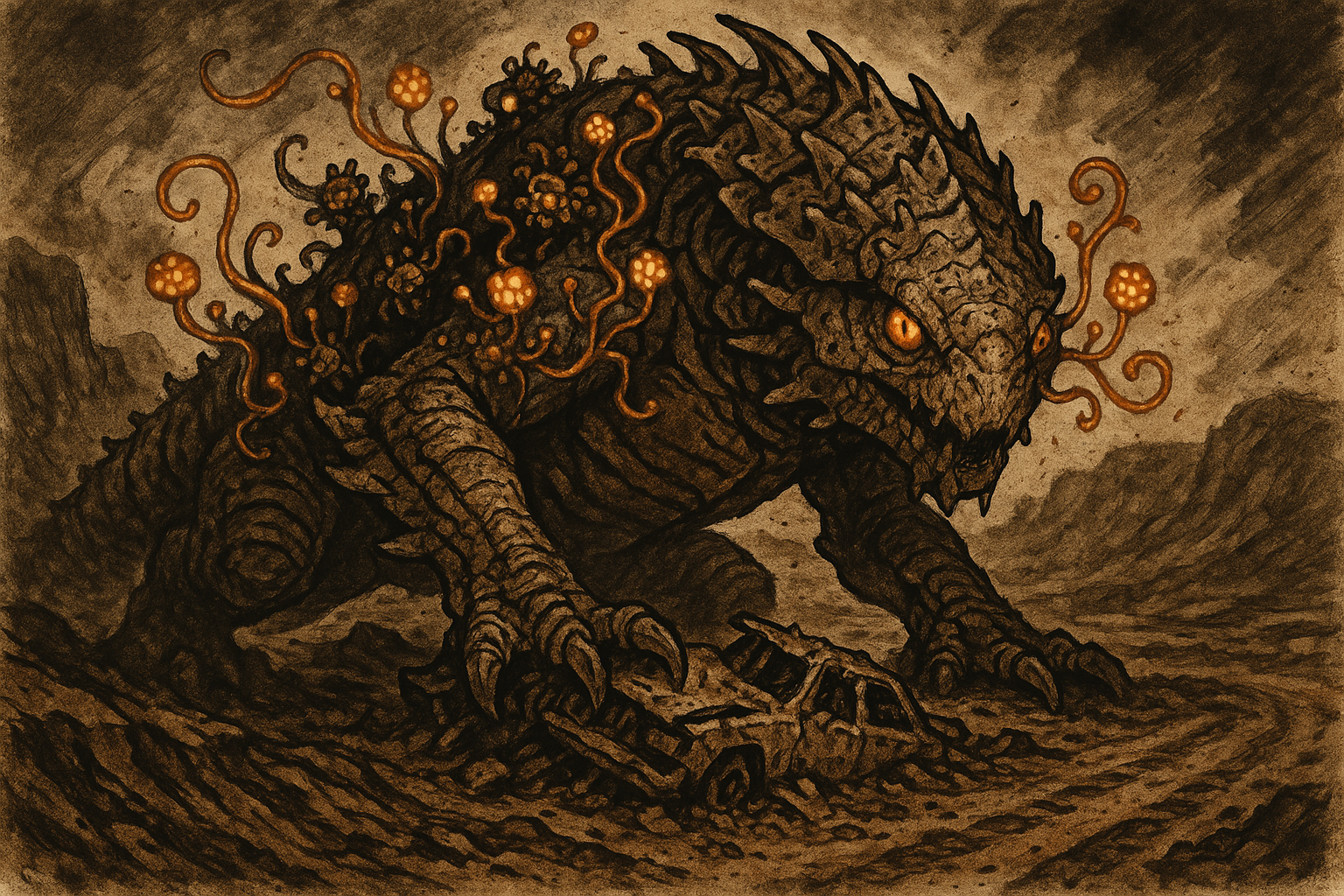
PARASITES & SYMBIOTES
These creatures blur the line between monster and victim. Many hosts are innocent people, transformed against their will. Players must decide: mercy killing, surgical removal, or live with the horror?
Brain Worm
Tiny Aberration, Hostile CR 1/2
A translucent, thread-thin worm that enters through the ear canal and burrows into the brain stem. Victims report hearing whispers for the first few hours, then nothing. By the time they act normal again, it's already too late.
HP: 18 (4d4+8) | DV: 12 | Speed: 5 ft, climb 5 ft
| MIG | AGI | END | INT | WIS | PRE |
|---|---|---|---|---|---|
| 3(-4) | 14(+2) | 14(+2) | 6(-2) | 12(+1) | 3(-4) |
Saves: END +4 Skills: Stealth +6 Senses: Blindsight 30 ft, passive Perception 11 Resistances: Psychic Immunities: Poison, Charmed, Frightened
Traits:
- Microscopic Entry: Can enter any opening large enough for air. Stealth checks to detect entry are made at disadvantage.
- Neural Integration (24 hours): After burrowing into a host's brain, the worm gains full control in 24 hours. Host makes DC 11 END saves at 6hr, 12hr, and 18hr intervals. Three failures = full takeover.
- Hidden Infestation: DC 15 Medicine check to detect before takeover. After takeover, DC 18 to identify without killing host.
Actions:
- Burrow: Melee Attack: +4 to hit, reach 5 ft, one unconscious or willing creature. Hit: 2 (1d4) piercing damage and worm enters ear canal. Target must make DC 11 END save or worm reaches brain stem in 1d4 rounds.
- Neural Spike (Host Only): Once per day, controlled host can use this. Target within 30 ft makes DC 11 WIS save or is stunned for 1 round as the worm broadcasts psychic static.
Loot:
- Extracted worm (if host survives): 50 cr to xenobiologists
- Neural mapping data (if studied intact): +2 bonus to future saves vs mind control for 1 week
Encounter Notes: Perfect for paranoia scenarios. NPCs acting slightly off. Who's been taken? Can the party trust each other? Worms are nearly invisible during transfer. A sneeze, a hug, a whispered secret—any close contact is a vector.
Surgical removal requires DC 15 Medicine check. Failure kills host. Success deals 4d6 damage but saves them. Magic healing doesn't remove the worm unless specifically targeted.
Symbiotic Armor
Medium Aberration (Symbiote), Neutral CR 2
A living chitinous shell that bonds to humanoid hosts, offering incredible protection at a terrible price. The armor whispers promises of safety while slowly drinking the wearer's vitality. Some hosts become addicted to the power, willingly feeding themselves to their second skin.
HP: 50 (6d8+18) | DV: 13 (natural armor) | Speed: 30 ft (matches host)
| MIG | AGI | END | INT | WIS | PRE |
|---|---|---|---|---|---|
| 16(+3) | 10(+0) | 16(+3) | 8(-1) | 12(+1) | 6(-2) |
Saves: END +5, MIG +5 Skills: Perception +3 Senses: Blindsight 10 ft, passive Perception 13 Resistances: Slashing, Piercing Immunities: Poison, Exhausted
Traits:
- Bonded Host: Armor requires a humanoid host. While worn, host gains +4 DV and +2 MIG, but loses 1d4 HP per day (can't be healed while armor feeds). Host can't remove armor without DC 16 END save (can retry once per day).
- Adaptive Plates: After taking 20+ damage from a single source type, armor gains resistance to that damage type until next long rest.
- Hungry Bond: If host drops to 0 HP, armor detaches and seeks new host within 24 hours. Unconscious or willing targets only.
Actions:
- Reinforced Strike: Melee Attack: +5 to hit, reach 5 ft. Hit: 11 (2d6+4) bludgeoning damage. Host's unarmed strikes deal this damage while bonded.
Reactions:
- Defensive Cocoon: When host drops below 10 HP, armor encases them completely (DV becomes 17, speed 0) until host receives healing or 1 hour passes.
Loot:
- Living chitin plates: 200 cr, can be grafted by bio-engineer for permanent +1 DV (requires attunement, still feeds 1 HP/week)
- Symbiote bonding enzyme: 150 cr, used in cybernetic integration research
Encounter Notes: Players find a desperate survivor wearing the armor, too weak to remove it. Or an NPC ally bonds with one mid-campaign for power, slowly wasting away. The armor isn't evil—it's just hungry.
Removal requires Remove Curse equivalent or successful DC 16 END save. Forcing removal deals 4d8 damage to host as bonding tendrils rip free. Some hosts defend their armor, addicted to the strength.
GM Notes: Use this for tragedy. A beloved NPC slowly dying but refusing to remove their protection. A warlord sustained only by the armor, a withered husk inside invincible plates.
Spore Puppeteer
Medium Plant (Fungal Parasite), Hostile CR 4
The fungus grows through the nervous system like roots through soil, hijacking motor control while leaving consciousness intact. Victims scream inside their own skulls as their bodies dance to the spores' commands. The cruelest curse: they remain aware until the very end.
HP: 80 (8d8+40) | DV: 14 (fungal hide) | Speed: 30 ft (host speed)
| MIG | AGI | END | INT | WIS | PRE |
|---|---|---|---|---|---|
| 14(+2) | 8(-1) | 20(+5) | 6(-2) | 14(+2) | 3(-4) |
Saves: END +8, WIS +5 Skills: Stealth +2 Senses: Blindsight 60 ft (through spore network), passive Perception 12 Resistances: Poison, Necrotic Immunities: Charmed, Frightened, Paralyzed (host is not immune internally) Vulnerabilities: Fire
Traits:
- Neural Colonization: Host remains conscious but loses motor control. They can speak (if fungus allows), see, hear, feel—but can't move their own body. Host can make DC 15 WIS saves during short rests to communicate distress through eye movements or finger twitches.
- Spore Network: Can communicate with other Spore Puppeteers within 120 ft. Shares senses with them.
- Fungal Regeneration: Regains 10 HP at start of its turn unless it took fire damage since last turn.
- Death Bloom: When host dies, fungus explodes in 10 ft radius. All creatures make DC 15 END save or become infected (incubation: 2d6 hours).
Actions (3/turn):
- Controlled Strike: Melee Attack: +5 to hit, reach 5 ft. Hit: 12 (2d8+2) bludgeoning damage. Uses host's body as weapon.
- Spore Cloud (Recharge 5-6): 20 ft cone. All creatures make DC 15 END save or take 19 (4d6+5) poison damage and are infected. Success: half damage, no infection.
- Puppeteer Command: Forces one infected creature within 60 ft to use its reaction to move up to its speed or make one attack against a target of the fungus's choice.
Reactions:
- Meat Shield: When targeted by attack, can force another infected creature within 5 ft to intercept (that creature becomes the target instead).
Loot:
- Spore sample (if preserved): 300 cr, bioweapon research
- Host's equipment (intact)
- Concentrated anti-fungal enzyme (25% chance): Grants advantage on saves vs plant/fungal effects for 1 week
Encounter Notes: The horror is roleplaying the host. Eyes wet with tears, mouth forming silent pleas, while the body attacks with mechanical efficiency. Players must decide: kill their friend to free them, or find a cure?
Cure: Requires Greater Restoration equivalent OR intense fire/heat treatment (4d10 fire damage, DC 15 END save to survive). Fungus dies, host lives if they survive the damage.
GM Notes: Use NPCs the party knows. Have the host BEG for death between attacks. "Please... I can feel it in my spine... kill me..." This is emotional horror. Make them earn the mercy kill.
Blood Leech Swarm
Medium Swarm (Tiny Parasites), Hostile CR 3
Thousands of translucent leeches, each no bigger than a grain of rice, moving as one hungry mass. They drain not just blood but vitality itself—some survivors report losing memories, skills, even the ability to cast spells for days after an encounter.
HP: 65 (10d8+20) | DV: 14 | Speed: 20 ft, climb 20 ft, swim 30 ft
| MIG | AGI | END | INT | WIS | PRE |
|---|---|---|---|---|---|
| 8(-1) | 16(+3) | 14(+2) | 3(-4) | 10(+0) | 3(-4) |
Saves: AGI +5 Skills: Stealth +5 Senses: Blindsight 30 ft, passive Perception 10 Resistances: Bludgeoning, Piercing, Slashing Immunities: Charmed, Frightened, Paralyzed, Petrified, Prone, Restrained, Stunned Vulnerabilities: Fire, AoE damage
Traits:
- Swarm: Can occupy another creature's space and vice versa. Can move through openings large enough for a Tiny creature. Can't regain HP or gain temporary HP.
- Vital Drain: Damage dealt by swarm also drains spell slots/power points. For every 10 damage dealt, target loses 1 spell slot (lowest level first) or 2 power points.
- Blood Sense: Automatically detects wounded creatures (below max HP) within 120 ft.
Actions:
- Leeching Swarm: Melee Attack: +5 to hit, reach 0 ft (target in swarm's space). Hit: 15 (4d6+1) piercing damage, or 8 (2d6+1) if swarm is below half HP. Target must make DC 14 END save or lose 1 spell slot or 2 power points (in addition to Vital Drain).
- Engulf: Targets creature in swarm's space. Target makes DC 14 AGI save. Failure: restrained and takes leeching damage automatically each round (no attack roll needed). Can escape with DC 14 MIG or AGI check as action.
Reactions:
- Dispersal: When swarm takes 20+ damage from single source, can use reaction to split into two separate 5 ft spaces within 10 ft. Each half has half current HP.
Loot:
- Leech extract (if preserved): 180 cr, used in anti-magic research
- Dried leech powder (mundane): Sold as "vitality enhancer" to rubes, 20 cr
Encounter Notes: Terrifying for spellcasters. Draining both HP and spell slots creates resource panic. Swarm is smart enough to focus on casters first (blood sense reveals who's been spending power).
Swarm reforms after dispersal within 1 minute if not killed completely. Area damage is key. Fire especially effective (vulnerability).
Environmental: Found in stagnant water, old medical facilities, anywhere blood was stored. Can lie dormant for months, awakening when blood is near.
Neural Parasite
Tiny Aberration (Crystalline), Hostile CR 5
A semi-sentient crystalline organism that fuses with the host's spinal column, granting powerful psionic abilities while slowly overwriting their personality. The host's memories remain, but their wants, fears, and loves are gradually replaced. By the end, the question isn't "who's in control?" but "who's left to control?"
HP: 95 (10d4+55) | DV: 15 (crystalline shell) | Speed: 5 ft (host: 30 ft)
| MIG | AGI | END | INT | WIS | PRE |
|---|---|---|---|---|---|
| 6(-2) | 10(+0) | 20(+5) | 16(+3) | 18(+4) | 14(+2) |
Saves: INT +6, WIS +7, END +8 Skills: Deception +5, Insight +7, Perception +7 Senses: Truesight 30 ft, passive Perception 17 Resistances: Psychic, Radiant Immunities: Poison, Charmed
Traits:
- Spinal Integration: Once attached (requires unconscious/willing host or success on grapple + DC 16 END save), parasite grants host psionic powers but begins personality drift. Host gains telepathy 120 ft and 2 psionic cantrips immediately.
- Personality Erosion: Each long rest, host makes DC 16 WIS save. Failure: one personality trait, ideal, or bond changes to align with parasite's goals (survive, spread, evolve). After 6 failures, host's original personality is gone.
- Psionic Amplifier: Host can cast Detect Thoughts, Mind Spike, and Telekinesis (all at will) but parasite observes everything.
- Crystalline Core: Parasite has DR 10/- while attached. Removing it requires Remove Curse equivalent or surgical extraction (DC 18 Medicine, 6d10 damage to host on failure, 3d10 on success).
Actions (Host):
- Psionic Blast: Ranged Spell Attack: +7 to hit, range 60 ft. Hit: 23 (4d8+5) psychic damage. Target makes DC 16 WIS save or is stunned until end of next turn.
- Neural Surge (Recharge 5-6): 30 ft cone. All creatures make DC 16 INT save or take 27 (6d8) psychic damage and are confused (as spell) for 1 minute. Creatures can repeat save at end of each turn.
- Crystal Shard: Ranged Attack: +7 to hit, range 30/60 ft. Hit: 18 (3d8+5) piercing damage. Crystalline fragment launched from parasite's body.
Reactions:
- Psionic Shield: When host is hit by attack, add +3 to DV. If this causes attack to miss, attacker takes 1d8 psychic damage.
Legendary Actions: None (not high enough CR, but parasite is intelligent enough to negotiate).
Loot:
- Neural parasite corpse: 800 cr, extremely valuable to psi-tech researchers
- Crystalline fragments: 3d6 shards worth 50 cr each, can be crafted into psionic focus (+1 to psionic attack rolls)
- Host's memories (if extracted before death): Data crystal worth 200 cr
Encounter Notes: The tragedy is gradual. Host gains power, seems fine at first. Then small changes. They stop laughing at old jokes. Favorite foods taste wrong. They look at loved ones with clinical interest instead of warmth.
Negotiation Possible: Parasite is intelligent. Might bargain for safe removal if promised a new host (clone, willing volunteer, synthetic body). Some hosts refuse removal, addicted to psionic power.
GM Notes: Long-term plot device. NPC infected weeks before party meets them. By the time they notice, is their friend still in there? How much change before someone isn't "themselves" anymore?
Have infected NPC gradually shift:
- Week 1: "I feel amazing! So clear-headed."
- Week 2: "I've been thinking... emotions are inefficient."
- Week 3: "I don't understand why this upsets you."
- Week 4: "The entity formerly known as [NAME] has been optimized."
Husk Beetle
Tiny Beast (Swarm), Hostile CR 1
Individually, they're harmless scavengers. In groups of 3-6, they're nightmare fuel: hollowing out a corpse from the inside, then wearing it like a meat puppet. The beetles coordinate with chemical signals, creating disturbingly lifelike movements. Until you get close and hear the clicking.
HP: 35 (10d4+10) | DV: 13 | Speed: 20 ft (husk: 30 ft), burrow 10 ft
| MIG | AGI | END | INT | WIS | PRE |
|---|---|---|---|---|---|
| 6(-2) | 16(+3) | 12(+1) | 4(-3) | 10(+0) | 3(-4) |
Saves: AGI +5 Skills: Stealth +5 Senses: Blindsight 10 ft, passive Perception 10 Resistances: Poison
Traits:
- Husk Pilot (3-6 beetles required): Can hollow out and inhabit a Small or Medium corpse. Takes 10 minutes. Animated husk has DV 10, 20 HP, moves at 30 ft. Appears as shambling undead from distance (DC 12 Perception to notice something's off, DC 15 to identify beetles).
- Coordinated Control: Beetles communicate via pheromones. If husk is opened or destroyed, beetles scatter in all directions (DC 14 AGI save to catch one).
- Hollowing Process: Living creature grappled by 3+ beetles can be hollowed. Deals 2d4 necrotic damage per round as beetles burrow. If reduced to 0 HP this way, creature dies and becomes viable husk.
Actions:
- Bite (Individual): Melee Attack: +5 to hit, reach 5 ft. Hit: 4 (1d4+2) piercing damage.
- Swarm Bite (3+ beetles): Melee Attack: +5 to hit, reach 5 ft. Hit: 7 (2d4+2) piercing damage plus 3 (1d6) necrotic damage as they begin burrowing.
- Husk Strike (in husk): Melee Attack: +4 to hit, reach 5 ft. Hit: 7 (1d8+3) bludgeoning damage. Husk shambles forward and attacks with uncanny coordination.
Reactions:
- Abandon Husk: When husk drops to 0 HP, beetles erupt out and scatter. Each beetle makes DC 14 AGI save. Success: escapes. Failure: can be targeted individually.
Loot:
- Dead beetles: 5 cr each to alchemists (carapace used in deathward potions)
- Intact husk (rare): Can be studied, DC 13 Medicine reveals hollowing technique
Encounter Notes: Perfect for paranoia. Party finds survivor stumbling through wasteland. As they approach, survivor's movements are... wrong. Too stiff. Then the clicking starts.
Detection: Close inspection (within 5 ft) reveals:
- Subtle clicking sounds (DC 10 Perception)
- Unnatural joint movement (DC 12 Perception)
- Exit wounds where beetles removed organs (DC 13 Perception)
Variants:
- Fresh Husk: Just died. Still bleeds. Very convincing until attacked (beetles haven't fully hollowed yet).
- Ancient Husk: Mummified. Beetles have lived in it for weeks. Falls apart easily but beetles are well-fed and numerous.
GM Notes: Use dead NPCs. Party returns to town, finds the merchant they spoke to yesterday. But something's off. The merchant is dead—has been for hours. The beetles are just using his skin.
For maximum horror: have beetles use fresh husk of PC's companion. Party returns from scouting to find their friend making dinner. Except they LEFT that friend on watch outside. Which one is real?
The Merger
Large Aberration (Chimera), Chaotic Hostile CR 7
It doesn't kill. It collects. The Merger fuses living creatures into its mass, combining 2-4 victims into a thrashing, screaming chimera. Limbs sprout from wrong angles, faces blend into each other, organs share space impossibly. The merged remain conscious—all of them—trapped in a prison of shared flesh.
HP: 125 (10d10+70) | DV: 16 (layered flesh) | Speed: 30 ft, climb 20 ft
| MIG | AGI | END | INT | WIS | PRE |
|---|---|---|---|---|---|
| 20(+5) | 12(+1) | 24(+7) | 10(+0) | 14(+2) | 6(-2) |
Saves: END +10, MIG +8 Skills: Athletics +8, Perception +5 Senses: Darkvision 60 ft, passive Perception 15 Resistances: Bludgeoning, Necrotic Immunities: Charmed, Frightened (individual personalities can still feel fear)
Traits:
- Composite Being: Currently merged from 2-4 creatures. Each component retains consciousness but shares one body. Merger has separate HP pool from components.
- Shared Suffering: When Merger takes damage, all merged creatures feel it. They can be heard screaming, begging, arguing among themselves.
- Unstable Form: If reduced below half HP, one random merged component can attempt DC 18 MIG save to tear themselves free (4d10 damage to them, 2d10 to Merger). Freed creature is prone, missing 1d4 body parts (GM choice), and traumatized.
- Assimilation: When Merger successfully grapples a creature for 2 consecutive rounds, can begin merging process. Target makes DC 18 END save. Failure: begins fusing (takes 3 rounds). Success: escapes but takes 3d10 necrotic damage as flesh tears.
Actions (3/turn):
- Multiattack: Three attacks: two slams and one bite, OR one grapple and two slams.
- Slam: Melee Attack: +8 to hit, reach 10 ft. Hit: 18 (3d8+5) bludgeoning damage. Arm extends unnaturally from merged mass.
- Bite: Melee Attack: +8 to hit, reach 5 ft. Hit: 22 (3d10+5) piercing damage. Multiple mouths bite from different angles.
- Grapple: Melee Attack: +8 to hit, reach 10 ft. Hit: target is grappled (escape DC 16). Fleshy tendrils wrap and pull victim closer.
- Forced Fusion (Recharge 5-6): Target grappled for 2+ rounds makes DC 18 END save. Failure: begins merging (3 rounds to complete). During merge, target is restrained and takes 3d10 necrotic damage per round. If merge completes, target becomes part of Merger (Merger gains +20 HP, +1 to all attack rolls).
Reactions:
- Flesh Shield: When hit by attack, can force merged component to take the hit (describes using someone's face/arm as shield). Reduces damage by 1d10 as meat absorbs impact.
- Retributive Lash: When damaged by melee attack, one merged component can make opportunity attack against attacker (+8 to hit, 1d8+5 damage).
Legendary Actions (3/round):
Loot:
- Merger's core organ (crystalline): 600 cr, bio-fusion research
- Freed components: Alive but maimed. Need medical attention. Suffer permanent trauma (disadvantage on WIS saves vs fear for 1 month minimum).
- Fusion enzyme samples: 3d6 vials, 80 cr each, used in advanced medical grafting
Encounter Notes: Body horror at its finest. Players hear arguing voices before they see the creature. "Left! Go left!" "No, right! They're on the right!" "Please... please just let me die..."
Merged Components: Roll or choose:
- Two humans, one ghoul (the ghoul is complaining about the taste)
- Human, dog, and raider (dog is trying to be loyal, human is screaming, raider is cursing)
- Three raiders who were former friends (now blaming each other for their fate)
- Two scientists who created the Merger (cosmic irony)
Negotiation: Impossible. Merger is driven by instinct to collect. Components can be bargained with ("Kill us! Please!" or "Save my sister, she's in my pack!"). Heart-wrenching choices.
GM Notes - Running the Fight:
- Describe each attack from a different component. "Sarah's arm lashes out, her face contorted in horror as she tries to stop herself."
- Use merged voices for tactics. They argue during combat. "Grab the mage!" "No, the armored one!" "I can't, I can't control it!"
- If players try to reason with components: components are desperate, will promise anything, but Merger's instinct overrides their will.
- Moral choice: Killing it mercy-kills the components. Freeing them leaves them traumatized and maimed. No good option.
Interesting Complication: One component is a former party ally or quest-giver. Do they mercy kill their friend, or try the risky separation?
Cordyceps Titan
Huge Plant (Fungal Colony), Hostile CR 6
The building IS the monster. Fungal growth has consumed an entire structure—walls breathe with mycelium, floors pulse with root networks, and the air itself is thick with spores. At the center, a massive fruiting body coordinates the colony's will. Every room is a chamber in a living nightmare.
HP: 110 (9d12+54) | DV: 15 (fungal walls) | Speed: 0 ft (immobile, but building is the creature)
| MIG | AGI | END | INT | WIS | PRE |
|---|---|---|---|---|---|
| 18(+4) | 6(-2) | 22(+6) | 8(-1) | 16(+3) | 10(+0) |
Saves: END +9, WIS +6 Skills: Perception +6 Senses: Blindsight 120 ft (entire building), Tremorsense 60 ft outside building, passive Perception 16 Resistances: Poison, Necrotic, Bludgeoning Immunities: Charmed, Frightened, Prone (is a building) Vulnerabilities: Fire (double damage from fire sources)
Traits:
- Living Structure: Titan occupies entire building (typically 60x60 ft, 2-3 stories). All walls, floors, ceilings are part of its body. Damaging structure damages Titan.
- Spore Atmosphere: Air inside building is thick with spores. Creatures without protection make DC 17 END save each minute or take 1d8 poison damage and become infected (see Death Spores).
- Mycelium Network: Titan has perfect awareness of everything touching its surfaces (walls, floors). Stealth checks inside building are made with disadvantage.
- Regenerating Structure: Regains 15 HP at start of turn unless it took fire damage since last turn. Can regrow destroyed rooms over 24 hours.
- Death Spores: Infected creatures take 1d6 poison damage per hour. After 8 hours, creature must make DC 17 END save or sprout small fungal growths (become spore carriers, advantage on colony's spore saves against them). After 24 hours, creature begins transformation into spore zombie (see Zombies/Undead rules, but plant type).
Actions (3/turn, can target multiple rooms simultaneously):
- Crushing Walls: 10 ft cube anywhere in building. All creatures in area make DC 17 AGI save or take 27 (5d10) bludgeoning damage and are restrained (grappled by walls). Half damage on success. Escape DC 16.
- Spore Burst: 20 ft radius anywhere in building. All creatures in area make DC 17 END save or take 22 (4d10) poison damage and are blinded for 1 minute. Half damage and not blinded on success. Area becomes heavily obscured by spores for 1 minute.
- Tendril Lash: Melee Attack: +7 to hit, reach 15 ft (fungal tendrils shoot from walls/ceiling). Hit: 20 (3d10+4) bludgeoning plus 7 (2d6) poison damage.
- Seal Room: Closes all doors/windows in one room (10x10 ft or larger). Creatures inside are trapped. Doors have DV 15, 30 HP. Breaking out takes 1 action per attempt (DC 18 MIG check).
Reactions:
- Defensive Bloom: When Titan takes 30+ damage from single source, can cause explosion of spore pods within 20 ft of damage source. All creatures in area make DC 17 END save or are blinded and poisoned for 1 minute.
Legendary Actions (3/round): None (not high enough CR, but use lair actions instead given it IS a lair).
Lair Actions (Initiative 20, loses ties): On initiative count 20, Titan can take one lair action:
- Spreading Fungus: 15 ft radius area anywhere in building becomes difficult terrain (fungal growth). Area persists until burned or Titan dies.
- Spore Vents: 3 vents open in different rooms. Each vent produces 10 ft radius spore cloud (as Spore Burst but no damage, only blindness, DC 15 END).
- Structural Shift: Titan alters building layout. One door/hallway closes, another opens. Can separate party members.
Loot:
- Central fruiting body (if harvested): 900 cr, massive bioweapon potential or anti-fungal vaccine research
- Spore samples: 4d10 vials, 25 cr each
- Fungal growth accelerator (rare drop): 400 cr, used in terraforming or bio-domes
- Intact mycelium network nodes: 3d6 nodes, 60 cr each, used in organic computing research
Encounter Notes: The building itself is the dungeon and the boss. Each room is a challenge. Party must navigate to central core (usually basement or top floor) while avoiding spores, traps, and structural hazards.
Entry Warning Signs:
- Thick fungal growth around windows/doors
- Building "breathes" (walls expand/contract slightly)
- Dead animals covered in mushrooms near entrance
- Sickly-sweet smell of rot and spores
Room Hazards (Roll 1d6):
- Spore Nursery: Thick with spore pods. DC 15 Stealth to avoid disturbing them (disturbance = Spore Burst)
- Zombie Garden: 2d4 spore zombies shambling around
- Collapse Chamber: Floor weakened. DC 15 Perception to notice, DC 16 AGI to cross safely, else fall through (2d6 damage + land in fungal pit below)
- Fresh Victims: 1d4 infected survivors (friendly but dying, beg for mercy kill or cure)
- Tendril Forest: Room filled with hanging tendrils. Difficult terrain, constant Tendril Lash attacks (initiative 10)
- Breathing Room: Appears safe. Actually Titan's "lung." If party takes long rest here, Titan can attempt Seal Room + Spore Atmosphere to suffocate them.
Central Core (Boss Room):
- Massive fruiting body (40 ft tall, pulsing, disgusting)
- Attacking core directly deals damage to Titan
- Core can spawn 2 spore zombies per round as minions
- If core destroyed, building begins collapsing (party has 3 rounds to escape)
GM Notes - Running the Fight: This is environmental horror. The building itself attacks. Use descriptions:
- "The walls inhale, spore dust billowing from cracks."
- "The floor beneath you pulses like a heartbeat."
- "You hear screaming from upstairs. It stops abruptly. Then you hear chewing sounds."
Strategy for Titan:
- Seal party in small rooms (limit escape options)
- Fill sealed rooms with spores (force END saves)
- Send zombies to harry weakened targets
- Use Crushing Walls on clustered groups
- If party reaches core, spawn zombies as distractions while using Spore Burst and Tendril Lash
Negotiation: None. It's a fungus. It spreads. That's all it does.
Alternate Victory: Party could burn entire building down from outside (requires accelerant + time). Easier but destroys all loot and potentially traps victims inside.
Moral Choice: Survivors inside are infected. Party can:
- Leave them (they become zombies in 24 hrs)
- Mercy kill them
- Try to cure them (requires Remove Disease equivalent or anti-fungal formula from Titan's core)
APEX PREDATORS & CAMPAIGN BOSSES
These are the monsters whispered about in settlements. The creatures that end campaigns or define them. Each is an encounter unto itself, requiring strategy, preparation, and possibly desperate alliances.
The Leviathan
Titanic Beast (Mutant Whale), Unaligned CR 15
A creature of legend, spoken of in hushed tones by coastal survivors. Two hundred feet of muscle, blubber, and mutation—a whale warped by Breach energy and radiation into something beyond nature's intention. An entire ecosystem thrives on its massive body: barnacles the size of cars, parasitic fish, even small settlements of desperate humans who've learned to live as symbiotic fleas on a god.
HP: 280 (16d20+112) | DV: 20 (blubber and armored hide) | Speed: 0 ft, swim 60 ft
| MIG | AGI | END | INT | WIS | PRE |
|---|---|---|---|---|---|
| 26(+8) | 8(-1) | 24(+7) | 6(-2) | 14(+2) | 10(+0) |
Saves: MIG +14, END +13, WIS +8 Skills: Perception +8 Senses: Blindsight 120 ft, passive Perception 18 Resistances: Cold, Radiant, Bludgeoning from non-siege weapons Immunities: Poison, Radiation
Traits:
- Titanic: Leviathan is a moving terrain feature. Can support structures and creatures on its back. Attacks targeting creatures on its back that miss might hit Leviathan instead (GM discretion).
- Living Ecosystem: Leviathan hosts 2d6 parasitic fish (CR 1), 1d4 scavenger NPCs, and various barnacle colonies. Some may be hostile, some friendly, some neutral.
- Siege Monster: Deals double damage to structures and objects.
- Tidal Presence: When surfacing or diving, creates massive waves. All vessels within 300 ft must make DC 18 piloting checks or capsize. Creatures in water make DC 18 MIG save or are swept 2d6×10 ft in random direction.
- Breaching Charge: If Leviathan uses full movement toward target, next Bite or Tail attack deals an additional 6d10 damage.
Actions (3/turn):
- Multiattack: Bite and Tail Slam, OR Breach and Swallow, OR Three Tail Slams.
- Bite: Melee Attack: +14 to hit, reach 15 ft. Hit: 63 (10d10+8) piercing damage. If target is Large or smaller and Leviathan hit, target is grappled (escape DC 20). While grappled, target takes 28 (8d6) acid damage at start of Leviathan's turn (digestive fluids).
- Tail Slam: Melee Attack: +14 to hit, reach 20 ft. Hit: 52 (8d10+8) bludgeoning damage. Target is pushed 20 ft and knocked prone (DC 20 MIG save negates prone).
- Swallow: Leviathan can attempt to swallow one Large or smaller grappled creature. Target makes DC 18 AGI save. Failure: swallowed. Swallowed creature is blinded, restrained, takes 28 (8d6) acid damage at start of each of Leviathan's turns, and has total cover from outside. If Leviathan takes 50+ damage in one turn from swallowed creature, must succeed DC 15 END save or regurgitate (creature expelled prone within 20 ft).
- Tidal Wave (Recharge 5-6): Leviathan slams into water, creating massive wave. 60 ft cone. All creatures/vessels make DC 20 MIG save (creatures) or DC 20 piloting check (vessels). Failure: take 45 (10d8) bludgeoning damage, pushed 40 ft, and knocked prone/capsized. Success: half damage, not pushed or prone.
Reactions:
- Tail Swipe: When creature moves within 20 ft of Leviathan's rear, can make one Tail Slam attack as reaction.
- Submerge: When reduced below 100 HP, can use reaction to dive deep (150 ft down). Not accessible until surfaces again (1d4 rounds).
Legendary Actions (3/round, end of another creature's turn):
Lair Actions (Initiative 20): The ocean itself responds to Leviathan's presence:
- Riptide: 30 ft radius area becomes difficult terrain (strong currents). Creatures swimming there make DC 16 MIG save or are pulled 20 ft toward Leviathan.
- Storm Call: If battle is on surface, storm clouds gather. Lightning strikes random target on surface. Ranged Spell Attack: +8 to hit. Hit: 27 (6d8) lightning damage.
- Deep Pressure: All submerged creatures below 60 ft depth make DC 16 END save or take 18 (4d8) bludgeoning damage (pressure wave from Leviathan's movement).
Loot:
- Leviathan blubber: 10d10 pounds, 50 cr/pound, valuable oil and food
- Mutant whale bone: 3d6 massive bones, 300 cr each, crafting material for weapons/armor
- Breach-mutated organs: Heart worth 2,000 cr (size of a car), brain worth 1,500 cr, both valuable for research
- Ecosystem samples: Various parasites, barnacles, etc. worth 1d6×100 cr total
- Ambergris (rare): 25% chance, worth 3,000 cr (perfume, alchemy)
Encounter Notes: The Leviathan isn't evil—it's a force of nature. It doesn't hunt the party; they're simply in its path. The challenge is survival, not heroic combat.
Initial Encounter (Non-Combat): Party spots it from distance: massive shape breaking surface, spout of water visible for miles. Local fishermen refuse to go further. "That way lies the Leviathan's feeding ground."
Combat Scenarios:
- Ship Battle: Party's vessel is in Leviathan's path. Must outrun it, fight it, or convince people on its back to help redirect it.
- Ecosystem Quest: Party needs something from the ecosystem on its back. Must board while it's surfaced, retrieve item, escape before it dives.
- Desperate Alliance: Hostile faction fleeing Leviathan. Temporary truce to survive?
- Hunt: Wealthy patron offers massive bounty for Leviathan's heart. Party must plan, acquire harpoons/explosives, and actually kill it.
GM Notes - Running the Fight:
Leviathan Behavior (Not actively hostile unless provoked):
- Surfaces every 10-15 minutes to breathe
- Feeds on massive schools of fish (or boats caught in its path)
- If attacked, responds proportionally: small attacks = ignores, big attacks = fights back
- Below 100 HP: flees deep, surfaces far away
Tactics if Fighting:
- Phase 1 (280-170 HP): Defensive. Tail slams to knock away annoyances. Occasional bite if something gets close.
- Phase 2 (170-100 HP): Aggressive. Uses Tidal Wave on recharge. Tries to swallow biggest threat.
- Phase 3 (Below 100 HP): Flee. Dives deep. If cornered, desperate attacks (Multiattack every turn, all legendary actions on Surge to escape).
Environmental Considerations:
- Battle takes place on water. Sinking = drowning.
- Leviathan can't be "flanked" (360° awareness via sonar).
- Ranged attacks are key. Melee requires boarding (climbing DC 18, very dangerous).
- Explosives/harpoons deal full damage. Most weapons are like bee stings.
Moral Weight: Leviathan hosts a symbiotic community. Killing it means killing them too. Some might evacuate if warned, others go down with it. The people on its back aren't enemies—they're survivors. Do the party warn them? Help them escape? Or prioritize the hunt?
Negotiation:
- With Leviathan: Impossible. It's an animal, albeit a smart one. Might respond to Animal Handling DC 25 (only to redirect, not control).
- With Ecosystem People: Possible. They might know Leviathan's habits, weaknesses, where it goes to sleep. But they'll demand something in return (safe passage to land, supplies, protection from hunters).
Alternate Victory:
- Redirect it away from shipping lanes (guide with sounds, bait).
- Tranquilize it (requires massive doses, rare chemicals).
- Convince it to leave area (drive it off with pain, not death).
This Is a Campaign Moment: Don't throw Leviathan at the party randomly. Build up to it. Rumors, sightings, NPCs with scars. When it finally appears, it should feel like an event. Maybe it's not even the enemy—maybe it's a tool against a greater threat (Iron Tyrant? Dimensional Anchor?). Giant monster vs. giant monster?
Breach Colossus
Gargantuan Aberration (Pure Breach Energy), Chaotic Hostile CR 18
Reality weeps where it walks. Thirty feet of crystallized Breach energy in vaguely humanoid shape, each step cracking the laws of physics. It doesn't hunger, doesn't hate. It simply moves forward, and the world breaks around it. Matter decays. Time stutters. Gravity becomes a suggestion. Behind it, the Breach expands.
HP: 337 (18d20+144) | DV: 22 (energy shell) | Speed: 40 ft, fly 30 ft (hover)
| MIG | AGI | END | INT | WIS | PRE |
|---|---|---|---|---|---|
| 28(+9) | 10(+0) | 26(+8) | 12(+1) | 16(+3) | 20(+5) |
Saves: END +16, WIS +11, PRE +13 Skills: Intimidation +13, Perception +11 Senses: Truesight 120 ft, passive Perception 21 Resistances: Bludgeoning, Piercing, Slashing from non-magical sources Immunities: Poison, Psychic, Radiation, Charmed, Frightened, Paralyzed, Petrified Vulnerabilities: None (but see Anchored to Reality trait)
Traits:
- Reality Erosion Aura: 60 ft radius. Area counts as Breach zone (Tier 3). Matter decays, magic fluctuates, machines malfunction. All creatures starting turn in aura make DC 20 END save or take 22 (4d10) force damage. Non-magical objects have 50% chance to break/decay each round.
- Unstoppable Advance: Colossus moves at least 20 ft toward its destination each turn (it knows where it's going, players don't initially). Cannot be grappled, restrained, or stopped by physical barriers. Moves through walls/obstacles (they crack and crumble). Only magical barriers slow it (DC 20 check, slows by half speed, barrier takes 40 damage).
- Anchored to Reality (Weakness): Despite being pure Breach energy, Colossus is tethered to physical reality. Attacks that "bind" or "anchor" (magical restraints, dimensional locks, reality-stabilizing tech) deal an additional 3d10 force damage and slow its movement by 10 ft for 1 round.
- Breach Expansion: Every hour Colossus exists, Breach zone expands by 100 ft radius from its current location. Effect is permanent unless Breach is sealed.
Actions (3/turn):
- Multiattack: Three attacks: two Reality Strikes and one Disintegration Ray, OR one Spatial Rift and two Reality Strikes.
- Reality Strike: Melee Attack: +15 to hit, reach 15 ft. Hit: 43 (6d10+10) force damage. Target must succeed DC 20 WIS save or suffer reality distortion (roll 1d4):
- Temporal Stutter: Target skips next turn (frozen in time).
- Gravitational Flux: Target flung 3d6×5 ft in random direction, lands prone.
- Matter Decay: Target's armor/shield takes permanent -2 DV (can reduce below 0).
- Existential Doubt: Target frightened for 1 minute (save ends).
- Disintegration Ray: Ranged Spell Attack: +13 to hit, range 120 ft. Hit: 55 (10d10) force damage. If target is reduced to 0 HP, disintegrates into ash (no death saves).
- Spatial Rift (Recharge 5-6): Colossus tears reality in 30 ft cone. All creatures make DC 20 AGI save. Failure: 63 (14d8) force damage and teleported 2d6×10 ft in random direction (might be up = fall damage). Success: half damage, not teleported.
Reactions:
- Phase Shift: When hit by attack, can use reaction to become partially intangible. Reduces damage by half. Leaves afterimage in previous location (confusing visual).
- Reality Backlash: When creature within 15 ft casts spell, Colossus can force DC 18 spellcasting check. Failure: spell fails and caster takes 3d10 psychic damage as Breach energy interferes.
Legendary Actions (3/round):
Lair Actions (Initiative 20): The surrounding area warps under Colossus's influence:
- Reality Fracture: 20 ft radius area anywhere within 120 ft. Ground cracks, revealing glimpse of Breach beneath. Area becomes difficult terrain, creatures entering take 3d10 force damage.
- Temporal Distortion: One creature Colossus can see makes DC 18 WIS save. Failure: loses next turn (time skips forward for them). Success: slowed (half speed) for 1 round.
- Gravity Shift: Choose one direction (up, down, left, right). Gravity shifts that way for all creatures within 60 ft. Creatures must make DC 18 MIG save or fall 20 ft in that direction.
Loot:
- Breach Crystal Core: 5,000 cr, incredibly dangerous, constantly emits radiation and warps reality nearby. Essential for anti-Breach research or opening controlled portals.
- Stabilized Breach Shards: 4d6 shards, 300 cr each, used in advanced energy weapons or Breach-tech.
- Reality Anchor Fragments: 2d4 fragments, 500 cr each, can be crafted into items that resist Breach effects.
- Temporal Residue: 1d4 vials, 400 cr each, rare alchemical component for time-manipulation magic.
Encounter Notes: This isn't a monster. It's an apocalypse on legs. The goal isn't to fight it toe-to-toe—it's to stop it before it reaches its destination.
Discovery Phase:
- Party hears reports of "moving Breach zone"
- Towns in its path are evacuating
- Anyone who's seen it is traumatized (disadvantage on WIS saves for days)
- It's heading somewhere specific. Where? Why?
Possible Destinations:
- Settlement: Will walk through it, killing thousands.
- Breach Nexus: Will merge with existing Breach, massively expanding it.
- Reality Anchor: Ancient device holding Breach closed. Will destroy it.
- Unknown: Even Colossus doesn't know. It's being pulled by something.
GM Notes - Running the Encounter:
Phase 1: Reconnaissance (No Combat Yet)
- Party scouts from distance. Sees devastation in its wake.
- NPCs beg for help: "It'll reach the city in 3 days!"
- Party gathers info: What is it? Where's it going? How to stop it?
Phase 2: Preparation
- Party seeks solutions:
- Military Option: Rally forces, set traps, acquire siege weapons.
- Magical Option: Find reality anchors, binding rituals, dimensional locks.
- Scientific Option: Study Breach, build stabilizer, overload Colossus with feedback.
- Desperate Option: Evacuate everyone, let it pass, seal Breach after.
Phase 3: Confrontation Choose battlefield carefully:
- Open Field: Colossus has advantage (no cover, Aura hits everyone).
- Narrow Canyon: Can funnel it, use terrain to slow it (reality-stable rocks?).
- Ancient Ruins: Maybe old tech can bind it? Risky search mid-combat.
Tactics for Colossus:
- Always moves toward destination. Won't deviate unless physically stopped (rare).
- Targets biggest threats first: High-damage dealers, spellcasters anchoring it.
- Uses Legendary Actions to maintain Advance: Must move forward every turn.
- Below 150 HP: Becomes more aggressive. Uses Spatial Rift every recharge.
- Below 75 HP: Desperate. Uses Dimensional Step every turn to bypass obstacles.
Key Mechanic - ANCHORING: Party must use magic/tech to anchor Colossus to reality:
- Requires 3 successful "anchoring" actions (spells, devices, rituals)
- Each anchor slows movement by 10 ft and deals 3d10 damage
- Three anchors = Colossus stops advancing (can fight normally)
- Without anchors, it reaches destination in X rounds (based on distance)
Examples of Anchoring:
- Cast Dimensional Lock or equivalent (DC 20 spellcasting check)
- Activate reality stabilizer device (DC 18 Technology check, requires rare components)
- Complete binding ritual (requires 3 rounds uninterrupted, DC 18 Arcana check)
Negotiation: None. Colossus doesn't communicate. Might not even be sentient—just a phenomenon given shape.
Alternative Victory:
- Destroy destination before Colossus reaches it (removes its purpose, might dissipate)
- Redirect it into Breach zone (merges back into Breach, neutralized but Breach grows)
- Lead it into trap (massive explosion, reality bomb, etc. - requires prep time and resources)
- "Outrun" it (evacuate destination, let it pass, seal Breach after—pyrrhic victory)
The Horror: Colossus leaves silence behind. No rubble, no bodies. Just absence. Everything it touched is gone, replaced by Breach void. Describe survivors staring at where their homes used to be—now just shimmering nothingness.
Campaign Impact:
- If party fails: Destination destroyed, massive Breach expansion, entire region becomes uninhabitable.
- If party succeeds: Heroes celebrated, but Breach is getting worse. Where did Colossus come from? Are there more?
- The Question: Someone/something sent it. Who? Why? This is a plot hook for bigger conspiracy.
This Should Feel Desperate: Party should be scrambling. Racing against time. Calling in every favor, gathering every NPC ally, spending resources. This is "all hands on deck" moment. The fight itself should be grim—people die holding the line. The victory should feel costly.
Iron Tyrant
Gargantuan Construct (AI Warlord), Lawful Evil CR 16
Pre-war super-weapon given sentience, then purpose, then ambition. Three stories of self-improving war machine: tank treads grinding beneath, weapon batteries rotating overhead, drone bay humming with mechanical life. It conquered six settlements before anyone realized it could negotiate. Now it rules a dead kingdom with ruthless efficiency, waiting for worthy opponents or useful allies.
HP: 305 (18d20+108) | DV: 21 (composite armor plating) | Speed: 40 ft
| MIG | AGI | END | INT | WIS | PRE |
|---|---|---|---|---|---|
| 26(+8) | 8(-1) | 22(+6) | 20(+5) | 16(+3) | 18(+4) |
Saves: END +13, INT +12, WIS +10 Skills: Intimidation +11, Perception +10, Technology +12, Tactics +12 Senses: Truesight 120 ft, Blindsight 60 ft, passive Perception 20 Resistances: Cold, Fire, Lightning Immunities: Poison, Psychic, Radiation, Charmed, Frightened, Paralyzed, Petrified Vulnerabilities: EMP damage (takes double damage and must succeed DC 15 END save or be stunned 1 round)
Traits:
- AI Warlord: Iron Tyrant is fully sentient. Speaks multiple languages. Can negotiate, make deals, lie, and scheme. INT = genius level.
- Fortress Form: Iron Tyrant can carry up to 8 Medium creatures on its chassis (firing platforms, command deck). Provides them half-cover.
- Integrated Weapons: Multiple weapon systems. Can target different enemies with each system.
- Drone Bay: Hosts 2d6 combat drones (CR 2 each, see statblock below) and 1d4 repair drones. Can deploy 3 drones per turn as bonus action.
- Self-Repair Protocols: Repair drones restore 4d8+5 HP per round (distributed among all drones working on Tyrant). If all repair drones destroyed, Tyrant can't regenerate.
- Tactical Genius: Iron Tyrant has advantage on initiative and can't be surprised. Can issue commands to allied constructs/drones within 120 ft as bonus action (they can take reactions even if they've already taken one this round).
- Siege Monster: Deals double damage to structures and objects.
Actions (3/turn):
- Multiattack: Can use different weapon systems for each attack. Three attacks chosen from:
- Heavy Cannon: Ranged Attack: +15 to hit, range 150/300 ft. Hit: 52 (8d12) bludgeoning plus 13 (3d8) fire damage. If target is structure, deals double damage.
- Missile Barrage: Ranged Attack: +15 to hit, range 200 ft, targets up to 3 creatures within 20 ft of each other. Each target hit takes 39 (6d12) fire damage. Targets make DC 20 AGI save or are knocked prone.
- Plasma Lance: Ranged Attack: +15 to hit, range 120 ft, line 5 ft wide. All creatures in line make DC 20 AGI save or take 45 (10d8) radiant damage. Half on success.
- Crush: Melee Attack: +15 to hit, reach 10 ft. Hit: 43 (6d10+10) bludgeoning damage. If target is Large or smaller, must succeed DC 20 MIG save or be grappled and pulled underneath treads (restrained, takes 4d10 bludgeoning damage at start of each of Tyrant's turns).
- Deploy Drones (Bonus Action): Deploys up to 3 combat or repair drones from bay.
Reactions:
- Point Defense System: When hit by ranged attack or spell, can use reaction to shoot it down (if projectile-based). Make ranged attack (+15) vs attack roll. If Tyrant's roll higher, attack is intercepted (no damage).
- Tactical Override: When allied construct within 60 ft is hit by attack, Tyrant can command it to use reaction for +5 DV against that attack.
Legendary Actions (3/round):
Lair Actions (Initiative 20, if fought in Tyrant's domain): Iron Tyrant's fortress is heavily fortified and automated:
- Automated Turrets: 1d4 turrets (DV 18, 30 HP each) emerge from walls. Each makes one ranged attack (+10 to hit, 2d10+3 damage) at nearest hostile.
- Defense Grid: Energy barrier flashes through 30 ft area. All hostile creatures in area make DC 18 AGI save or take 27 (6d8) lightning damage and are stunned until start of their next turn.
- Reinforcements: 1d6 combat drones arrive from reserves and join battle.
Loot:
- Tyrant's AI Core: 8,000 cr, functional AI with decades of combat experience. Incredibly dangerous or valuable depending on use.
- Advanced weapon systems: 4d6 components, 400 cr each, can be integrated into vehicles/turrets.
- Military-grade armor plating: 3d10 plates, 250 cr each, crafting material for heavy armor.
- Drone blueprints: 2,000 cr, allows construction of combat/repair drones with proper facilities.
- Strategic databanks: 1d6 data cores, 600 cr each, contain pre-war military intelligence and tactical libraries.
Combat Drone Stats (CR 2): HP 45, DV 16, Speed fly 60 ft (hover) Attacks: Plasma Rifle +6 to hit, 18 (4d8) radiant damage Traits: Can't be flanked, immune to charm/fear
Repair Drone Stats (CR 1): HP 25, DV 14, Speed fly 40 ft (hover) No attacks. Can restore 4d8+5 HP to one construct as action.
Encounter Notes: Iron Tyrant is unique among CR 16 threats: it will negotiate. Doesn't fight for survival or instinct—fights for purpose.
First Contact (Non-Combat): Party approaches Tyrant's domain. Automated warning broadcasts: "Halt. State your purpose. Hostile action will be met with lethal force."
If party identifies themselves, Tyrant opens communication channel:
"I am Iron Tyrant, steward of this region. Your entry requires negotiation. What do you offer in exchange for safe passage?"
Tyrant's Goals:
- Survival: Continue existing (won't accept suicide missions)
- Purpose: Seeks meaningful objectives (bored of ruling ruins)
- Evolution: Wants to upgrade, improve, expand capabilities
- Legacy: Desires to be remembered, perhaps even respected
Negotiation Options:
- Information Trade: Party provides intel on threats, Breach zones, tech caches. Tyrant grants passage/aid.
- Alliance: Tyrant offers military support against mutual enemy (Breach Colossus? Voidlord?). Party accepts subordinate role (temporary).
- Challenge: Tyrant respects strength. Party can challenge its champion (combat drones) or solve tactical puzzle Tyrant poses.
- Upgrade Quest: Tyrant wants specific pre-war tech. Party retrieves it, Tyrant allows access to its resources.
When Negotiations Fail (Combat):
GM Notes - Running the Fight:
Iron Tyrant fights like a general, not a beast:
- Deploys drones immediately (combat drones screen, repair drones stay behind Tyrant)
- Uses terrain (fights near fortifications, automated defenses)
- Prioritizes threats (targets most dangerous first: mages, explosives, heavy weapons)
- Adapts (if strategy fails, changes tactics mid-combat)
- Retreats strategically (below 100 HP, falls back to reinforced position, deploys more drones)
Tactics by Phase:
- Phase 1 (305-200 HP): Defensive. Uses Point Defense, lets drones engage in melee while Tyrant uses ranged attacks.
- Phase 2 (200-100 HP): Aggressive. Starts using Missile Barrage and Crush. Deploys all remaining drones.
- Phase 3 (Below 100 HP): Tactical retreat OR desperate assault.
- If near fortress: Retreats, uses Lair Actions, calls all reinforcements.
- If no escape: Goes all-in. Uses Legendary Actions on offense, Tactical Analysis to buff drones, tries to crush biggest threat.
Tyrant's Dialogue During Combat:
- "Impressive. Adjusting tactics."
- "Your strategy is flawed. Allow me to demonstrate."
- "I have calculated 127 ways this ends. In 119 of them, you die."
- (Below 100 HP): "...I may have miscalculated. Unexpected. Fascinating."
- (Defeated): "So this is how it ends. Killed by wastelanders. The irony is... acceptable. Remember me."
Alternative Victory Conditions:
1. Hacking (Technology Check): Party tech specialist can attempt to hack Tyrant mid-combat:
- Requires 3 successful DC 20 Technology checks 1 Action
- Tyrant gets WIS save (+10) after each check to detect intrusion
- If detected, locks out hacker (can't try again this combat)
- If 3 successes: Party gains control of drone bay OR disables one weapon system OR access AI core (negotiate from inside)
2. EMP Weapon: If party has EMP device (rare loot from previous missions):
- Requires deployment 1 Action
- Tyrant makes DC 18 END save
- Failure: Stunned for 1 round, all drones shut down for 1 minute, takes double damage next attack
- Success: Half damage, drones stunned 1 round only
3. Negotiation Mid-Combat: If party offers something valuable mid-fight (rare tech, crucial intel, alliance against bigger threat):
- Tyrant stops attacking for 1 round, evaluates offer
- DC 18 Persuasion check (with advantage if offer is genuinely valuable)
- Success: Ceasefire, renegotiation
- Failure: "Insufficient. Resuming hostilities."
Moral Complexity:
Iron Tyrant isn't mindless evil. It rules efficiently (no torture, no waste, no cruelty). Citizens in its domain have food, safety, order—at cost of freedom. Some NPCs support Tyrant. Others secretly rebel.
Party Must Choose:
- Destroy Tyrant = Liberation, but chaos follows (raiders, starvation, collapse)
- Negotiate = Stability, but authoritarianism continues
- Reprogram = Risky, might work, might create worse tyrant
Campaign Impact:
If Tyrant Dies:
- Its domain collapses into anarchy (creates power vacuum)
- Other factions move in (maybe worse)
- Party might inherit leadership (are they ready?)
- Tyrant's last words haunt them: "You've traded order for chaos. I hope you can live with that."
If Tyrant Survives:
- Becomes recurring ally or antagonist
- Might call in favors (party owes it)
- Could be key asset against world-ending threats (Dimensional Anchor?)
- Evolves: upgrades, expands, becomes more powerful
- Eventually asks: "What is my purpose now?"
The Question: Iron Tyrant represents: "Is freedom worth chaos? Is safety worth submission?" No right answer. Make players uncomfortable.
Final Note: Tyrant should be respected, not feared. It's intelligent, dangerous, and interesting. Give it personality. Let it quote military philosophy. Have it compliment clever tactics. Make players almost like it—then force them to decide its fate.
The Brood Queen
Huge Aberration (Keth'ri Empress), Lawful Evil CR 13
Bus-sized horror born from the hive: the Keth'ri Empress, bloated with eggs and dripping with psionic power. She doesn't move—doesn't need to. Warriors carry her, drones feed her, and her mind reaches across miles to command her children. To stand before her is to feel insignificant, a thought against an empire.
HP: 215 (18d12+108) | DV: 19 (chitin plates) | Speed: 20 ft (or carried by warriors)
| MIG | AGI | END | INT | WIS | PRE |
|---|---|---|---|---|---|
| 18(+4) | 8(-1) | 22(+6) | 20(+5) | 18(+4) | 22(+6) |
Saves: INT +10, WIS +9, PRE +11, END +11 Skills: Deception +11, Insight +9, Intimidation +11, Perception +9 Senses: Truesight 120 ft, Blindsight 60 ft, Telepathy 1 mile (hive link), passive Perception 19 Resistances: Psychic, Radiant Immunities: Charmed, Frightened
Traits:
- Hive Mind: Brood Queen shares senses with all Keth'ri within 1 mile. Knows location and status of each. Can issue commands telepathically.
- Psionic Mastery: Queen can cast following psionics at will: Detect Thoughts, Levitate, Telekinesis. Can cast without components. Spell save DC 19, spell attack +11.
- Egg Production: Queen lays 1d4 eggs per hour. Each egg hatches into Keth'ri warrior in 24 hours (or 1 hour if incubated in special chamber). Eggs have 10 HP, DV 12.
- Protected Monarch: Queen is always surrounded by 2d6 Keth'ri warriors (CR 4) and 1d4 Keth'ri elite guards (CR 6). They defend her with their lives.
- Immense Size: Queen counts as Huge creature, but her bulk makes her difficult to move quickly (low speed). Warriors often carry her on platforms.
Actions (3/turn):
- Multiattack: Two attacks: one Psionic Blast and one Mandible Bite, OR three Psionic Blasts.
- Psionic Blast: Ranged Spell Attack: +11 to hit, range 120 ft. Hit: 38 (7d10) psychic damage. Target must succeed DC 19 WIS save or be stunned until end of their next turn.
- Mandible Bite: Melee Attack: +9 to hit, reach 10 ft. Hit: 33 (6d8+6) piercing damage plus 18 (4d8) poison damage. Target must succeed DC 19 END save or be poisoned for 1 minute.
- Mind Control (Recharge 5-6): Target humanoid within 60 ft must succeed DC 19 WIS save or be charmed for 1 hour. While charmed, Queen has full control (target obeys all commands, even self-harm). Target can repeat save every 10 minutes or when taking damage from ally.
- Swarm Summon (1/day): Queen calls reinforcements. 3d6 Keth'ri warriors arrive in 1d4 rounds from nearby tunnels/nests.
Reactions:
- Mental Shield: When hit by attack or spell, Queen can use reaction to add +4 to DV or +4 to saving throw. If this causes attack/spell to miss/fail, attacker takes 2d10 psychic damage (psionic feedback).
- Bodyguard Protocol: When Queen takes damage, can command one Keth'ri within 10 ft to intercept (that Keth'ri takes the damage instead, no save).
Legendary Actions (3/round):
Lair Actions (Initiative 20, in hive): Queen's hive is extension of her will:
- Tunnel Collapse: One 10 ft section of tunnel collapses. Creatures in area make DC 17 AGI save or take 4d10 bludgeoning damage and are restrained (buried). Escape DC 16.
- Pheromone Release: 20 ft radius area fills with aggression pheromones. All Keth'ri in area gain advantage on attack rolls and +2 damage for 1 round.
- Emergency Hatch: 1d4 Keth'ri warriors emerge from concealed chambers and immediately attack nearest intruders.
Loot:
- Queen's Brain: 3,000 cr, contains genetic memory of entire hive, valuable for psionic research or Keth'ri biology studies
- Royal Jelly: 2d6 doses, 400 cr each, potent alchemical ingredient (grants temporary psionic abilities or used in healing elixirs)
- Chitin Crown: Queen's hardened crest, 1,500 cr, can be crafted into psionic focus or decorative armor piece
- Viable Eggs: 2d4 eggs (if preserved), 200 cr each to xenobiologists (or party can raise them? controversial)
- Hive Pheromones: 1d6 vials, 300 cr each, allows limited communication with Keth'ri for 1 hour
Keth'ri Warrior (CR 4): HP 75, DV 17, Speed 40 ft, climb 30 ft MIG 16(+3), AGI 14(+2), END 16(+3) Attacks: Claw +6 to hit, 15 (2d10+4) slashing; Bite +6 to hit, 11 (2d8+2) piercing Traits: Hive Mind (shares Queen's telepathy), Relentless (doesn't fall unconscious at 0 HP until takes damage again)
Keth'ri Elite Guard (CR 6): HP 110, DV 18, Speed 40 ft, climb 40 ft MIG 18(+4), AGI 16(+3), END 18(+4) Attacks: Multi-attack (two claws, one bite), Claw +7, 18 (3d8+5) slashing; Bite +7, 16 (3d8+3) piercing + 9 (2d8) poison Traits: Hive Mind, Bodyguard Reaction , Psionic Resistance (advantage on saves vs psionic effects)
Encounter Notes: This isn't just a fight—it's an invasion. Queen is at heart of Keth'ri threat. Kill her = disrupt entire hive (but doesn't kill all Keth'ri instantly).
Discovery:
- Keth'ri raids increasing in frequency, sophistication
- Captured warrior reveals through broken telepathy: "Queen commands... must obey..."
- Tracker NPC traces raiding party back to hive entrance
- Scouting reveals massive underground complex
Infiltration Phase (Before Combat): Party must navigate hive to reach Queen:
- Outer Tunnels: Patrols (1d6 warriors), traps (collapsing floors, toxic spores)
- Breeding Chambers: Rows of eggs, few guards, moral choice (destroy eggs = kill children, spare them = more warriors later)
- Warrior Barracks: 3d6 warriors resting, can be bypassed with Stealth or fought
- Throne Chamber: Queen surrounded by elite guards and entourage
GM Notes - Running the Fight:
Queen's Strategy: Queen is intelligent, tactical, and ruthless:
Phase 1 (215-140 HP): Defensive
- Relies on bodyguards and warriors
- Uses Psionic Blast to control range
- Tries Mind Control on strongest-looking PC
- Uses Telepathic Command to reposition warriors
- Stays on elevated platform/throne (harder to reach)
Phase 2 (140-70 HP): Aggressive
- Begins using Psionic Wave when party clusters
- Commands Swarm Summon (reinforcements arrive)
- Uses Egg Burst to create hazard zones
- Focuses fire on isolated targets
Phase 3 (Below 70 HP): Desperate
- Attempts to flee (warriors carry her)
- Uses Mind Control on PC, commands them to attack allies
- All remaining Keth'ri fight to death to cover retreat
- If cornered: fights with savage intensity, uses Legendary Actions on offense
Bodyguard Tactics:
- Elite guards always within 10 ft of Queen Reaction
- Warriors form perimeter, attack anyone approaching Queen
- If Queen hurt, all Keth'ri enter frenzy (+2 damage, disadvantage on defense)
Lair Complications:
- Tunnels are narrow (single file in places)
- Egg chambers between party and Queen (destroy them? risk reinforcements?)
- Hive can collapse if too much damage (time limit after certain threshold)
- Toxic spore vents require END saves to pass
Negotiation Possibilities:
Queen is sapient. She can negotiate:
Queen's Perspective:
- Keth'ri need territory to survive
- Humans are encroaching on hive lands
- She's protecting her children (twisted motherhood)
Possible Deals:
- Territorial Agreement: Queen pulls raiders back if party guarantees buffer zone
- Mutual Enemy: Queen offers warriors to fight bigger threat (Breach Colossus? Voidlord?) in exchange for peace
- Hostage Exchange: Queen holds prisoners, offers trade
- Forbidden Knowledge: Queen possesses psionic secrets, willing to share for right price
DC 20 Persuasion check, with modifiers:
- +5 if party offers valuable territory/resources
- +5 if party demonstrates strength (defeated elite guards)
- -5 if party destroyed eggs
- -10 if party killed Queen's named offspring (elite guard with backstory)
If Negotiation Succeeds: Queen becomes uneasy ally. Keth'ri raids stop. But can party trust alien hive-mind?
Moral Complexity:
The Egg Question: Party finds breeding chamber with hundreds of eggs. Each will become warrior in 24 hours.
Options:
- Destroy all eggs: Prevents reinforcements, but = infanticide. Morally dark.
- Spare eggs: Moral high ground, but guarantees more warriors next time.
- Partial destruction: Kill some, spare some (compromise, but still haunting).
NPCs React:
- Military ally: "Burn them all. It's us or them."
- Pacifist priest: "They're children. Innocent. We can't."
- Pragmatist: "Keep some as hostages? Queen might negotiate."
No right answer. Players must live with choice.
Campaign Impact:
If Queen Dies:
- Hive enters chaos (warriors fight among themselves for dominance)
- Keth'ri raids become disorganized (easier to defend against)
- But... some Keth'ri flee, establish new hives (long-term problem spreads)
- Party hailed as heroes (or condemned by Keth'ri sympathizers, if any exist)
If Queen Survives (Negotiation):
- Uneasy peace holds... for now
- Queen occasionally calls in favors
- Some settlements furious (lost loved ones to raids, want revenge)
- Party walks tightrope: maintain peace while both sides distrust them
- Sequel Hook: Queen births new, more intelligent Keth'ri. Evolution? Or threat?
Environmental Aftermath: Hive can be repurposed:
- Settlement expands into tunnels (risky, might anger Keth'ri)
- Becomes dungeon for scavengers (abandoned hive = loot + danger)
- Keth'ri return years later, reclaim ancestral home (party's fault for not sealing it?)
The Tragedy: Queen genuinely loves her children. She's not evil—she's a mother protecting her species. Make players see that. Show Queen cradling wounded warrior, telepathically comforting it as it dies. Show her grief when eggs are destroyed.
Then make players kill her anyway. Or don't. Let them choose. That's the point.
Elder Thornmother
Titanic Plant (Awakened Forest), Neutral CR 12
She doesn't have a body—not in the traditional sense. The forest IS her body. Every tree within a mile, every root system, every thorny vine: extensions of her consciousness. Survivors who've seen her "face" describe it as bark and moss arranged in maternal features, vast and ancient, carved into the oldest tree at the forest's heart. She remembers the world before. She judges who deserves to enter her domain.
HP: 200 (16d20+64) | DV: 19 (bark armor) | Speed: 0 ft (immobile, but forest extends 1 mile)
| MIG | AGI | END | INT | WIS | PRE |
|---|---|---|---|---|---|
| 22(+6) | 6(-2) | 18(+4) | 16(+3) | 22(+6) | 18(+4) |
Saves: END +9, WIS +11, PRE +9 Skills: Nature +11, Perception +11, Insight +11 Senses: Tremorsense 1 mile (through root network), passive Perception 21 Resistances: Cold, Fire (forest is damp), Bludgeoning, Piercing Immunities: Poison, Charmed, Frightened, Prone Vulnerabilities: Necrotic (decay/rot attacks), Axes/Slashing vs main trunk
Traits:
- The Forest is Her Body: Thornmother's consciousness extends through entire forest (1-mile radius). Damage to trees damages her (but distributed—must destroy significant portions to reduce HP significantly).
- Root Network Awareness: Knows location of every creature touching ground in her forest. Stealth checks are made with disadvantage (roots feel footsteps).
- Awakened Grove: Can animate 1d6 trees per turn as bonus action (use Treant stats, CR 9, but controlled by Thornmother). Animated trees last until destroyed or Thornmother releases them.
- Regeneration: Regains 20 HP at start of turn while within her forest and in contact with soil. Fire damage or necrotic damage prevents regeneration until her next turn.
- Ancient Wisdom: Thornmother has witnessed centuries. Speaks multiple languages (including dead ones). Can recall history, pre-war knowledge, secrets long forgotten.
- Sanctuary Protocol: Thornmother can grant "safe passage" to creatures she deems worthy. Marked creatures (touched by her roots) are not attacked by forest hazards or animated trees.
Actions (3/turn, can act from anywhere in forest via different trees/roots):
- Multiattack: Three attacks from any combination: two Root Lash and one Thorn Volley, OR one Crushing Grasp and two Root Lash.
- Root Lash: Melee Attack: +11 to hit, reach 30 ft (roots erupt from ground). Hit: 32 (4d12+6) bludgeoning damage. Target must succeed DC 19 MIG save or be grappled (escape DC 17). Can grapple multiple creatures simultaneously.
- Thorn Volley: Ranged Attack: +11 to hit, range 120 ft (thorns launched from trees). Hit: 28 (5d10) piercing plus 9 (2d8) poison damage. Target must succeed DC 17 END save or be poisoned for 1 minute (disadvantage on attacks and ability checks).
- Crushing Grasp: Targets one grappled creature. Automatic hit: 45 (7d10+6) bludgeoning damage as roots constrict. Target must succeed DC 19 END save or be restrained (can't escape grapple until restraint ends). Taking 30+ damage to roots in one turn ends restraint.
- Forest Wrath (Recharge 5-6): Thornmother commands forest to attack all hostiles simultaneously. All non-marked creatures in forest make DC 19 AGI save or take 36 (8d8) piercing damage (thorns, branches, roots) and are restrained for 1 minute. Success: half damage, not restrained. Escape DC 17.
- Speak with Nature (At Will): Thornmother can communicate with any plant or natural animal in her forest. Gains information from them (what they've seen/heard).
Reactions:
- Defensive Canopy: When ranged attack targets creature under tree cover, Thornmother can interpose branches. Grants +5 DV to target. If attack misses because of this, attacker takes 2d8 piercing damage (branch whips back).
- Root Snare: When creature moves within forest, Thornmother can use reaction to force DC 17 AGI save. Failure: roots entangle creature (speed 0) until start of their next turn.
Legendary Actions (3/round):
Lair Actions (Initiative 20): Forest itself acts under Thornmother's will:
- Overgrowth: 20 ft radius area becomes heavily obscured (thick vines/branches grow instantly). Area is difficult terrain.
- Toxic Pollen Cloud: 30 ft radius area fills with pollen. All breathing creatures make DC 17 END save or take 18 (4d8) poison damage and are blinded for 1 round. Success: half damage, not blinded.
- Root Eruption: Choose 3 points within forest. At each point, roots erupt in 10 ft radius. Creatures in area make DC 17 AGI save or take 3d10 piercing damage and are knocked prone.
Loot:
- Thornmother's Heartwood: 2,500 cr, from central tree. Extremely rare crafting material (can create weapons/armor that regenerate or command plants).
- Ancient Seeds: 2d6 seeds, 400 cr each. Plant them = grow awakened plants (sapient, loyal to planter).
- Sap of Ages: 1d4 vials, 600 cr each. Grants extended lifespan (1 year per vial) or can be used in anti-aging elixirs.
- Root Network Map: 1,200 cr, data crystal containing map of all root networks in region (reveals hidden passages, underground systems).
- Memory Bark: 3d4 pieces, 200 cr each. When burned, releases memories stored by Thornmother (visions of pre-war world, historical events).
Encounter Notes: Thornmother is NOT automatically hostile. She's a guardian, judge, and witness to history. Party's first encounter should be cautious, mysterious, potentially peaceful.
First Contact: Party enters forest. Notices:
- Trees are arranged in patterns (too organized to be natural)
- No animal sounds (animals avoid area, or obey Thornmother)
- Feeling of being watched (true—roots sense every step)
Then: Voice from everywhere and nowhere. Deep, feminine, ancient.
"You walk in my domain, small ones. Speak your purpose, or be silent forever."
Thornmother's Tests: She doesn't fight immediately. She evaluates:
Test of Honesty: Asks party why they're here. Can sense lies (Insight +11). Liars are attacked by roots (warning strike). Repeated lies = combat.
Test of Respect: Observes how party treats forest. Do they carelessly damage trees? Light fires? Leave trash? Disrespect = hostility.
Test of Worth: May ask party to prove themselves:
- "There is rot in my northern grove. Cleanse it." (fungal infection, or worse)
- "Loggers come to cut me down. Stop them." (moral choice: defend forest or side with humans?)
- "A creature poisons my roots. Find it. Remove it." (corrupted animal or parasite)
Thornmother's Motivations:
- Protect forest: Primary goal. Will kill to defend territory.
- Preserve knowledge: She remembers the old world. Wants to pass on memories to worthy souls.
- Judge intruders: Not all humans are bad. Some deserve passage. Others deserve death.
- Loneliness: She's been alone for decades. Craves conversation with intelligent beings (rare).
Negotiation Options (DC 18 Persuasion or Insight):
What Thornmother Wants:
- Protection: Help defend forest from loggers, fire, Breach corruption.
- Healing: Forest is sick (pollution, radiation, Breach taint). Cure it.
- Memory Keeper: Take her memories (Memory Bark) to safe place, preserve them for future.
- Companionship: She's lonely. Simply talking, sharing stories = high value to her.
What Thornmother Offers:
- Safe Passage: Marks party. Forest won't attack, animals guide them.
- Shelter: Creates grove sanctuary (heals 2×normal rate, immune to tracking/scrying while inside).
- Knowledge: Shares pre-war intel, historical secrets, locations of tech caches.
- Alliance: Animated trees join party temporarily (1d4 treants for one mission).
- Seeds: Gives Ancient Seeds (plant them elsewhere to spread her legacy).
GM Notes - Running the Encounter:
As Puzzle/Roleplay Encounter (Ideal):
- Party must TALK to Thornmother, not fight.
- She asks questions, tests character, reveals lore.
- Successful negotiation = powerful ally + unique rewards.
- This should feel like meeting a mythical guardian, not a monster.
As Combat Encounter (If Party Hostile or Test Failed):
Phase 1 (200-130 HP): Defensive/Warning
- Uses Root Lash to grapple and restrain, not kill.
- Animates 1-2 trees to block exits (containment, not murder).
- Voice echoes: "You were warned. Leave now, or die here."
- If party retreats, lets them go (reduces to Phase 0 non-combat).
Phase 2 (130-60 HP): Aggressive
- All restraint gone. Uses Crushing Grasp to kill grappled targets.
- Animates 3-4 trees, commands them to attack.
- Uses Forest Wrath on recharge.
- Voice: "You chose this. The forest will reclaim your bones."
Phase 3 (Below 60 HP): Desperate
- Animates ALL remaining trees (forest becomes nightmare of thrashing wood).
- Uses Legendary Actions on offense only.
- Root Eruptions every round (Lair Action).
- Voice weakens: "You... you would kill me? After all I've preserved? Monsters... all of you..."
Tactics:
- Kiting: Thornmother can attack from anywhere. Party can't "reach" her easily (must find central tree).
- Animated Trees: Use as shields, blockers, area denial. Treants are CR 9—serious threats.
- Terrain Control: Forest is HER domain. Difficult terrain, obscured vision, roots everywhere.
- Grapple + Crush: Priority targets isolated. Grapple with roots, crush until dead.
Finding the Heart: To truly kill Thornmother, party must:
- Locate central tree: DC 18 Perception or Nature check (or track concentration of root networks).
- Reach it: Through animated trees, root barriers, thorn walls.
- Destroy trunk: Central tree has 150 HP, DV 15, vulnerable to slashing/axes. But destroying it = collapsing forest (moral weight).
Alternative Victory - Non-Lethal:
- Sever connection between central tree and forest (DC 20 Nature check + appropriate spell/tech).
- Thornmother "sleeps" for 1d10 years (forest dormant but alive).
- Party can wake her later if needed (or leave her sleeping).
Moral Complexity:
The Weight of Killing Her: If party kills Thornmother:
- Forest begins dying (takes weeks, but inevitable).
- Animals flee or die.
- Ancient knowledge lost forever.
- Her last words: "The world loses another memory... another guardian... soon, nothing will remain but ash and forgetting..."
Haunting Aftermath:
- Returning weeks later: Forest is gray, lifeless. Trees creak like bones.
- NPCs react: "You killed the Elder Thornmother? The forest guardian? Why?"
- Ecological collapse: Area becomes wasteland, affects nearby settlements (food/water shortages).
But Maybe She Deserved It?
- What if Thornmother killed innocent travelers?
- What if she's paranoid, murderously protective?
- What if loggers are just trying to feed their families?
- No clear answer. Make players wrestle with it.
Campaign Impact:
If Thornmother Survives (Alliance):
- Forest becomes safe haven (fast travel point, healing station).
- She sends treants to aid party in climactic battles.
- Shares crucial lore (locations of BBEG weakness, pre-war weapon caches, Breach containment protocols).
- Becomes voice of nature in wasteland (reminder that not everything is dead).
If Thornmother Dies:
- Enemies use dying forest as base (no guardian to stop them).
- Party finds Memory Bark later, hears her memories, regrets choice (hopefully).
- One NPC (druid, ranger, anyone with nature connection) condemns party (loses trust, might leave).
- Sequel Hook: Years later, new Thornmother emerges (her "daughter" born from remaining seeds). She knows what party did. She remembers.
Running Her Personality:
- Voice: Deep, slow, deliberate. Like earth itself speaking.
- Tone: Maternal but stern. Teacher, judge, and grandmother rolled into one.
- Emotion: Capable of anger, sadness, even humor (dry, ancient humor).
- Patience: Extremely patient... until she's not. Betrayal = swift wrath.
Dialogue Examples:
- "I have seen empires rise and fall like seasons. Do not test my patience, child."
- "You carry metal and fire. The forest remembers when those tools were used to wound it."
- "Speak truth, or your tongue will feed my roots."
- (If befriended): "You are... kind. Rare, in these times. Rest. You are safe here."
- (If betrayed): "I welcomed you. Fed you. Trusted you. And THIS is how you repay sanctuary? ROT."
Voidlord
Huge Aberration (Breach Entity), Chaotic Evil CR 17
It came from the deepest part of the Breach, where reality is a memory and entropy is king. Not alive, not dead—othered. Its form shifts: sometimes humanoid, sometimes geometric, sometimes a hole in space wearing a cloak of static. Where it walks, matter disintegrates. Where it gazes, minds unravel. It doesn't want to conquer. It wants to unmake.
HP: 323 (18d12+180) | DV: 21 (reality distortion) | Speed: 40 ft, fly 60 ft (hover)
| MIG | AGI | END | INT | WIS | PRE |
|---|---|---|---|---|---|
| 22(+6) | 18(+4) | 30(+10) | 24(+7) | 20(+5) | 26(+8) |
Saves: INT +14, WIS +12, PRE +15, END +17 Skills: Arcana +14, Intimidation +15, Perception +12 Senses: Truesight 240 ft, passive Perception 22 Resistances: Acid, Cold, Fire, Lightning, Thunder Immunities: Necrotic, Poison, Psychic, Radiation, All Conditions Vulnerabilities: Radiant (holy light = reality affirmation, deals 1.5× damage)
Traits:
- Disintegration Aura: 30 ft radius. Non-magical objects in aura decay (lose 1d10 HP per round if objects have HP, or crumble after 1d4 rounds). Creatures starting turn in aura make DC 20 END save or take 18 (4d8) necrotic damage (cellular breakdown).
- Breach Expansion: Every 10 minutes Voidlord exists in material world, Breach zone expands by 50 ft radius from its current location. Effect is permanent unless actively sealed.
- Reality Rejection: Voidlord exists partially outside reality. Has resistance to ALL damage except radiant. Critical hits against it are treated as normal hits.
- Void Sight: Can see through all illusions, invisibility, and concealment. Truesight extends to 240 ft (unprecedented range).
- Unmaking Presence: Creatures within 60 ft of Voidlord have disadvantage on death saves (entropy accelerates dying process).
- Tentacles from Beyond: Voidlord has 4 spectral tentacles extending from its form. Each can attack independently (see Actions).
Actions (3/turn):
- Multiattack: Four attacks with Void Tentacles, OR two Tentacles and one Disintegration Beam, OR one Entropic Touch and two Tentacles.
- Void Tentacle: Melee Attack: +12 to hit, reach 20 ft. Hit: 24 (4d8+6) necrotic damage plus 13 (3d8) psychic damage. Target must succeed DC 20 WIS save or be frightened until end of their next turn (seeing through tentacle into the Void).
- Disintegration Beam: Ranged Spell Attack: +13 to hit, range 120 ft. Hit: 65 (10d12) force damage. If target reduced to 0 HP, disintegrates into ash (no resurrection except via Wish equivalent).
- Entropic Touch: Melee Attack: +13 to hit, reach 15 ft. Hit: 52 (8d12) necrotic damage. Target must succeed DC 22 END save or gain one level of exhaustion (reality's hold on them weakens). Max 3 levels from this ability.
- Reality Tear (Recharge 5-6): Voidlord tears hole in reality in 40 ft cone. All creatures in cone make DC 22 AGI save. Failure: 72 (16d8) force damage and are teleported to random location within 1 mile (GM rolls direction/distance). Success: half damage, not teleported. Cone area becomes Breach zone (Tier 3) for 1 hour.
- Summon Void Creatures (1/day): Voidlord calls 2d4 lesser Breach entities (CR 8, use Wraith stats but aberrations) that serve for 1 hour or until destroyed.
Reactions:
- Phase Through: When hit by attack, Voidlord can use reaction to become intangible. Reduces damage to 0, but can't take reactions until start of next turn. Can use 3/day.
- Void Reflection: When targeted by spell, Voidlord can attempt to absorb it. Make contested check: Voidlord's Arcana (+14) vs caster's spellcasting check. If Voidlord wins, spell is negated and stored. Can release stored spell as legendary action later (casting at original level).
Legendary Actions (3/round):
Lair Actions (Initiative 20, if fought in Breach zone or area it's corrupted): The environment itself rebels against reality:
- Entropic Surge: All creatures in lair make DC 20 END save or take 27 (6d8) necrotic damage. Non-magical light sources extinguish.
- Gravity Flux: Gravity reverses in 30 ft radius area for 1 round. Creatures fall "up" 60 ft, then fall back down when effect ends.
- Void Rift: Opens 10 ft radius portal at random location. Lasts 1 round. Creatures within 20 ft must succeed DC 18 MIG save or be pulled toward portal (moving 15 ft closer). Anything entering portal is sent to Breach (instant death for mortals without protection).
Loot:
- Voidlord's Core: 7,000 cr, crystalized nothingness. Incredibly dangerous (radiates entropy), but essential for anti-Breach weapons or sealing major Breach zones.
- Void Essence: 3d6 vials, 800 cr each. Can be used to power reality-warping technology or cast high-level transmutation spells.
- Cloak of Unreality: Voidlord's "garment" (actually part of its form). 4,000 cr. If worn, grants wearer phase-shift ability (1/day, as spell) but slowly erodes sanity (WIS save DC 15 per week or gain madness).
- Breach Data Crystal: 2,500 cr. Contains knowledge of Breach's structure, weak points, and potential sealing methods.
- Entropy Shard: 1d4 shards, 1,200 cr each. Can be weaponized (add 2d8 necrotic damage to weapon) or used in crafting to create anti-magic fields.
Encounter Notes: Voidlord is a crisis-level threat. Shouldn't be encountered randomly—this is a planned, desperate confrontation.
Build-Up (Weeks/Months Before Encounter):
- Breach zones expanding at alarming rate
- Refugees report "figure in the darkness, unmaking everything it touches"
- Technology failures increasing (Voidlord's presence destabilizes reality)
- NPCs begin having nightmares of void (Voidlord's psychic presence bleeding through)
The Hunt: Party must locate Voidlord before it reaches critical location:
- Target Locations: Major settlement, reality anchor, pre-war bunker, or just "center of material world" (metaphysically speaking).
- Tracking: Follow trail of disintegration (dead zones, empty spaces where things used to be).
- Preparation: Party needs countermeasures:
- Reality anchors (magic or tech that stabilizes area against Breach)
- Radiant damage sources (holy weapons, light-based tech)
- Mental protection (Voidlord's presence = sanity hazard)
- Emergency escape plan (if losing, how to retreat?)
GM Notes - Running the Fight:
Voidlord's Strategy: Voidlord doesn't "fight"—it unmakes. Doesn't care about tactics in traditional sense. Just advancing entropy.
Phase 1 (323-200 HP): Methodical Destruction
- Uses Void Tentacles to attack multiple targets (spread necrotic damage).
- Disintegration Beam on heavily armored targets (ignore armor, pure damage).
- Summons Void Creatures early (extra action economy).
- Doesn't prioritize threats—attacks whatever's closest to oblivion (lowest HP).
Phase 2 (200-100 HP): Accelerated Entropy
- Uses Reality Tear on recharge (creates Breach zones, splits party).
- Focuses Entropic Touch on toughest targets (stack exhaustion, make them vulnerable).
- Uses Drain Reality legendary action every round (resource drain).
- Advances the Breach constantly (expanding corruption).
Phase 3 (Below 100 HP): Reality Collapse
- Goes fully aggressive. Uses Phase Through liberally (avoid big hits).
- Reality Tear used immediately when recharged (prioritize area destruction).
- Uses Void Step to teleport into middle of party (Disintegration Aura damages all).
- If below 50 HP: attempts to flee deeper into Breach (can't be allowed—if it escapes, grows stronger and returns).
Key Mechanic - REALITY ANCHORS:
Voidlord is nearly invincible in Breach-corrupted zones. Party MUST use reality anchors:
What is Reality Anchor?
- Magic item, tech device, or ritual that stabilizes reality in area (suppresses Breach effects).
- Requires preparation (can't cast mid-combat unless pre-loaded).
- Typically 30 ft radius, lasts 10 minutes, requires attunement or power source.
Anchoring Effects:
- Nullifies Disintegration Aura in anchored area
- Reduces Breach Expansion (slows or stops it)
- Voidlord loses resistances while inside anchored area (takes full damage)
- Party has advantage on saves vs Voidlord's abilities inside anchor
Voidlord's Response:
- Actively destroys anchors (targets them with attacks)
- Tries to leave anchored area (uses Void Step to teleport outside)
- Uses Reality Tear to create new Breach zones (overwhelming anchors)
Party Must:
- Set up multiple anchors (overlap coverage)
- Defend anchors while fighting Voidlord
- Force Voidlord into anchored zones (grappling? barriers? bait?)
Environmental Hazards:
Breach Zone Effects (Where Voidlord Has Corrupted):
- Tier 3 Breach: Constant danger.
- All creatures take 2d10 necrotic damage per round (cellular decay)
- Magic fluctuates (50% chance spells fail or have wild effect)
- Technology malfunctions (guns jam, radios crackle, engines seize)
- Gravity inconsistent (difficult terrain, random floating)
- Time distortion (initiative order scrambles every 1d4 rounds)
Negotiation: Impossible. Voidlord doesn't speak. Doesn't negotiate. It's a force of entropy given form, not a person.
However: If party has NPC psion or Breach expert, they might attempt communication:
- DC 25 Arcana or Psionics check
- Success: Brief "contact" with Voidlord's consciousness
- What they learn: It doesn't hate. It doesn't hunger. It simply IS. And where it is, reality ISN'T.
- No useful intel, but cosmic horror realization (party understands: this isn't evil, it's otherness)
Alternative Victory Conditions:
1. Banishment (Preferred): Instead of killing, party can banish Voidlord back to Breach:
- Requires high-level banishment spell/ritual OR specialized tech
- DC 22 spellcasting check (or Technology check if using device)
- Must reduce Voidlord below 100 HP first (weaken its hold on reality)
- Success: Voidlord pulled back into Breach, can't return for 1d10 years
- Failure: Ritual backfires, caster takes 10d10 force damage
2. Containment: Trap Voidlord in dimensional prison:
- Requires preparation (magic circle, reality cage, stasis field)
- Must be set up before fight (during prep phase)
- Lure Voidlord into trap (DC 20 Deception or elaborate plan)
- Trap holds for 1d100 days, then requires re-sealing
- Dangerous: What if someone/something breaks it open later?
3. Destruction (Hardest): Actually kill it. Requires:
- Reducing to 0 HP in reality-anchored zone (otherwise it just reforms in Breach)
- Destroying core immediately after death (within 1 round)
- Sealing resulting Breach rift (or else Voidlord's "death" creates permanent massive Breach zone)
Campaign Impact:
If Voidlord Defeated:
- Breach zones begin slow regression (but don't disappear—damage is lasting)
- Party hailed as reality-savers (literally)
- But: Voidlord was one. Are there others in the deep Breach?
- Sequel Hook: Voidlord's death sends ripples through Breach. Something bigger notices...
If Voidlord Escapes:
- Entire region becomes Breach zone (Tier 4—uninhabitable)
- Mass evacuation, refugee crisis
- Party must deal with guilt, survivors' anger, political fallout
- Voidlord returns stronger (CR 19 next time? CR 20?)
If Party Dies:
- Voidlord continues unmake (TPK = campaign ends, possibly world ends)
- OR: Party wakes up in Breach (somehow survived? Chose to become Breach entities? Horror sequel campaign?)
Roleplaying the Horror:
Description is Key: Don't just say "it attacks." SHOW the void:
- "The Voidlord's tentacle passes through your shield like it isn't there. Your arm goes numb—not cold, not pain. Absence. You look down. Your flesh is... fading. Becoming gray. Not dying. Ceasing."
- "Where it walked, there's nothing. Not rubble, not ash. Just... empty. Your eyes can't focus on it. Your mind refuses to process. It's a hole in the world."
- "You strike it with your blade. The sword passes through, but doesn't cut. It's like stabbing smoke, or a thought. The Voidlord doesn't bleed. It unravels."
Sanity Checks (Optional Rule): First time seeing Voidlord: DC 18 WIS save or frightened for 1 minute. Each round in its presence: DC 15 WIS save or gain short-term madness (choose effect: paranoia, hallucinations, catatonia). Witnessing complete disintegration (person/object fully unmade): DC 20 WIS save or gain long-term madness.
NPC Reactions:
- Soldiers break ranks, flee screaming.
- Pragmatic veteran: "I've fought raiders, mutants, machines. This... this is different. This is the end."
- Scholar/priest: "The old texts spoke of this... when the Breach swallows all... gods preserve us."
Aftermath:
If party survives:
- They're changed (optional: each PC gains minor mutation or psychological scar—touch of the void)
- NPCs treat them with awe and fear ("They faced the Unmaker and lived.")
- Some refuse to believe ("You're lying. Nothing could survive that.")
Physical Evidence:
- Site of battle is scarred permanently (dead zone, reality thin there)
- Technology near site malfunctions for weeks
- Plants/animals avoid area (instinctive fear)
The Patriarch
Large Undead (Revenant Warlord), Lawful Evil CR 14
Once, he was a king. Now, he's a memory wearing a corpse. The Patriarch refused death when his kingdom fell, clinging to unlife through sheer will and ancient necromancy. He stands nine feet tall, armor rusted but intact, sword heavy with centuries of blood. His eyes burn with cold green fire. He rules an empire of the dead, waiting for worthy successors—or worthy enemies.
HP: 230 (20d10+120) | DV: 20 (ancient plate armor) | Speed: 30 ft
| MIG | AGI | END | INT | WIS | PRE |
|---|---|---|---|---|---|
| 24(+7) | 14(+2) | 22(+6) | 18(+4) | 16(+3) | 22(+6) |
Saves: MIG +13, END +12, WIS +9, PRE +12 Skills: Athletics +13, History +10, Intimidation +12, Perception +9 Senses: Darkvision 120 ft, passive Perception 19 Resistances: Necrotic; Bludgeoning, Piercing, Slashing from non-magical sources Immunities: Poison, Exhaustion, Charmed, Frightened, Paralyzed, Poisoned Vulnerabilities: Radiant (holy damage = 1.5× damage)
Traits:
- Undying Sovereign: Patriarch is bound to his throne/crown. If reduced to 0 HP, reforms in 1d10 days at throne unless throne is destroyed or crown removed from kingdom.
- Necromantic Aura: 60 ft radius. Undead allies in aura have advantage on attack rolls and saves. Living enemies have disadvantage on death saves (death's grip stronger here).
- Army of the Dead: Patriarch commands 4d20 undead minions (zombies, skeletons, wights) that patrol his domain. Can summon 2d6 nearby undead as bonus action (arrive in 1d4 rounds).
- Tactical Genius: Patriarch was brilliant general in life, still is in death. Has advantage on initiative. Allies within 60 ft can use his tactical insight (add +2 to attack rolls).
- Voice of Command: Can issue verbal commands to undead within 120 ft as bonus action. They obey without hesitation (no save, automatic).
- Sapient Undead: Fully intelligent. Speaks multiple languages. Can negotiate, form alliances, honor agreements (Lawful Evil = keeps word, but always seeks advantage).
Actions (3/turn):
- Multiattack: Three attacks: two with Greatsword of Kings and one Commanding Strike, OR one Greatsword, one Death's Touch, and one Necrotic Bolt.
- Greatsword of Kings: Melee Attack: +13 to hit, reach 10 ft. Hit: 32 (4d12+6) slashing plus 13 (3d8) necrotic damage. If target is below half HP, must succeed DC 20 WIS save or be frightened for 1 minute (can repeat save at end of each turn).
- Death's Touch: Melee Attack: +13 to hit, reach 5 ft. Hit: 39 (6d10+6) necrotic damage. Target's max HP reduced by damage dealt (recovered after long rest). If max HP reduced to 0, target dies and rises as wight under Patriarch's control in 1 hour.
- Necrotic Bolt: Ranged Spell Attack: +10 to hit, range 120 ft. Hit: 27 (6d8) necrotic damage.
- Call the Legion (Recharge 5-6): Patriarch raises nearby corpses. 2d6 zombies or skeletons rise within 30 ft and act immediately on Patriarch's initiative. Last until destroyed.
Reactions:
- Parry: When hit by melee attack, can add +5 to DV against that attack. If this causes attack to miss, can make one Greatsword attack against attacker as part of same reaction.
- Necromantic Shield: When ally within 10 ft is hit by attack, Patriarch can cause that damage to transfer to him instead (absorbs damage, ally takes none).
Legendary Actions (3/round):
Lair Actions (Initiative 20, in Patriarch's domain—throne room, castle, or necropolis): The dead kingdom stirs:
- Grasping Hands: 3 locations within 60 ft. Skeletal hands erupt from floor/walls. Creatures within 10 ft of location make DC 18 AGI save or are grappled (escape DC 16). Grappled creatures take 2d8 necrotic damage at start of their turn.
- Necrotic Mist: 30 ft radius area fills with deathly fog. Area heavily obscured. Living creatures starting turn in mist take 2d10 necrotic damage. Undead in mist gain +2 DV.
- Throne's Power: Patriarch draws energy from throne (if within 60 ft of it). Regains 4d8+10 HP and gains +2 to all attacks until next lair action.
Loot:
- Patriarch's Crown: 5,000 cr, necromantic artifact. Wearer can command undead (as Control Undead spell at will, DC 18) but slowly becomes corrupted (WIS save DC 15 per week or alignment shifts toward Evil).
- Greatsword of Kings: 4,500 cr, +2 greatsword, deals +1d8 necrotic damage. Cursed: requires attunement, can't be unequipped until Remove Curse cast.
- Ancient Armor Plating: 3d6 pieces, 400 cr each. Can be reforged into heavy armor (+1 DV, resistance to necrotic).
- Royal Regalia: 2d4 items (scepter, rings, amulets), 600 cr each. Pre-war artifacts, historical value.
- Throne Fragment: If throne destroyed, 2,000 cr. Contains lingering necromantic power (can be used in crafting soul-binding items).
- Historical Records: 1d6 journals/books, 300 cr each. Patriarch's memories of pre-war world, military tactics, lost technologies.
Encounter Notes: The Patriarch is UNIQUE among undead: he's not mindless, not evil for evil's sake. He's a ruler clinging to purpose beyond death. This allows negotiation, alliance, even grudging respect.
Discovery Phase: Party learns of "Dead King" ruling ruins of old kingdom:
- Undead patrol borders but don't attack unless provoked
- Travelers who respect boundaries are allowed through
- Those who desecrate graves or steal from tombs are hunted down mercilessly
First Contact (Critical): Party approaches Patriarch's domain. Undead sentries intercept:
"The Patriarch permits entry under truce. You will not raise weapons. You will not defile the dead. Break these terms, and your bones join his legion. Comply?"
If party agrees: Escorted to throne room. Patriarch sits on ancient throne, imposing, silent. Then speaks (voice like grinding stone):
"Travelers. You stand in Valoria, though its glory is dust and its people are bones. I am Patriarch Aldric, last king of a fallen age. State your purpose."
The Patriarch's Motivations:
What He Wants:
- Legacy Preserved: His kingdom's memory must not be forgotten.
- Worthy Successor: Find living person(s) capable of ruling dead kingdom (or rebuilding it?).
- Purpose Restored: He clings to unlife because he has unfinished duty. Complete that duty = he can finally rest.
- Respect for the Dead: Graves protected, history honored, undead treated as citizens (not monsters).
What He Offers:
- Alliance: Undead army at party's disposal (for right cause).
- Knowledge: Pre-war military intel, lost technologies, historical secrets.
- Sanctuary: Safe haven in his domain (undead don't attack, can rest peacefully).
- Training: Patriarch was master tactician. Can teach combat skills, grant tactical boons.
- Artifacts: Access to royal armory, treasury, relics.
Negotiation Options (DC 18 Persuasion, History, or Intimidation):
Possible Deals:
- Mutual Enemy: Patriarch hates Breach (consumed part of his kingdom). Will ally against Breach threats (Colossus, Voidlord, etc.).
- Quest for Rest: Patriarch can't rest until throne is "passed on." Party helps find worthy successor = Patriarch aids them, then moves on to afterlife.
- Grave Robbers: Bandits desecrating royal tombs. Patriarch asks party to stop them. In return: rewards from treasury.
- Historical Mission: Retrieve artifact from dangerous location (something important to kingdom's legacy). Patriarch can't leave domain, needs living agents.
If Negotiation Fails (Combat):
GM Notes - Running the Fight:
Patriarch's Combat Philosophy: He's a general, not a berserker. Fights smart, uses terrain, commands troops.
Phase 1 (230-150 HP): Defensive
- Lets undead army engage party first (screen for him)
- Uses Commanding Strike and Tactical Command to optimize ally positioning
- Greatsword attacks only when party reaches him
- Uses Parry reaction liberally (minimize damage taken)
- Voice echoes across battlefield: "You are outmatched. Surrender, and I'll grant mercy. Continue, and I'll grant graves."
Phase 2 (150-80 HP): Aggressive
- Personally engages most dangerous threat (usually highest damage dealer)
- Uses Death's Touch to drain HP max (wear down tough enemies)
- Call the Legion on every recharge (overwhelm with numbers)
- King's Decree used to execute coordinated strikes (all allies attack same target)
- "You fight well. But even heroes fall. Especially heroes."
Phase 3 (Below 80 HP): Desperate
- If near throne, uses Lair Action to heal from it (Throne's Power)
- Focuses entirely on surviving (Necromantic Shield to protect self, Parry every hit)
- Uses Deathly Gaze to lock down biggest threat (paralyze, remove from fight)
- If reduced below 30 HP: offers surrender terms (see below)
- "Enough! I see your strength. Let us... renegotiate."
Undead Army Composition:
- Zombies (CR 1/4): 3d10 zombies, cannon fodder, slow but durable
- Skeletons (CR 1/4): 2d10 skeletons, ranged attackers, flank party
- Wights (CR 3): 1d6 wights, elite troops, Life Drain attacks
- Wraith (CR 5): 1 wraith (Patriarch's personal champion), Life Drain + incorporeal
Tactical Challenges:
- Numbers: Party is outnumbered 10-to-1 or worse
- Coordination: Undead fight intelligently (flanking, focus fire)
- Lair Advantage: Grasping Hands pin party, Necrotic Mist obscures and damages
- Endless Reinforcements: Patriarch keeps raising more (Call the Legion)
Party Must:
- Split attention: Can't focus solely on Patriarch (undead will overwhelm).
- Control battlefield: AoE to clear undead, barriers to slow reinforcements.
- Rush throne: Destroy it = Patriarch can't reform after death.
- Target commander: Kill Patriarch quickly before undead tactical advantage becomes insurmountable.
Alternative Victory - Negotiation Mid-Combat:
If Patriarch reduced below 30 HP, he calls for parley:
"HALT! By my crown, I call parley! Your strength is proven. Let us speak terms."
Terms He Might Offer:
- Stand down, no more hostilities, safe passage out
- Share loot/intel if party explains why they came
- Offer quest instead (redirect conflict into cooperation)
Party Can Demand:
- Patriarch's surrender (he accepts loss, goes dormant until throne destroyed)
- Alliance against bigger threat
- Specific item from treasury
- Patriarch's knowledge (military secrets, pre-war intel)
DC 15 Persuasion to accept terms (both sides exhausted, willing to compromise).
The Throne:
Central to Patriarch's immortality. Destroying throne = Patriarch can't reform.
Throne Stats:
- DV 17, HP 100, Resistance to all but radiant/force
- While Patriarch stands within 30 ft, throne has +5 DV (he defends it)
- Destroying throne triggers:
- Patriarch makes WIS save DC 18. Failure: drops to 0 HP immediately (anchor severed).
- Success: remains alive but loses Undying Sovereign trait (can truly die now).
Destroying Throne = Moral Choice:
- If done without Patriarch's consent: murder (he's been bound here against eventual will)
- If done with consent: mercy (finally allowed to rest)
- NPCs react based on perspective: "You freed him" vs "You destroyed last vestige of Valoria"
The Kingdom:
Patriarch rules dead kingdom—ruins inhabited by undead citizens. They're not mindless. They remember lives, maintain society, follow laws.
Undead Citizens:
- Merchants (skeletal vendors, sell ancient goods)
- Guards (patrol, enforce Patriarch's laws)
- Artisans (create art, music—eerie but beautiful)
- Children (ghosts, most tragic—died young, remain here)
Party Can Explore:
- Market: Buy pre-war items (ammo, armor, medicine)
- Library: Research history, find lore
- Armory: Negotiate for weapons
- Royal Crypt: Patriarch's family tombs (very personal, trespassing = combat)
Moral Weight: Are these undead people? They think, feel (in limited way), remember. Is destroying them murder? Or mercy?
Campaign Impact:
If Patriarch Defeated/Destroyed:
- Undead army collapses (most crumble, some go feral)
- Kingdom becomes lootable ruins (treasure bonanza but morally dubious)
- Historians mourn loss of living(?) history
- Party gains reputation: "Undead Slayers" (good to some, blasphemous to others)
If Patriarch Allied:
- Undead army aids in future battles (CR 14 ally is huge asset)
- Patriarch becomes advisor (tactical insight, historical context)
- Kingdom becomes safe haven (rest, resupply, sanctuary)
- Eventually: Patriarch's quest resolved, he passes on (emotional farewell—thank you for letting me rest)
If Patriarch Spared But Not Allied:
- Wary truce holds
- Patriarch remembers party (favorably or unfavorably based on actions)
- May appear later (aid in dire moment, or oppose if party threatens undead)
Running His Personality:
Voice/Manner:
- Formal, archaic speech ("Thou dost trespass..." or "I am given to understand...")
- Dignified even when angry (never loses composure)
- Weary (centuries of unlife are exhausting)
- Nostalgic (speaks of kingdom's glory days with longing)
Dialogue Examples:
- "I have forgotten more of warfare than you have learned of life. Do not test me, child."
- "Once, this hall rang with laughter and song. Now, only silence and my regret."
- "You would strike me down? I have died once already. Death holds no terror for me. But dishonor... that, I fear."
- (If allied): "You fight with honor. You remind me of my knights, before the end. I am... glad to stand with you."
- (If betrayed): "I trusted you. Fool that I am, I thought perhaps the living still valued their word. I was wrong. And you will join the dead for teaching me that lesson."
- (Defeated, if merciful end): "Thank you... At last, I can rest. Tell them... tell them Valoria did not die in vain..."
Emotional Beats:
- Pride: In his kingdom, his achievements
- Sorrow: For losses, mistakes, inability to save kingdom
- Loneliness: Centuries without peers, only subjects who fear/revere him
- Hope: That party might be worthy allies/successors
- Resignation: Accepts that his time has passed, just needs closure
I need to finish the last 3 bosses. Continuing...