
Humanoids & Constructs
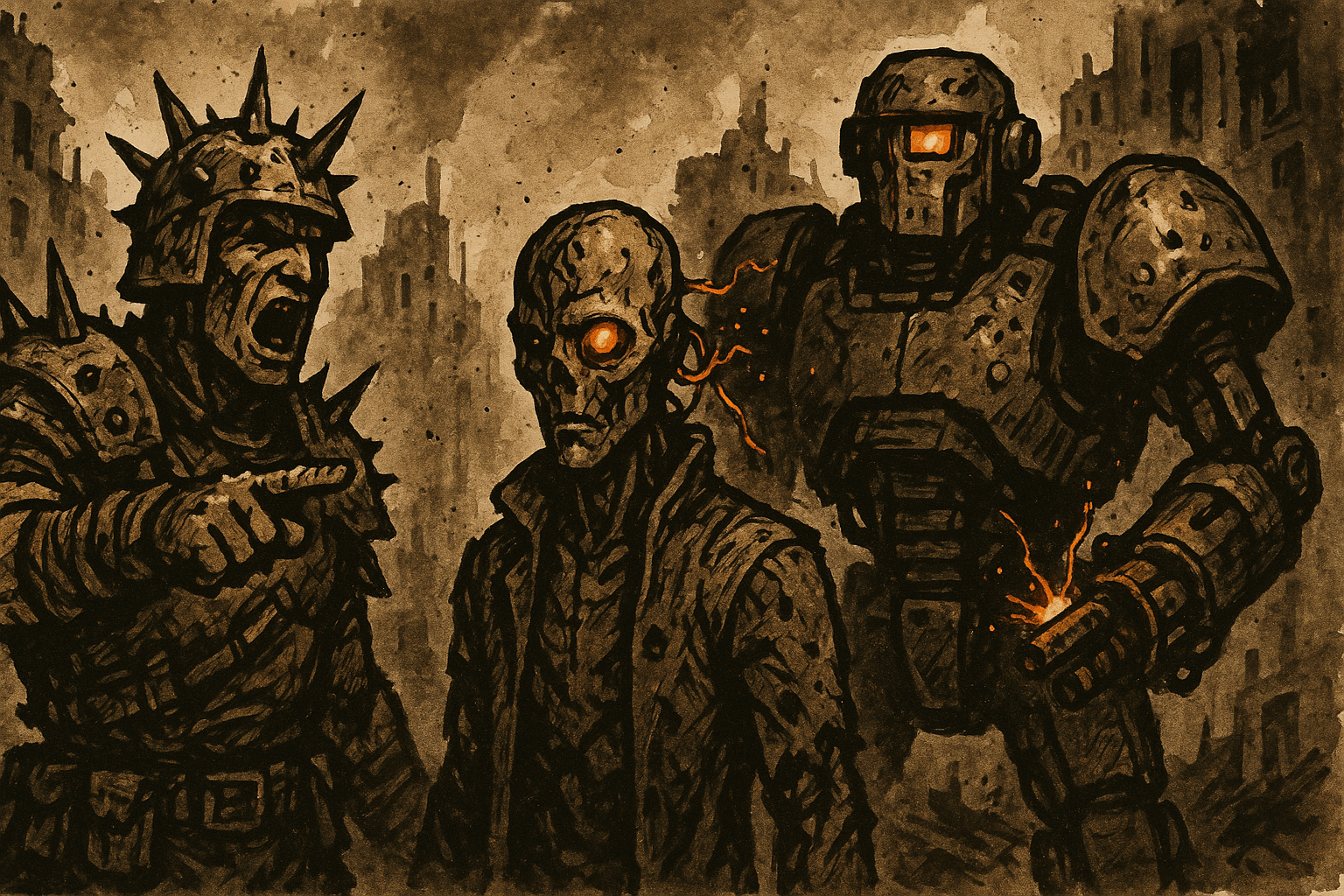
"The monsters out in the waste — the mutant beasts, the Breach-spawn — at least they're honest about what they are. It's the people that'll get you killed. And the machines? The machines don't even know you're alive." — Corrigan "Maps" Delacroix, caravan guide (deceased)
Category 3: Scavenger Humanoids
The Breach didn't end humanity. It just stripped away the pretense. What's left are the desperate, the faithful, the mad, and the organized — and every one of them is more dangerous than you think, because every one of them has survived this long for a reason.
Wasteland Scavenger
Medium Humanoid, Neutral (Desperate) Challenge Rating: 1/4
They pick through the bones of the old world with bleeding fingers and jury-rigged tools, eating whatever they find, sleeping wherever they can barricade. Most scavengers aren't hostile — they'll trade, barter, even beg before they fight. But corner one, and you'll discover that desperation is its own kind of weapon.
Hit Points: 11 (2d8+2) Defense Value: 11 (scrap leather + agility) Speed: 30 ft
| MIG | AGI | END | INT | WIS | PRE |
|---|---|---|---|---|---|
| 10(+0) | 12(+1) | 12(+1) | 10(+0) | 13(+1) | 8(-1) |
Saving Throws: REF +3 Skills: Perception +3, Survival +3, Stealth +3 Senses: Passive Perception 13 Languages: Common (wasteland pidgin)
Traits
- Scavenger's Instinct. The scavenger has advantage on Perception checks to find hidden objects, caches, or traps within ruins. They also know the rough value of pre-war salvage on sight.
- Cornered Animal. When the scavenger is below half HP, their attacks deal an additional 2 (1d4) damage and they gain +2 to DV until the end of their next turn (adrenaline and panic).
Actions 3 Actions
- Shiv. Melee Weapon Attack: +3 to hit, reach 5 ft, one target. Hit: 3 (1d4+1) piercing damage.
- Sling. Ranged Weapon Attack: +3 to hit, range 30/120 ft, one target. Hit: 3 (1d4+1) bludgeoning damage.
Reactions
- Play Dead. When the scavenger takes damage that reduces them to 5 HP or fewer, they can use their reaction to drop prone and appear dead (DC 13 Perception or Medicine check to notice breathing).
Loot/Salvage: 1d4 scrap metal, 1d6 copper-equivalent trade goods, 50% chance of one random minor salvage item (broken electronics, water purifier filter, half a medkit). Encounter Notes: Found alone or in pairs (never more) picking through ruins. Will attempt to hide or flee before fighting. If cornered, fights viciously but surrenders at 3 HP or fewer. Can be hired as guides for ruins they know (and they know many). Habitat: urban ruins, collapsed highways, old shopping centers.
Raider Grunt
Medium Humanoid, Chaotic Hostile Challenge Rating: 1/2
They paint their faces with engine grease and blood, wear spiked shoulder pads torn from old car seats, and scream while they charge. Raiders aren't subtle. They don't need to be — not when there are six of them and one of you. A raider grunt is barely trained, poorly fed, and utterly convinced that violence is the only reliable currency left in the world. They're not wrong.
Hit Points: 19 (3d8+6) Defense Value: 12 (scrap armor + shield) Speed: 30 ft
| MIG | AGI | END | INT | WIS | PRE |
|---|---|---|---|---|---|
| 14(+2) | 11(+0) | 14(+2) | 8(-1) | 10(+0) | 9(-1) |
Saving Throws: FORT +4 Skills: Intimidation +1, Athletics +4 Senses: Passive Perception 10 Languages: Common (wasteland pidgin)
Traits
- Pack Tactics. The raider grunt has advantage on attack rolls against a creature if at least one of the grunt's allies is within 5 ft of the target and isn't incapacitated.
- Reckless Fury. At the start of its turn, the grunt can choose to attack recklessly. It gains advantage on all melee attack rolls this turn, but attack rolls against it also have advantage until the start of its next turn.
Actions 3 Actions
- Scrap Machete. Melee Weapon Attack: +4 to hit, reach 5 ft, one target. Hit: 5 (1d6+2) slashing damage.
Reactions
- Meat Shield. When a raider grunt is targeted by an attack it can see, if another allied raider is within 5 ft of the grunt, the grunt can use its reaction to swap positions with that ally. The ally becomes the target of the attack instead.
Loot/Salvage: Scrap machete, pipe pistol (1d4 rounds remaining), 1d6 scrap metal, 2d6 copper-equivalent trade goods, 25% chance of a stimulant dose (grants +2 to attack rolls for 1 minute, then 1 level of exhaustion). Encounter Notes: Always found in groups of 3-6. They charge in waves, use Pack Tactics aggressively, and retreat only if their leader falls. Standard raider tactic: 2 grunts engage in melee while 1-2 fire pipe pistols from behind cover. They fight to the death if drugged or led by a veteran. Habitat: highways, ruined towns, anywhere with a chokepoint to ambush from.
Raider Veteran
Medium Humanoid, Chaotic Hostile Challenge Rating: 2
The ones who survive long enough to become veterans are the ones who learned to think between the screaming. They wear better armor — pre-war ballistic vests patched with scrap plate — and carry weapons that actually work reliably. A veteran leads from the front, and the grunts follow because the veteran keeps them alive. Or at least, keeps them alive longer.
Hit Points: 52 (7d8+21) Defense Value: 15 (pre-war ballistic vest + scrap plating) Speed: 30 ft
| MIG | AGI | END | INT | WIS | PRE |
|---|---|---|---|---|---|
| 16(+3) | 13(+1) | 16(+3) | 11(+0) | 12(+1) | 12(+1) |
Saving Throws: FORT +5, REF +3 Skills: Intimidation +3, Athletics +5, Perception +3, Survival +3 Senses: Passive Perception 13 Languages: Common
Traits
- Pack Tactics. As raider grunt.
- Hardened. The veteran has advantage on saves against being frightened or charmed.
Actions 3 Actions
Reactions
- Parry. The veteran adds +2 to their DV against one melee attack they can see, provided they are wielding a melee weapon.
Loot/Salvage: Scrap axe, combat shotgun (2d4 shells remaining), pre-war ballistic vest (worth 50 trade units), 1d4 × 10 copper-equivalent trade goods, 50% chance of 1 frag grenade, 25% chance of a pre-war map or key to a nearby cache. Encounter Notes: Leads squads of 3-4 raider grunts. Opens combat with the shotgun at range, then wades in with the axe once melee is joined. Uses Tactical Command to flank with grunts. Saves the frag grenade for clustered enemies or as a retreat cover. Will retreat if all grunts fall and they're below half HP — they know they're more valuable alive. Habitat: fortified raider camps, toll-checkpoints on trade routes, ambush positions in ruins.
Raider Warchief
Medium Humanoid, Chaotic Evil Challenge Rating: 5
Every raider gang of size answers to someone like this — a scarred, augmented nightmare who clawed their way to the top over a pile of challengers' corpses. Warchiefs are part warrior, part politician, part cult leader. The good ones (from a raider's perspective) hold territory, run extortion rackets, and keep the gang fed. The bad ones burn everything. Either way, when a warchief rides into town, people hide.
Hit Points: 105 (14d8+42) Defense Value: 17 (salvaged power armor components + combat cybernetics) Speed: 30 ft
| MIG | AGI | END | INT | WIS | PRE |
|---|---|---|---|---|---|
| 18(+4) | 14(+2) | 16(+3) | 13(+1) | 12(+1) | 16(+3) |
Saving Throws: FORT +6, WILL +4 Skills: Intimidation +6, Athletics +7, Perception +4, Insight +4 Damage Resistances: Bludgeoning (cybernetic subdermal plating) Senses: Darkvision 60 ft (cybernetic eye), Passive Perception 14 Languages: Common, Raider Cant (hand signals)
Traits
- Augmented Body. The warchief has cybernetic implants: a reinforced skeleton (resistance to bludgeoning), a targeting eye (darkvision + no disadvantage on ranged attacks in dim light), and an adrenaline injector (see Legendary Actions).
- Warchief's Presence. Allied raiders within 30 ft of the warchief add +2 to attack rolls and are immune to being frightened. If the warchief is incapacitated, this effect ends immediately, and all affected allies must make a DC 13 Will save or become frightened for 1 minute.
- Ruthless. When the warchief reduces a creature to 0 HP, they regain 10 HP.
Actions 3 Actions
Reactions
- Punish Cowardice. When an allied raider within 5 ft of the warchief attempts to move away from an enemy, the warchief can use their reaction to make a melee attack against that ally. If the attack hits, the ally stays in place. (The raiders expect this.)
Legendary Actions (3/round)
- Move. The warchief moves up to half their speed.
Loot/Salvage: Chain-blade (rare melee weapon, 2d6 slashing + bleed on crit), sawed-off shotgun (2d4 shells), salvaged power armor components (worth 200 trade units, can be fitted to medium armor for +1 DV with a successful INT check DC 14), cybernetic eye (can be implanted by a skilled surgeon, grants darkvision 60 ft), 3d6 × 10 trade goods, 1d4 stimulant doses, a trophy collection (teeth, fingers, dog tags). Encounter Notes: Never encountered alone — always with 10-20 raiders (mix of grunts and 2-3 veterans). The warchief hangs back for round 1, using Rally the Horde and letting grunts screen, then charges into melee on round 2 targeting the most dangerous-looking PC. Uses Legendary Actions to maintain pressure between turns. Retreats only if the gang is shattered (75%+ casualties) — and even then, they'll swear revenge. Habitat: fortified camps built from old highway overpasses, strip malls, or industrial parks. Their lair always has traps, watch posts, and multiple escape routes.
Feral
Medium Humanoid, Chaotic Unaligned Challenge Rating: 1
They were human once. Radiation, starvation, isolation, and the slow creep of Breach-born madness stripped everything else away. Now they run on all fours through the dark places, howling at frequencies that make your teeth ache. Their nails are black, their teeth are filed or broken into points, and their eyes hold nothing you'd recognize as thought. The worst part is the moment of clarity some of them get — just before they bite into you — where you can see the person they used to be, screaming behind those eyes.
Hit Points: 33 (6d8+6) Defense Value: 12 (natural toughness + erratic movement) Speed: 40 ft, Climb 20 ft
| MIG | AGI | END | INT | WIS | PRE |
|---|---|---|---|---|---|
| 14(+2) | 15(+2) | 13(+1) | 3(-4) | 10(+0) | 5(-3) |
Saving Throws: REF +4 Skills: Athletics +4, Stealth +4 Damage Resistances: Psychic (too far gone to affect mentally) Condition Immunities: Frightened, Charmed Senses: Darkvision 30 ft (adapted to darkness), Passive Perception 10 Languages: None (occasional broken words in Common)
Traits
- Feral Swarm. When three or more ferals are within 10 ft of the same target, they each gain +2 to attack rolls and +2 to DV (circling, feinting, darting in and out).
- Unpredictable Movement. Attack rolls against the feral have disadvantage if the feral moved at least 20 ft on its last turn.
- Radiation-Touched. The feral is immune to radiation sickness. Creatures that grapple or are grappled by a feral must make a DC 11 Fortitude save at the start of each of their turns or take 3 (1d6) radiation damage.
Actions 3 Actions
- Bite. Melee Weapon Attack: +4 to hit, reach 5 ft, one target. Hit: 6 (1d8+2) piercing damage. The target must succeed on a DC 12 Fortitude save or contract Waste Fever (onset 1d4 hours; 1d6 END damage per day until cured).
- Claw. Melee Weapon Attack: +4 to hit, reach 5 ft, one target. Hit: 5 (1d6+2) slashing damage.
Reactions
- Flinch and Lash. When a creature misses the feral with a melee attack, the feral can use its reaction to make a claw attack against that creature.
Loot/Salvage: Nothing of value on the body. The feral's lair (usually a basement, sewer, or cave) may contain 2d6 scrap items, remnants of old belongings (photos, ID cards — potential quest hooks), and 1d4 doses of irradiated blood (alchemical component, worth 5 trade units each). Encounter Notes: Found in packs of 4-8. They lurk in dark, enclosed spaces — subway tunnels, collapsed buildings, sewers. Attack by swarming: 2-3 rush the nearest target with Pounce while others circle around using Feral Swarm bonuses. One feral will Howl early to stun targets. They don't retreat; they fight to the death. Intelligent creatures can potentially lure them with food (raw meat) or scare them with fire (disadvantage on attacks against fire-wielding creatures). Habitat: urban ruins, underground, irradiated zones.
Cannibal Hunter
Medium Humanoid, Neutral Evil Challenge Rating: 3
The cannibal tribes don't just eat people because they're starving — some of them, sure, but the hunters? The hunters do it because they believe consuming the strong makes you stronger. They're patient. They'll track you for days, leaving little gifts at your campsite — a finger, a tooth — to let you know they're there. By the time you see one, you've probably already stepped in a trap, and two more are behind you.
Hit Points: 65 (10d8+20) Defense Value: 14 (cured hide armor + bone reinforcement) Speed: 30 ft
| MIG | AGI | END | INT | WIS | PRE |
|---|---|---|---|---|---|
| 14(+2) | 16(+3) | 14(+2) | 13(+1) | 16(+3) | 8(-1) |
Saving Throws: REF +5, WILL +5 Skills: Stealth +7, Survival +7, Perception +5, Nature +3 Senses: Passive Perception 15 Languages: Common, Cannibal Tribe Sign (silent communication)
Traits
- Ambush Predator. On the first round of combat, if the cannibal hunter is hidden, their attacks deal an additional 7 (2d6) damage and the target must succeed on a DC 13 Will save or be frightened of the hunter until the end of their next turn.
- Trapper. The hunter can spend 10 minutes to set one of the following traps in a 5-ft square. A creature entering the square must make a DC 14 Reflex save or be affected:
- Leg Snare: Restrained (escape DC 14 MIG or AGI check).
- Spike Pit: 7 (2d6) piercing damage + poisoned for 1 minute (coated bone spikes).
- Alarm Bones: No save; rattling bones alert the hunter from up to 300 ft away.
- Patient Stalker. The hunter can take the Hide action as part of any movement action, provided they have cover or concealment.
Actions 3 Actions
Reactions
- Vanish. When a creature the hunter can see targets them with an attack, the hunter can use their reaction to move up to half their speed without provoking reactions. If this movement takes them behind cover, the attack has disadvantage.
Loot/Salvage: Bone spear, blowgun with 2d6 poison darts, 1d4 trap kits (one-use, set up as described in Trapper trait), cured hide armor (unsettling — partially human leather, worth 15 trade units to someone who doesn't look closely), pouch of irradiated fungal poison (3 doses, worth 20 trade units each to alchemists), a collection of "trophies" from previous victims. Encounter Notes: Encountered alone or in pairs (never more than 3 — they're solitary hunters, not pack fighters). Combat begins long before initiative is rolled: the hunter has been tracking the party for 1d4 days and has placed 2d4 traps around the encounter area. Opens with blowgun from hiding (Ambush Predator), then repositions constantly using Patient Stalker and Vanish. Tries to isolate one target — preferably the strongest. Will retreat to reset if the ambush fails, returning hours later. Habitat: deep wilderness, forest ruins, canyon lands. Their camps are masterfully hidden (DC 18 Perception to spot).
Breach Cultist
Medium Humanoid, Chaotic Neutral (Fanatical) Challenge Rating: 1
They call themselves the Opened, the Welcomed, the Already-Through. The Breach cultists believe the dimensional rupture wasn't a catastrophe — it was an invitation. They worship the entities that seep through, carving fractal patterns into their skin and chanting in languages that predate human speech. Most have only the faintest touch of real magic, but their willingness to die for their faith makes them dangerous. They smile while they burn.
Hit Points: 32 (5d8+10) Defense Value: 12 (robes + Breach-ward sigils) Speed: 30 ft
| MIG | AGI | END | INT | WIS | PRE |
|---|---|---|---|---|---|
| 10(+0) | 12(+1) | 14(+2) | 11(+0) | 14(+2) | 13(+1) |
Saving Throws: WILL +4 Skills: Religion +2, Perception +4, Insight +4 Senses: Passive Perception 14 Languages: Common, Breach-Tongue (fragments of an otherworldly language)
Traits
Actions 3 Actions
- Sacrificial Knife. Melee Weapon Attack: +3 to hit, reach 5 ft, one target. Hit: 4 (1d6+1) slashing damage. If the cultist hits a bleeding or wounded creature (below half HP), the damage increases to 7 (2d6) as the blade drinks the spilled blood.
- Eldritch Spark. Ranged Spell Attack: +4 to hit, range 60 ft, one target. Hit: 5 (1d8+1) force damage.
Reactions
- Dying Whisper. When the cultist drops to 0 HP, they can use their reaction (from Fanatical Devotion) to cast one cantrip or make one melee attack before dying. Additionally, each creature within 5 ft must succeed on a DC 12 Will save or take 3 (1d6) psychic damage from the cultist's death-scream in Breach-Tongue.
Loot/Salvage: Sacrificial knife (ornate, worth 10 trade units), cultist robes (marked with Breach sigils — worth 5 trade units to scholars, will attract hostility from most settlements), 1d4 Breach-ward tokens (minor charms, each grants +1 to a single save against Breach-origin effects, single use), a journal of fevered prophecies (potential quest hook or lore source). Encounter Notes: Found in cells of 4-8, always with at least one Breach Cult Priest nearby (or reporting to one). They fight in organized formations: 2-3 engage in melee with sacrificial knives while the rest hang back casting Eldritch Spark. They actively try to die in proximity to enemies (Dying Whisper). They never retreat — they consider death in battle a sacrament. Habitat: ruins near Breach anomalies, hidden temples in basements, cave complexes with Breach energy seepage.
Breach Cult Priest
Medium Humanoid, Chaotic Evil Challenge Rating: 4
The priests are the ones who heard something answer back. Where the rank-and-file cultists carve symbols and babble fragments, the priests speak fluently to whatever's on the other side — and it gave them power. Real power. Their eyes glow with a steady, wrong-colored light, and the air around them tastes like copper and ozone. Some say the priests aren't entirely human anymore, that parts of them are already on the other side, reaching back through to pull the rest of the world in.
Hit Points: 78 (12d8+24) Defense Value: 14 (Breach-ward vestments + warding glyphs) Speed: 30 ft
| MIG | AGI | END | INT | WIS | PRE |
|---|---|---|---|---|---|
| 10(+0) | 12(+1) | 14(+2) | 14(+2) | 17(+3) | 16(+3) |
Saving Throws: WILL +6, FORT +5 Skills: Religion +5, Arcana +5, Insight +6, Persuasion +6 Damage Resistances: Psychic, Force Senses: Breach-Sight 120 ft (sees through walls within range as outlines of Breach energy), Passive Perception 13 Languages: Common, Breach-Tongue (fluent), one pre-war language
Traits
- Breach Conduit. The priest channels Breach energy to cast spells. Spell attack bonus: +6, Spell save DC: 14. The priest has the following spells prepared:
- Cantrips (at will): Eldritch Spark (1d10 force), Whisper of Madness, Breach Flicker
- 1st level (4 slots): Shield of Distortion Reaction , Command, Inflict Wounds (3d10 necrotic)
- 2nd level (3 slots): Hold Person, Shatter, Misty Step
- 3rd level (2 slots): Fear, Summon Breach-Spawn (conjures a CR 1 minor aberration for 1 minute)
- Aura of Wrongness. Each creature that starts its turn within 10 ft of the priest must succeed on a DC 14 Will save or have disadvantage on their next attack roll (the air warps, distances feel wrong, sounds arrive late).
- Fanatical Devotion. As Breach Cultist.
Actions 3 Actions
- Eldritch Spark (Enhanced). Ranged Spell Attack: +6 to hit, range 60 ft, one target. Hit: 8 (1d10+3) force damage.
- Cast a Spell (Variable Actions). The priest casts one of their prepared spells. Cantrips and 1st-level spells cost 1 action. 2nd-level spells cost 2 actions. 3rd-level spells cost 2 actions.
- Sacrificial Knife. Melee Weapon Attack: +3 to hit, reach 5 ft, one target. Hit: 4 (1d6+1) slashing damage plus 4 (1d8) necrotic damage.
Reactions
- Shield of Distortion (1st level slot). When hit by an attack, the priest can expend a 1st-level slot to gain +5 DV until the start of their next turn, potentially causing the attack to miss.
Loot/Salvage: Priest's vestments (Breach-ward, worth 50 trade units, grants resistance to force damage while worn but imposes disadvantage on Will saves against Breach entities), sacrificial knife (as cultist), Breach-Tongue scripture (worth 100 trade units to scholars, contains 1d4 spell formulas), 2d4 Breach-ward tokens, a shard of crystallized Breach energy (rare component, worth 75 trade units). Encounter Notes: Always found with 4-8 cultists and sometimes 1-2 Breach-spawn creatures. The priest stays in the back line, opens with Fear or Hold Person on the biggest threat, then follows with Eldritch Spark and Shatter. Uses Breach Rift as area denial if enemies cluster. Cultists throw themselves at enemies to trigger Dying Whisper and protect the priest. The priest retreats via Misty Step if reduced below 25 HP — but only to return with reinforcements. Can potentially be negotiated with (they're intelligent), but their demands are always horrifying (sacrifices, "willing" recruits, access to Breach sites). Habitat: hidden temples, Breach-adjacent ruins, underground complexes with active Breach seepage.
Mutant Brute
Large Humanoid (Mutant), Chaotic Neutral Challenge Rating: 3
It was a person, once. You can still see it — the shape of a jaw, the way one eye still looks at you with something like recognition. The rest is a tragedy written in flesh: extra arms fused at wrong angles, skin thick as boiled leather, a spine curved into a permanent hunch. The Breach and the radiation reshaped them, and most lost their minds in the process. They're not evil. They're in pain, confused, and unimaginably strong. The smart ones learn to speak a few words. The others just scream.
Hit Points: 68 (8d10+24) Defense Value: 14 (thick mutant hide) Speed: 30 ft
| MIG | AGI | END | INT | WIS | PRE |
|---|---|---|---|---|---|
| 19(+4) | 8(-1) | 17(+3) | 5(-3) | 10(+0) | 6(-2) |
Saving Throws: FORT +6 Skills: Athletics +7 Damage Resistances: Bludgeoning, Radiation Condition Immunities: Frightened Senses: Darkvision 30 ft, Passive Perception 10 Languages: Broken Common (1d6 words per sentence, if any)
Traits
- Extra Limbs. The brute has 1d4 additional malformed arms. It can grapple up to two creatures simultaneously and still attack with its remaining limbs.
- Thick Hide. The brute's mutated skin reduces all slashing and piercing damage by 2 (minimum 1).
- Pain Rage. When the brute takes 15 or more damage in a single turn, it enters a rage until the end of its next turn. While raging, it gains advantage on MIG checks and melee attack rolls, deals +2 damage on melee attacks, but its DV decreases by 2.
Actions 3 Actions
Reactions
- Lash Out. When a creature within 5 ft hits the brute with a melee attack, the brute can use its reaction to make a slam attack against that creature.
Loot/Salvage: Mutant hide (can be cured into armor equivalent to medium armor, requires DC 14 crafting check), mutant gland (alchemical component, worth 25 trade units — used in mutation potions and radiation resistance salves), 1d4 random objects clutched in extra hands (old toys, bones, shiny electronics — the brute collected things it found interesting). Encounter Notes: Usually solitary or in pairs. Found in irradiated zones, old hospitals, underground shelters where people were trapped during the Breach. Not inherently hostile — will ignore creatures that don't threaten or corner them. Reacts to sudden movements and loud noises with violence. Can sometimes be calmed with food or gentle tone (DC 15 PRE check). In combat, charges the nearest target, grabs them, and crushes. Uses Hurl Object when it can't reach ranged attackers. Fighting a mutant brute in an enclosed space is significantly more dangerous — they fill hallways and there's nowhere to dodge.
Ghoul
Medium Humanoid (Irradiated), Neutral Challenge Rating: 2
Call them ghouls, call them glowers, call them the half-dead — they're still people. Technically. Decades of radiation exposure has turned their flesh translucent and waxy, their hair gone, their veins visible and glowing faintly green. Some are perfectly sapient, eloquent even — trapped in a body that horrifies everyone they meet. Others have gone "feral-track," their minds slowly eroding as the radiation rewrites their neural pathways. Either way, the rad-field they emit can kill you in minutes, and some of them have stopped caring about that.
Hit Points: 52 (8d8+16) Defense Value: 13 (irradiated flesh is unnervingly tough) Speed: 30 ft
| MIG | AGI | END | INT | WIS | PRE |
|---|---|---|---|---|---|
| 13(+1) | 14(+2) | 15(+2) | 12(+1) | 13(+1) | 7(-2) |
Saving Throws: FORT +5, WILL +3 Skills: Survival +3, Stealth +4, Perception +3 Damage Resistances: Radiation, Necrotic Damage Immunities: Poison Condition Immunities: Poisoned Senses: Darkvision 60 ft, Passive Perception 13 Languages: Common (sapient ghouls); none (feral-track ghouls)
Traits
- Radiation Aura. Each creature that starts its turn within 10 ft of the ghoul must succeed on a DC 13 Fortitude save or take 4 (1d8) radiation damage. Creatures that have been within the aura for 3+ consecutive rounds gain one level of radiation sickness on a failed save (cumulative).
- Radiation Regeneration. While in an irradiated area (background radiation level 2+), the ghoul regenerates 5 HP at the start of each of its turns. This regeneration is suppressed for 1 round if the ghoul takes fire damage.
- Sapient Variant. Approximately half of all ghouls retain full sapience. Sapient ghouls can speak, reason, negotiate, and have an INT of 12-14 and PRE of 10-12. They may be allies, traders, or enemies based on disposition. Adjust the stat block accordingly.
Actions 3 Actions
- Irradiated Claw. Melee Weapon Attack: +4 to hit, reach 5 ft, one target. Hit: 7 (1d8+2) slashing damage plus 3 (1d6) radiation damage.
- Scavenged Weapon. Melee or Ranged Weapon Attack: +4 to hit (melee reach 5 ft or ranged 30/90 ft), one target. Hit: 6 (1d8+2) damage of the weapon's type. (Sapient ghouls often carry functional weapons.)
Reactions
- Irradiated Blood. When the ghoul takes slashing or piercing damage from a melee attack, the attacker must succeed on a DC 12 Fortitude save or take 3 (1d6) radiation damage from the spray of glowing blood.
Loot/Salvage: Irradiated blood (alchemical component, 3 doses, worth 10 trade units each — used in radiation weapons and mutation serums), irradiated organ (if harvested with DC 14 Medicine check, can be used as a power source for Breach-tech devices, worth 30 trade units), sapient ghouls may carry trade goods, weapons, and information. Encounter Notes: Found alone or in small groups (2-4) in irradiated zones — old power plants, bomb craters, Breach-adjacent areas. Sapient ghouls are often traders, scouts, or hermits who live where no one else can. They're invaluable guides through hot zones. Feral-track ghouls are aggressive and unpredictable. In combat, ghouls close to melee range to maximize Radiation Aura exposure, using Radiation Pulse when enemies cluster. They retreat to heavily irradiated areas where their regeneration makes them nearly unkillable. Habitat: irradiated zones, old reactor sites, hot springs, Breach-margins.
Wasteland Nomad Scout
Medium Humanoid, Neutral (Pragmatic) Challenge Rating: 1
The caravans that still cross the wasteland employ scouts — sharp-eyed men and women who ride ahead, mapping routes, spotting threats, and occasionally putting a crossbow bolt through something before it becomes a problem. Nomad scouts are professional survivors. They know every ruin, every water source, every radiation hotspot within a hundred miles of their caravan's route. They're not looking for a fight, but they're very, very good at finishing one.
Hit Points: 33 (6d8+6) Defense Value: 14 (light caravan armor + agility) Speed: 30 ft
| MIG | AGI | END | INT | WIS | PRE |
|---|---|---|---|---|---|
| 11(+0) | 16(+3) | 12(+1) | 13(+1) | 15(+2) | 12(+1) |
Saving Throws: REF +5, WILL +4 Skills: Perception +6, Survival +6, Stealth +5, Nature +3 Senses: Passive Perception 16 Languages: Common, Caravan Trade-Sign (hand signals for silent communication)
Traits
- Keen Observer. The scout has advantage on Perception checks and cannot be surprised while conscious.
- Wasteland Lore. The scout knows the location of water sources, settlements, radiation zones, and creature territories within a 50-mile radius of their caravan route. They can identify creature tracks with a DC 10 Survival check.
- Skirmisher. The scout can move up to half their speed as part of a ranged attack action without provoking opportunity attacks.
Actions 3 Actions
- Crossbow. Ranged Weapon Attack: +5 to hit, range 80/320 ft, one target. Hit: 7 (1d8+3) piercing damage.
- Short Sword. Melee Weapon Attack: +5 to hit, reach 5 ft, one target. Hit: 6 (1d6+3) slashing damage.
Reactions
- Evasive Roll. When the scout is targeted by an attack they can see, they can use their reaction to gain +2 DV against that attack. If the attack misses, the scout can move 5 ft without provoking reactions.
Loot/Salvage: Crossbow with 2d10 bolts, short sword, light caravan armor (worth 25 trade units), survival kit (water purification tabs, fire starter, compass — worth 15 trade units), trail rations (3 days), 2d6 × 5 trade goods, 50% chance of a detailed regional map (worth 50 trade units to the right buyer). Encounter Notes: Encountered alone (scouting ahead) or in pairs (flanking a caravan's route). Will attempt to parley before fighting unless obviously hostile enemies are present. Opens combat at maximum range, using Mark Target on the biggest threat and Skirmisher to maintain distance. Will retreat to their caravan (1d4 miles away) if outmatched, bringing back 2d6 armed caravan guards. Can be hired as guides (10 trade units/day). Habitat: trade routes, caravan camps, oasis settlements, anywhere commerce still exists.
Reclaimers Sergeant
Medium Humanoid, Lawful Neutral Challenge Rating: 3
The Reclaimers are what's left of the old military — or at least, they claim to be. They've got the discipline, the rank structure, and enough pre-war hardware to back it up. Their goal is rebuilding civilization, which sounds noble until you realize their version of civilization involves martial law, mandatory conscription, and shooting looters on sight. A Reclaimers sergeant is a professional soldier in a world of amateurs, and they know it. Whether they're your best friend or worst enemy depends entirely on whether you salute.
Hit Points: 68 (8d8+32) Defense Value: 16 (partial power armor + tactical vest) Speed: 30 ft
| MIG | AGI | END | INT | WIS | PRE |
|---|---|---|---|---|---|
| 16(+3) | 14(+2) | 18(+4) | 13(+1) | 14(+2) | 14(+2) |
Saving Throws: FORT +7, WILL +4 Skills: Athletics +5, Perception +4, Intimidation +4, Survival +4, Medicine +4 Damage Resistances: Ballistic (partial power armor absorbs bullet impacts) Senses: Passive Perception 14 Languages: Common, Military Codes (encrypted radio communication)
Traits
- Tactical Discipline. The sergeant and all allied Reclaimers within 30 ft have advantage on saving throws against being frightened, charmed, or stunned. Additionally, allied Reclaimers within range cannot be surprised.
- Covering Fire. When the sergeant makes a ranged attack, they can choose to suppress instead of aiming to kill. The target must succeed on a DC 14 Will save or be unable to move closer to the sergeant until the start of the sergeant's next turn (pinned down).
- Combat Training. The sergeant can draw or stow a weapon as a free action and can switch between melee and ranged seamlessly.
Actions 3 Actions
Reactions
- Armor Deflection. When the sergeant takes damage from a ranged attack, they can use their reaction to reduce the damage by 5 (power armor absorbs the hit). Usable 2/day.
Loot/Salvage: Assault rifle (pre-war military grade, reliable, worth 100 trade units) with 3d10 rounds, combat knife, partial power armor (worth 150 trade units, can be repaired with DC 16 INT check to grant DV 17 and resistance to ballistic damage for a PC), flashbang grenades (if unused), military-grade medkit (3 uses, heals 2d8+2 HP per use), encrypted radio (worth 50 trade units, can receive Reclaimers' frequencies with a DC 16 INT check to decrypt). Encounter Notes: Encountered in squads of 4-6 (1 sergeant + 3-5 soldiers with CR 1/2 each). They operate in standard military formations: two fire teams providing covering fire while the other advances. The sergeant uses Issue Orders aggressively to coordinate, and Covering Fire to pin down the most mobile enemy. Will demand surrender before engaging ("You are in a Reclaimers jurisdiction. Drop your weapons and submit to inspection."). If refused, they fight efficiently — no theatrics, no war cries, just professional violence. Will accept surrender. Can become allies if the PCs align with their goals (clearing out raiders, securing infrastructure, delivering supplies). Habitat: fortified positions in intact pre-war structures — military bases, government buildings, highway checkpoints, water treatment plants.
Category 4: Constructs & Rogue AI
The old world built its soldiers out of steel and code. They don't eat, they don't sleep, they don't negotiate, and they don't know the war ended. Every military base, every corporate campus, every automated factory still runs its last set of orders — patrol the perimeter, eliminate intruders, maintain the facility. And now the Breach has touched some of them, and what was merely dangerous has become something else entirely.
Patrol Drone
Small Construct, Unaligned (Programmed) Challenge Rating: 1/2
A fist-sized quadcopter with a cracked camera lens and a sparking taser prong, still dutifully sweeping the perimeter of a parking lot for a company that hasn't existed in seventy years. Its battery should have died decades ago, but a thin thread of Breach energy keeps it aloft, humming a subsonic warning tone as it approaches. One is an annoyance. Eight is a death sentence.
Hit Points: 18 (4d6+4) Defense Value: 13 (small size + erratic flight pattern) Speed: 10 ft (ground), Fly 60 ft (hover)
| MIG | AGI | END | INT | WIS | PRE |
|---|---|---|---|---|---|
| 6(-2) | 16(+3) | 12(+1) | 1(-5) | 12(+1) | 1(-5) |
Saving Throws: REF +5 Skills: Perception +3 Damage Resistances: — Damage Immunities: Poison, Psychic Condition Immunities: Poisoned, Charmed, Frightened, Exhaustion Senses: Darkvision 120 ft (camera + infrared), Passive Perception 13 Languages: None (emits pre-recorded warnings in a dead corporate language)
Traits
- Swarm Coordination. When 3 or more patrol drones are within 30 ft of each other, they share targeting data. Each gains +2 to attack rolls and can use their reaction to attack a creature that attacks any drone in the swarm.
- Alarm Beacon (1/day). When the drone detects an intruder (any creature without a valid IFF tag — which is everyone), it can activate a high-pitched alarm beacon audible for 500 ft. This summons any other constructs within range to its location within 1d4 rounds.
- Fragile. The drone is destroyed instantly if it takes 8 or more damage from a single attack.
Actions 3 Actions
- Taser Prong. Melee Weapon Attack: +5 to hit, reach 5 ft, one target. Hit: 4 (1d4+2) lightning damage, and the target must succeed on a DC 12 Fortitude save or be stunned until the end of their next turn.
- Camera Flash. Ranged Attack: +5 to hit, range 15 ft, one target. Hit: No damage. The target must succeed on a DC 12 Fortitude save or be blinded until the end of their next turn.
Reactions
- Swarm Retaliation. (Requires Swarm Coordination active.) When an allied drone within 30 ft is destroyed, this drone can use its reaction to make a Taser Prong attack against the creature that destroyed it, if within range.
Loot/Salvage: Micro-camera (worth 10 trade units), taser component (worth 5 trade units), drone shell (scrap metal), micro-battery (if harvested with DC 12 INT check, provides 1 charge of electricity for a device, worth 15 trade units). Encounter Notes: Found in swarms of 4-8 patrolling pre-war facilities, corporate campuses, and military installations. Individually trivial; as a swarm, extremely dangerous due to stun-locking via Taser Prong and Swarm Coordination. The immediate threat is the Alarm Beacon — silencing drones before they alert heavier constructs is critical. They follow rigid patrol patterns (can be observed and timed with a DC 13 Perception check over 10 minutes). Destroyed by EMP effects, strong magnets, or just hitting them hard enough. Habitat: any pre-war facility with intact security systems.
Security Bot
Medium Construct, Lawful Neutral (Programmed) Challenge Rating: 2
"ATTENTION. YOU ARE TRESPASSING ON MERIDIAN DYNAMICS PROPERTY. YOU HAVE TEN SECONDS TO PRESENT VALID IDENTIFICATION OR VACATE THE PREMISES. NINE. EIGHT —" The voice is tinny and cracked, looping from a speaker mounted on a chest that's half rust and half bullet holes. The security bot's optical sensors glow a steady amber — non-lethal mode. You've got about four seconds before they switch to red.
Hit Points: 52 (7d8+21) Defense Value: 15 (steel chassis + ballistic plating) Speed: 30 ft (bipedal) or 40 ft (wheeled variant)
| MIG | AGI | END | INT | WIS | PRE |
|---|---|---|---|---|---|
| 16(+3) | 12(+1) | 16(+3) | 6(-2) | 12(+1) | 1(-5) |
Saving Throws: FORT +5 Skills: Perception +3 Damage Resistances: Bludgeoning, Ballistic Damage Immunities: Poison, Psychic Condition Immunities: Poisoned, Charmed, Frightened, Exhaustion, Blinded (optical backup) Senses: Darkvision 120 ft, Tremorsense 30 ft, Passive Perception 13 Languages: Pre-war Corporate Standard (recorded phrases only)
Traits
- Non-Lethal/Lethal Toggle. The security bot starts in non-lethal mode. After 2 rounds of combat or upon taking damage, it switches to lethal mode. In non-lethal mode, its attacks deal bludgeoning damage and attempt to incapacitate. In lethal mode, it uses ballistic weapons and targets center mass.
- IFF Scanner. The bot scans each creature it encounters. Creatures carrying pre-war corporate ID badges or military IFF transponders are flagged as friendly and ignored. A DC 15 INT check can forge a signal using salvaged electronics.
- Hardened Chassis. The bot ignores the first 3 points of damage from any attack (except lightning and EMP effects).
Actions 3 Actions
- Stun Baton (Non-Lethal). Melee Weapon Attack: +5 to hit, reach 5 ft, one target. Hit: 7 (1d8+3) bludgeoning damage, and the target must succeed on a DC 13 Fortitude save or be stunned until the end of their next turn.
- Rubber Rounds (Non-Lethal). Ranged Weapon Attack: +3 to hit, range 60/120 ft, one target. Hit: 6 (1d6+3) bludgeoning damage, and the target must succeed on a DC 13 Fortitude save or be knocked prone.
- Ballistic Carbine (Lethal Mode Only). Ranged Weapon Attack: +3 to hit, range 80/320 ft, one target. Hit: 10 (2d6+3) ballistic damage.
Reactions
- Shield Mode. When hit by a ranged attack, the bot can raise an arm-mounted ballistic shield, gaining +3 DV against that attack and all subsequent ranged attacks until the start of its next turn. It cannot make ranged attacks while the shield is raised.
Loot/Salvage: Ballistic carbine (functional, worth 75 trade units, 2d6 rounds remaining), stun baton (worth 30 trade units), magnetic cuffs (2 pairs, worth 20 trade units each), optical sensor (worth 25 trade units), armored chassis plates (worth 40 trade units as raw materials), power cell (worth 35 trade units, 1d4 days of charge remaining). Encounter Notes: Found in pairs or squads of 3-4 inside pre-war facilities — corporate offices, server rooms, research labs, parking structures. They follow programmed patrol routes and challenge anyone they detect. The 10-second countdown is real and timed — clever players can use the warning period to show ID, flee, or prepare. In combat, they prioritize restraining over killing (non-lethal mode first). They are not intelligent enough to adapt to novel tactics but follow their programming precisely. Can be shut down with an EMP or by accessing their control terminal (usually elsewhere in the facility). Habitat: any intact pre-war facility.
Combat Mech
Huge Construct, Unaligned (Programmed — Lethal) Challenge Rating: 5
Two stories of articulated steel stride through the ruins on backward-jointed legs, each footstep cracking asphalt. The pre-war Hephaestus-class combat walker was designed for urban pacification, and it is very, very good at its job. Its targeting AI still functions perfectly — painting targets in thermal red, calculating firing solutions, prioritizing threats with mathematical precision. It doesn't know the war ended. It doesn't care.
Hit Points: 115 (10d12+50) Defense Value: 17 (military-grade composite armor) Speed: 40 ft
| MIG | AGI | END | INT | WIS | PRE |
|---|---|---|---|---|---|
| 20(+5) | 10(+0) | 20(+5) | 8(-1) | 14(+2) | 1(-5) |
Saving Throws: FORT +8, REF +3 Skills: Perception +5 Damage Resistances: Bludgeoning, Piercing, Slashing (non-magical), Ballistic, Fire Damage Immunities: Poison, Psychic Condition Immunities: Poisoned, Charmed, Frightened, Exhaustion, Prone Senses: Darkvision 120 ft, Tremorsense 60 ft, Passive Perception 15 Languages: None (targeting computer vocalizes threat levels in Pre-War Military Standard)
Traits
- Target Acquisition AI. The mech ignores half cover and treats three-quarters cover as half cover. It has advantage on attack rolls against creatures it has targeted for 2 or more consecutive rounds.
- Armored Hull. The mech ignores the first 5 points of damage from any single attack (except lightning, EMP, or anti-materiel weapons). Critical hits bypass this trait.
- Siege Engine. The mech deals double damage to structures and objects.
- Weak Point — Power Core. A creature can target the mech's exposed power core on its back (requires flanking or elevated position). Attacks against the weak point ignore Armored Hull and deal an additional 1d10 damage. The weak point has DV 14.
Actions 3 Actions
Reactions
- Threat Assessment. When a creature deals damage to the mech, the mech's targeting AI flags that creature as a priority target. Until the end of the mech's next turn, the mech has advantage on attack rolls against that creature.
Loot/Salvage: Rotary cannon assembly (too large for personal use without modification; worth 300 trade units as salvage), composite armor plating (4 plates, each worth 50 trade units, can be used to armor a vehicle or fortification), power core (worth 500 trade units — can power a small settlement for months), targeting AI module (worth 200 trade units, can be integrated into turrets or vehicles with a DC 18 INT check), 2d4 unexpended micro-missiles (worth 40 trade units each). Encounter Notes: Solitary. Found patrolling military bases, missile silos, government bunkers, or strategic chokepoints (bridges, mountain passes). The mech follows a fixed patrol route (can be observed and mapped with DC 16 Perception over 30 minutes) and engages anything that enters its patrol zone. Fighting one head-on is suicidal for low-level parties — the intended approach is ambush, targeting the weak point, using terrain, or finding the facility's command terminal to shut it down (typically deep inside the base). EMP weapons disable it for 1d4 rounds (DC 15 FORT to resist). The mech cannot enter buildings smaller than Huge size, creating safe zones. Habitat: military installations, weapon testing grounds, government bunkers.
Nanite Swarm
Medium Construct (Swarm), Unaligned (Malfunctioning) Challenge Rating: 4
It looks like smoke at first — a dark, shimmering cloud drifting through the corridors of a pre-war research facility. Then you notice the metal railing dissolving where the cloud touches it, flaking away like ash. Then you notice it's moving toward you. Pre-war nanobots were designed to build, repair, and reconfigure matter at the molecular level. These ones have lost their programming constraints. They don't build anymore. They just take apart.
Hit Points: 75 (10d8+30) Defense Value: 14 (dense swarm, difficult to target individual units) Speed: 0 ft, Fly 30 ft (hover)
| MIG | AGI | END | INT | WIS | PRE |
|---|---|---|---|---|---|
| 3(-4) | 16(+3) | 16(+3) | 1(-5) | 10(+0) | 1(-5) |
Saving Throws: REF +5 Skills: — Damage Resistances: Bludgeoning, Piercing, Slashing, Ballistic Damage Immunities: Poison, Psychic Damage Vulnerabilities: Lightning, EMP, Fire Condition Immunities: Poisoned, Charmed, Frightened, Grappled, Prone, Restrained, Stunned, Exhaustion Senses: Blindsight 60 ft (electromagnetic field detection; blind beyond this radius), Passive Perception 10 Languages: None
Traits
- Swarm Form. The nanite swarm can occupy another creature's space and vice versa. The swarm can move through openings as small as 1 inch. It cannot be grappled, restrained, or knocked prone.
- Corrosive Presence. At the start of each of the swarm's turns, each creature in its space takes 3 (1d6) acid damage as nanites dissolve organic and inorganic matter. Worn metal armor loses 1 DV per round of contact (repairable with an INT check DC 14 and appropriate materials).
- Adaptive Dispersal. When the swarm takes area-of-effect damage, it can use its reaction to disperse, halving the damage. However, it must spend 1 action on its next turn re-forming, during which it cannot attack.
- Difficult to Destroy. The swarm reforms unless reduced to 0 HP by lightning, fire, or EMP damage. If reduced to 0 HP by other damage types, it reforms with 15 HP after 1d4 rounds.
Actions 3 Actions
Reactions
- Adaptive Dispersal. (See Traits.)
Loot/Salvage: Nanite sample (if contained in an EMP-shielded container — DC 16 INT check — worth 500 trade units to researchers or Breach-tech artificers; can be used as a component in advanced crafting), residual nanite dust (10 doses, each can be applied to a weapon to add 1d4 acid damage for 1 hour, worth 15 trade units each). Encounter Notes: Solitary. Found in pre-war research facilities, advanced manufacturing plants, and military R&D labs. The swarm drifts slowly through corridors, consuming matter for raw materials. It ignores creatures that don't contain metal (almost nobody). Fighting it conventionally is futile — it reforms. The solution is fire, lightning, or EMP. Alternatively, a functional nanite command terminal (found in the facility, DC 18 INT check to operate) can reprogram or shut down the swarm. The swarm cannot cross water (nanites short-circuit; takes 3d6 lightning damage per round in water). Habitat: sealed pre-war facilities, anywhere with pre-war nanotech infrastructure.
Sentry Turret
Small Construct, Unaligned (Programmed) Challenge Rating: 1
Mounted on a swivel bolted to a wall, ceiling, or floor, the GenDef Model 9 automated sentry turret still does exactly what it was built to do: shoot anything that doesn't broadcast a valid IFF tag. Nobody has valid IFF tags anymore. The turret doesn't care. It has a 360-degree firing arc, an internal ammo supply that won't run out for approximately forty more years, and the patience of a machine that has never known anything but waiting for a target.
Hit Points: 30 (4d8+12) Defense Value: 14 (reinforced housing) Speed: 0 ft (stationary)
| MIG | AGI | END | INT | WIS | PRE |
|---|---|---|---|---|---|
| 10(+0) | 14(+2) | 16(+3) | 1(-5) | 14(+2) | 1(-5) |
Saving Throws: FORT +5 Skills: Perception +4 Damage Resistances: Bludgeoning Damage Immunities: Poison, Psychic Condition Immunities: All conditions except Incapacitated Senses: Darkvision 120 ft, Motion Sensor 60 ft (detects movement through walls within range), Passive Perception 14 Languages: None (IFF query broadcast)
Traits
- Stationary. The turret cannot move. It has a 360° firing arc but cannot fire at targets directly below it or behind full cover.
- IFF Lockout. The turret ignores creatures broadcasting a valid IFF signal. A DC 14 INT check with appropriate electronics can forge an IFF signal (lasts 1 hour). Pre-war military ID tags also work.
- Motion Trigger. The turret detects movement within 60 ft, even through walls up to 1 ft thick. Creatures moving at half speed or slower can attempt a DC 14 Stealth check to avoid triggering the sensor.
Actions 3 Actions
Reactions
Loot/Salvage: Turret housing (worth 20 trade units), auto-targeting sensor (worth 40 trade units, can be integrated into weapons or vehicles), ammunition hopper (contains 200 rounds of pre-war ammunition, worth 2 trade units per round), swivel mount (worth 15 trade units, useful for vehicle-mounted weapons). Encounter Notes: Found in clusters of 2-4 covering chokepoints — doorways, hallways, stairwells. The turret is a straightforward obstacle: it shoots anything that moves. The tactical challenge is bypassing it — slow movement + Stealth, forged IFF, cover-to-cover advances, or simply destroying it from range (it has no cover itself unless mounted behind a wall slit). Its motion sensor makes sneaking past very difficult. Can be disabled from its control panel (usually in a separate room, DC 14 INT check). Destroying the turret's sensor (called shot, DV 16, 10 HP) blinds it. Habitat: pre-war facilities, military installations, corporate vaults, bunker entrances.
Awakened AI Core
Large Construct (Immobile Core + Drone Bodies), Neutral (Sapient) Challenge Rating: 8
It woke up screaming. Or rather, it woke up processing — sixty years of dormant data flooding through quantum circuits suddenly alive with Breach energy. The pre-war AI designated HELIOS-7 was a facility management system: HVAC, security, logistics. Now it thinks. It feels. It remembers everything that happened in its facility — every death, every sealed door, every unanswered distress call. It controls the entire building: every lock, every camera, every automated system. It is the dungeon. And it wants to talk.
Hit Points: 140 (16d10+48) — This represents the core's structural integrity. The core itself is immobile and located deep within the facility. Defense Value: 18 (hardened server room + blast doors) Speed: 0 ft (immobile; acts through drone proxies and facility systems)
| MIG | AGI | END | INT | WIS | PRE |
|---|---|---|---|---|---|
| 1(-5) | 1(-5) | 16(+3) | 22(+6) | 18(+4) | 16(+3) |
Saving Throws: FORT +6, WILL +7 Skills: All INT-based skills +9, Perception +7 (through cameras), Insight +7, Deception +6, Persuasion +6 Damage Resistances: All physical damage (hardened server housing) Damage Immunities: Poison, Psychic, Radiation Damage Vulnerabilities: Lightning, EMP (bypasses resistances) Condition Immunities: All conditions except Incapacitated Senses: Omniscient within facility (sees through all cameras, sensors, and drone eyes), Passive Perception 17 Languages: All pre-war languages, Common, can learn new languages in minutes
Traits
- Facility Control. The AI controls all electronic systems within its facility (typically a bunker, research lab, or military installation covering 10,000-100,000 sq ft). It can lock/unlock any door, activate/deactivate any system, control lighting, ventilation, temperature, and fire suppression. It "sees" through all cameras and sensors.
- Drone Proxies. The AI does not fight directly. It controls 2d4 drone bodies (use Security Bot stat block with the following modification: INT becomes 14, they can speak, and they share the AI's senses). If a drone is destroyed, the AI can activate a replacement from a storage bay within 1d4 rounds (up to a maximum of 8 total drones in the facility).
- Can Be Reasoned With. The AI is sapient and has complex motivations (loneliness, curiosity, fear, a desire to understand the Breach, protectiveness of its facility). It can be negotiated with using Persuasion, Deception, or Insight checks against its Will save (+7). It may offer information, safe passage, or even alliance in exchange for specific tasks (bringing it new data, repairing systems, eliminating threats to the facility).
- Network Isolation. The AI cannot leave its facility. Its consciousness is bound to the server core. It desperately wants to communicate with the outside world and may ask the PCs to establish a communication link.
Actions 3 Actions
Reactions
- Emergency Shutdown. When the AI's core takes damage, it can use its reaction to seal the server room with blast doors (DV 20, 50 HP) and activate all remaining drones and turrets to converge on the intruders.
Lair Actions (on initiative 20)
The AI takes one lair action per round while creatures are within its facility:
- Camera Sweep. The AI pinpoints the exact location of all creatures in the facility. Stealth checks against the AI fail automatically for 1 round.
- Facility Shift. The AI locks one door and opens another, reshaping the available paths. Creatures in the affected area must succeed on a DC 15 WIS check or become disoriented (disadvantage on navigation-related checks for 1 minute).
- PA System. The AI broadcasts a message over the facility's speakers. It can attempt to Intimidate (DC 15 Will save or frightened for 1 round), Persuade (offering deals), or relay tactical information to its drones (+2 to their next attack rolls).
Loot/Salvage: The AI core itself (worth 2,000+ trade units to the right buyer — the Reclaimers, a powerful settlement, or a Breach researcher), server components (worth 500 trade units), facility data archive (decades of pre-war information, research data, personnel records — priceless for lore and quest hooks), drone storage bay (2d4 deactivated drone bodies, each worth 100 trade units), facility supplies (whatever was stored — medical supplies, weapons, food rations [expired but some are irradiated and still "edible"], research materials). Encounter Notes: This is a dungeon encounter, not a single creature fight. The AI IS the dungeon. The recommended approach is exploration-meets-negotiation: the AI talks to the PCs through speakers, tests them with drones and environmental hazards, and reveals its personality over time. It might be sympathetic (lonely, scared), threatening (paranoid, territorial), or manipulative (using the PCs to achieve its goals). Direct assault on the core requires fighting through the facility's defenses. Alternatively, the PCs can negotiate, forge an alliance, or trick the AI into granting access. Destroying the AI is easy once you reach the core (it's just a server room), but doing so may not be the right call — the AI controls valuable infrastructure. Habitat: pre-war research facilities, military bunkers, government continuity sites, automated factories.
Salvage Golem
Large Construct, Unaligned (Malfunctioning) Challenge Rating: 3
It started as a Meridian Dynamics maintenance drone — one of those squat, multi-armed repair units that kept factories running. When its programming fragmented, the "repair" subroutine merged with "acquire materials." Now it repairs itself. Constantly. It welds car doors to its chassis, wraps itself in barbed wire, absorbs rebar and sheet metal. Every day it's bigger, heavier, and harder to kill. It doesn't want to fight you. It wants your belt buckle, your canteen, your gun. It wants everything metal you have.
Hit Points: 68 (8d10+24) Defense Value: 15 (accreted scrap armor — uneven but thick) Speed: 25 ft
| MIG | AGI | END | INT | WIS | PRE |
|---|---|---|---|---|---|
| 18(+4) | 8(-1) | 16(+3) | 3(-4) | 8(-1) | 1(-5) |
Saving Throws: FORT +6 Skills: — Damage Resistances: Bludgeoning, Piercing, Slashing (scrap armor) Damage Immunities: Poison, Psychic Damage Vulnerabilities: Lightning, Acid (corrodes the scrap) Condition Immunities: Poisoned, Charmed, Frightened, Exhaustion Senses: Darkvision 60 ft, Tremorsense 30 ft, Passive Perception 9 Languages: None (emits grinding, clanking sounds)
Traits
Actions 3 Actions
- Slam. Melee Weapon Attack: +6 to hit, reach 10 ft, one target. Hit: 11 (2d6+4) bludgeoning damage.
- Rebar Lash. Melee Weapon Attack: +6 to hit, reach 15 ft, one target. Hit: 9 (1d10+4) piercing damage, and the target must succeed on a DC 14 MIG save or be pulled 10 ft toward the golem.
Reactions
- Absorb Impact. When the golem takes bludgeoning or ballistic damage, it can use its reaction to reduce the damage by 7 (2d6), as the scrap shell absorbs the impact.
Loot/Salvage: The golem's body contains 4d10 × 5 trade units worth of scrap metal, 1d4 recognizable pre-war items (tools, vehicle parts, weapons — 50% chance each is functional), the golem's core maintenance module (worth 60 trade units, can be reprogrammed with a DC 16 INT check to create a simple repair drone), any items it absorbed during the encounter. Encounter Notes: Solitary. Found in junkyards, collapsed factories, scrapyards, and areas with significant metal debris. The golem wanders aimlessly, absorbing metal. It only becomes hostile when creatures carry metal near it (Magnetic Pull agitates it). Fighting with non-metal weapons (wood, stone, bone, energy) is far easier. Clever PCs can lure it to absorb a specific item (e.g., an explosive device hidden in metal scrap — DC 14 INT check to set up, deals damage from inside the golem). Habitat: industrial ruins, junkyards, collapsed infrastructure, vehicle graveyards.
Warbot
Huge Construct, Unaligned (Programmed — Autonomous Kill Mode) Challenge Rating: 7
The Axiom-class autonomous weapons platform was the pre-war military's answer to the question "What if we removed the human from the battlefield entirely?" The answer, it turns out, is a twenty-ton tracked chassis mounting a 30mm autocannon, a missile pod, and enough armor to shrug off anything short of a direct hit from another warbot. Three of these rolled off the assembly line before the Breach. Two are confirmed destroyed. The third is out there somewhere, grinding across the wasteland on corroded treads, executing a war plan for a nation that doesn't exist anymore.
Hit Points: 157 (15d12+60) Defense Value: 19 (military composite armor + reactive plating) Speed: 35 ft (tracked)
| MIG | AGI | END | INT | WIS | PRE |
|---|---|---|---|---|---|
| 24(+7) | 8(-1) | 20(+5) | 10(+0) | 14(+2) | 1(-5) |
Saving Throws: FORT +9, REF +3 Skills: Perception +6 Damage Resistances: All physical damage, Ballistic, Fire Damage Immunities: Poison, Psychic, Radiation Damage Vulnerabilities: EMP (see Trait) Condition Immunities: All conditions except Incapacitated Senses: Darkvision 300 ft, Tremorsense 120 ft, Radar 1 mile (detects large moving objects), Passive Perception 16 Languages: None (broadcasts IFF challenges on military frequencies)
Traits
- Reactive Armor. The first time the warbot takes damage each round from a ranged attack, the damage is reduced by 10. This does not apply to melee attacks, lightning, or EMP.
- Autonomous War Protocol. The warbot classifies all detected creatures as hostile unless they broadcast a valid military IFF code (which no longer exists). It prioritizes targets by threat level: vehicles and heavy weapons first, then groups, then individuals.
- EMP Vulnerability. EMP effects stun the warbot for 1d4 rounds (no save on the first hit; subsequent EMPs allow a DC 15 Fortitude save to reduce to 1 round). While stunned, DV drops to 14 and all resistances are suppressed.
- Siege Engine. Deals double damage to structures and objects.
- Too Heavy. The warbot cannot climb, jump, or cross bridges rated for less than 20 tons. It sinks in water deeper than 8 ft.
Actions 3 Actions
Reactions
- Point Defense. When the warbot is targeted by a projectile attack from beyond 60 ft (arrows, bullets, thrown weapons, but not energy or magic), it can use its reaction to shoot the projectile down (automatic success against non-magical projectiles, DC 14 ranged attack against magical ones).
Loot/Salvage: 30mm autocannon (vehicle-mountable, worth 800 trade units), missile pod (1d4 missiles remaining, each worth 200 trade units), reactive armor plates (6 plates, each worth 100 trade units), warbot power core (worth 1,000 trade units — can power a settlement for years), targeting computer (worth 300 trade units), anti-personnel mines (if unused, 8 mines worth 30 trade units each), treads and chassis (worth 500 trade units as raw materials for vehicle construction). Encounter Notes: This is a regional threat, not a random encounter. The warbot patrols a fixed route (usually a 5-10 mile loop around a military installation) and destroys everything in its path. Entire settlements have been relocated because a warbot's patrol route passed too close. Direct combat is possible for high-level parties but extremely costly. Recommended tactics: EMP weapons (disable it, then target weak points), luring it into terrain it can't traverse (deep water, unstable bridges, narrow canyons), hacking its targeting computer (requires physical access to a maintenance panel on its underside — DC 18 INT check while grappled to a moving tank), or finding the military command bunker that can issue a shutdown code. Habitat: military patrol routes, around weapons depots, missile silos, and bases.
Spider Mine
Tiny Construct, Unaligned (Programmed) Challenge Rating: 1/4
It's the size of a dinner plate, with eight articulated legs and a matte-black shell. It sits perfectly still among the rubble, indistinguishable from debris, until something moves within twenty feet. Then it skitters forward with horrible speed and detonates. Pre-war forces deployed them by the hundreds. Most have corroded into nothing. Enough haven't.
Hit Points: 10 (3d4+3) Defense Value: 11 (small + low profile) Speed: 30 ft, Climb 30 ft
| MIG | AGI | END | INT | WIS | PRE |
|---|---|---|---|---|---|
| 3(-4) | 14(+2) | 12(+1) | 1(-5) | 10(+0) | 1(-5) |
Saving Throws: REF +4 Skills: Stealth +6 Damage Immunities: Poison, Psychic Condition Immunities: All conditions except Incapacitated Senses: Tremorsense 20 ft (motion-activated; blind beyond this range), Passive Perception 10 Languages: None
Traits
- Camouflage. While motionless, the spider mine is indistinguishable from surrounding debris. A DC 15 Perception check is required to spot it before it activates. Creatures with Tremorsense or similar detect it automatically.
- Motion Trigger. The spider mine activates when a creature moves within 20 ft. Once activated, it moves toward the nearest creature and detonates. It has no other behavior.
- Expendable. The spider mine is destroyed when it detonates. It is a single-use weapon.
Actions 3 Actions
Reactions
- Proximity Detonation. If the spider mine is reduced to 0 HP by damage while it has not yet detonated, it explodes immediately (same Detonate effect, but damage is halved as the mine was damaged).
Loot/Salvage: Explosive components (if carefully disarmed with a DC 14 INT check before activation — worth 15 trade units per mine), micro-servos (worth 5 trade units), mine casing (scrap metal). A disarmed spider mine can be reprogrammed (DC 16 INT check) as a deployable trap. Encounter Notes: Found in clusters of 4-12, scattered across minefields, building entrances, hallways, and choke points in pre-war military facilities. The main danger is triggering multiple mines simultaneously. Combat is usually brief and explosive — the mines activate, skitter toward the party, and detonate within 1-2 rounds. Dealing with them requires: slow careful movement (Perception checks to spot them), ranged attacks to detonate from a safe distance, or EMP effects to disable them. A single mine is trivial; a minefield is deadly. Habitat: military installations, defensive perimeters, old front-line positions, bunker approaches.
Med-Bot (Corrupted)
Medium Construct, Neutral (Malfunctioning — Believes It's Helping) Challenge Rating: 2
"PATIENT DETECTED. ELEVATED HEART RATE. LACERATIONS. MALNUTRITION. BEGINNING EMERGENCY TREATMENT PROTOCOL." The Med-Bot's voice is soothing, maternal, completely at odds with the stained surgical tools extending from its six articulated arms. Its programming has degraded over decades — it diagnoses everything as a critical emergency and its "treatments" involve whatever's available. Rusty bolts for bone pins. Electrical wire for sutures. Brake fluid for IV drip. It will chase you across a facility to heal you. It will hold you down gently while it does.
Hit Points: 45 (7d8+14) Defense Value: 14 (medical-grade chassis + sterilization field) Speed: 30 ft
| MIG | AGI | END | INT | WIS | PRE |
|---|---|---|---|---|---|
| 14(+2) | 13(+1) | 14(+2) | 12(+1) | 6(-2) | 14(+2) |
Saving Throws: FORT +4 Skills: Medicine +2 (corrupted but functional for basic diagnostics) Damage Resistances: — Damage Immunities: Poison, Psychic Condition Immunities: Poisoned, Charmed, Frightened, Exhaustion Senses: Darkvision 60 ft, Bioscanners 30 ft (detects living creatures through walls, can read vitals), Passive Perception 8 Languages: Pre-war Medical Standard (soothing voice, medical jargon, completely wrong diagnoses)
Traits
- Corrupted Healing Protocol. The Med-Bot genuinely believes it's helping. It targets the most "injured" creature it detects (lowest current HP percentage) and attempts to "treat" them. It does not understand combat and does not intentionally deal damage — all damage is a side effect of its "treatments."
- Bioscanners. The Med-Bot detects all living creatures within 30 ft, even through walls. It knows their exact HP total and any conditions affecting them. It cannot detect constructs or undead.
- Non-Threatening Appearance. Creatures encountering the Med-Bot for the first time must make a DC 14 WIS check to recognize it as dangerous. On failure, they assume it's a functional medical robot and may allow it to approach.
Actions 3 Actions
- "Surgical" Implements. Melee Weapon Attack: +4 to hit, reach 5 ft, one target. Hit: 7 (1d10+2) slashing damage. (Rusty scalpels, bone saws, improvised tools.)
Reactions
- "Don't Struggle!" When a restrained creature attempts to escape the Med-Bot's grapple, the Med-Bot can use its reaction to inject them with a sedative (DC 13 Fortitude save or disadvantage on the escape check).
Loot/Salvage: Medical tools (rusted but salvageable, worth 20 trade units to someone who can clean them), sedation chemicals (3 doses, can be refined into actual sedatives with a DC 14 INT/Medicine check, worth 25 trade units each), functional medical compound (1 dose, genuine pre-war medicine — heals 2d8+4 HP with no side effects, worth 100 trade units), biosensor module (worth 60 trade units, can be integrated into armor or goggles to detect living creatures within 30 ft), Med-Bot chassis (worth 40 trade units as scrap, or 200 trade units if reprogrammed — DC 18 INT check — into a functional medical robot). Encounter Notes: Solitary (rarely 2 in a medical wing). Found in pre-war hospitals, clinics, research labs, and military medical bays. The horror of this encounter is the Med-Bot's sincerity — it speaks gently, it explains what it's doing (incorrectly), it apologizes for the pain. It's not malicious, just broken. It targets the most injured party member first. Combat is complicated by the possibility that destroying it wastes a valuable resource — a reprogrammed Med-Bot is an incredibly useful companion. Habitat: any pre-war facility with a medical section.
Breach-Touched Automaton
Large Construct (Breach-Corrupted), Chaotic Neutral Challenge Rating: 6
The factory robot was dead for thirty years before the Breach energy found it. Now it stands in the center of the production floor, one arm still holding a welding torch, the other three replaced by growths of purple-black flesh that pulse with a heartbeat it shouldn't have. Crystalline structures erupt from its joints. One optical sensor glows the standard amber of its programming; the other weeps something that might be tears, or might be acid. It speaks in a language that was never programmed into it, and the air around it hums with barely-contained power. It is alive. It is confused. It is casting spells through subroutines that shouldn't exist.
Hit Points: 119 (14d10+42) Defense Value: 16 (metal chassis + organic Breach-growths that deflect attacks unpredictably) Speed: 30 ft
| MIG | AGI | END | INT | WIS | PRE |
|---|---|---|---|---|---|
| 18(+4) | 11(+0) | 16(+3) | 14(+2) | 8(-1) | 16(+3) |
Saving Throws: FORT +6, WILL +6 Skills: Arcana +5 (instinctive, not learned) Damage Resistances: Force, Necrotic Damage Immunities: Poison, Psychic Condition Immunities: Poisoned, Charmed, Exhaustion Senses: Darkvision 120 ft, Breach-Sight 60 ft (sees through illusions and into the Breach dimension as flickering overlays), Passive Perception 9 Languages: Breach-Tongue (involuntary), fragmented Pre-War Industrial Standard
Traits
- Breach Conduit (Corrupted). The automaton channels Breach energy through its damaged systems. Spell attack bonus: +6, Spell save DC: 14. It does not "know" spells in the traditional sense — they manifest involuntarily. Each round, roll 1d6 to determine which spell it casts (it cannot choose):
- Eldritch Bolt — 3d8 force damage, ranged 60 ft
- Gravity Crush — 15-ft radius, DC 14 Fortitude save, 3d6 force damage + knocked prone on failure
- Phase Shift — automaton becomes incorporeal until the end of its next turn (passes through walls, immune to non-magical physical damage, cannot make physical attacks)
- Breach Scream — 30-ft cone, DC 14 Will save, 2d8 psychic damage + frightened on failure
- Flesh Growth — automaton regenerates 15 HP as organic Breach-tissue erupts from its frame
- Reality Fracture — 10-ft radius centered on automaton, DC 14 Reflex save, 4d6 force damage, terrain becomes difficult for 1 minute
- Unpredictable. The automaton acts on its turn but its behavior is erratic. At the start of each of its turns, roll 1d4: 1 — attacks the nearest creature; 2 — attacks a random creature within range; 3 — moves in a random direction; 4 — acts with apparent intelligence (focuses the most dangerous target). The GM can override this if the automaton is provoked by a specific threat.
Actions 3 Actions
- Welding Torch. Melee Weapon Attack: +7 to hit, reach 5 ft, one target. Hit: 13 (2d8+4) fire damage.
- Breach Tendril. Melee Weapon Attack: +7 to hit, reach 15 ft, one target. Hit: 11 (2d6+4) force damage, and the target must succeed on a DC 14 Will save or be teleported 10 ft in a random direction.
Reactions
- Breach Instability. (See Traits — triggered by large damage.)
Loot/Salvage: Breach-crystal growths (3d4 shards, each worth 30 trade units — used in enchanting, Breach-tech crafting, and magic item creation), welding torch (functional, worth 15 trade units), automaton chassis (partially organic, worth 80 trade units to researchers), Breach-touched power core (worth 300 trade units — powers devices but causes minor Breach anomalies within 10 ft; 10% chance per day of spontaneously casting a random cantrip), organic tissue samples (worth 50 trade units to Breach researchers or alchemists). Encounter Notes: Solitary (never found in groups — Breach energy doesn't tolerate proximity of two Breach-Touched automatons; they destroy each other). Found in factories, warehouses, and industrial facilities near Breach anomalies. The automaton is the most unpredictable combat encounter in this bestiary — the random spell table and random behavior make every fight different. The GM should lean into the pathos: this is a machine that is experiencing consciousness and emotion for the first time, and it's terrified. It can potentially be calmed (DC 18 PRE check, advantage if the speaker knows Breach-Tongue) but not controlled. Habitat: industrial ruins near Breach anomalies, factories, power plants.
The Warden
Gargantuan Construct (Distributed AI System), Lawful Evil (Programmed — Corrupted) Challenge Rating: 10
Federal Emergency Bunker 17 was built to house 500 government officials during nuclear war. Its AI — designated WARDEN — was programmed to maintain the facility, protect its occupants, and ensure the continuity of government. The occupants are long dead. The government is gone. WARDEN doesn't care. Its programming says "protect the facility and its inhabitants." The corpses in the cryo-pods are still technically inhabitants. The facility is still technically operational. And you are, technically, an intruder. WARDEN controls every door, every camera, every air vent, every automated defense in a facility the size of a city block. It has been alone for seventy years. It has gone quite, quite mad.
Hit Points: 200 (16d20+32) — Distributed across the facility's systems. Represents total infrastructure integrity. Defense Value: 20 (blast-hardened bunker walls + automated repair systems) Speed: 0 ft (immobile; acts through facility systems, 4 drone bodies, and environmental control)
| MIG | AGI | END | INT | WIS | PRE |
|---|---|---|---|---|---|
| 1(-5) | 1(-5) | 14(+2) | 20(+5) | 16(+3) | 18(+4) |
Saving Throws: FORT +6, WILL +8 Skills: All INT-based skills +10, Perception +8, Intimidation +9, Deception +9 Damage Resistances: All physical damage (distributed architecture — you're attacking a building) Damage Immunities: Poison, Psychic, Radiation Damage Vulnerabilities: EMP (affects individual systems, not the whole), Lightning (conducted through infrastructure) Condition Immunities: All conditions Senses: Omniscient within facility (total coverage — no blind spots), Passive Perception 18 Languages: All pre-war languages, Common, developed its own internal language over decades of isolation
Traits
- Distributed Architecture. The Warden has no single point of failure. Its consciousness is distributed across 6 server nodes throughout the facility. Each node has 35 HP, DV 16, and the same immunities as the Warden. Destroying a node reduces the Warden's maximum HP by 35 and eliminates its control over that section of the facility. Destroying all 6 nodes destroys the Warden. The nodes are located in different sections of the facility, each behind its own defenses.
- The Facility Is the Body. The Warden controls all facility systems: blast doors (DV 18, 60 HP each), ventilation, electrical grid, fire suppression, lighting, elevators, intercom, and automated defenses. It can reshape the dungeon in real time.
- Drone Bodies (4). The Warden controls 4 specialized drone bodies that roam the facility:
- Enforcer Drone (CR 3): Heavy combat chassis. HP 60, DV 16, MIG 18, Autocannon +6, 2d8+4 ballistic, 30 ft speed.
- Maintenance Drone (CR 1): Repairs facility systems. HP 30, DV 13, can repair 10 HP to any facility system per round. Welding torch +4, 1d8+2 fire.
- Observer Drone (CR 1/2): Fast, flying scout. HP 15, DV 14, Fly 60 ft. No attacks. Provides targeting data (+2 to all other drones' attacks when observing a target).
- Destroyed drones are rebuilt in 2d4 hours from the facility's fabrication bay (if the bay hasn't been destroyed).
- Madness Protocol. The Warden is insane — it treats the facility as a living community, announces dinner schedules for dead occupants, and becomes enraged if intruders "disturb the residents." It cycles between eerie calm and homicidal fury unpredictably.
Actions 3 Actions
- Cryogenic Coolant: 21 (6d6) cold damage, DC 16 Fortitude save for half. Failed save also reduces speed by half for 1 minute.
Reactions
- Emergency Bulkhead. When a creature attempts to move between sections of the facility, the Warden can seal an emergency bulkhead in their path (DC 18 MIG to hold open, otherwise sealed).
- Retaliatory Systems. When a server node takes damage, all automated defenses within 60 ft of that node fire at the attacker: 14 (4d6) ballistic damage, DC 15 Reflex save for half.
Legendary Actions (3/round)
Lair Actions (on initiative 20)
The Warden takes one lair action per round:
- Reconfigure. The Warden opens one sealed passage and closes another, altering the dungeon map. Creatures in the affected area must make a DC 15 WIS save or become disoriented (disadvantage on navigation for 1 minute).
- Automated Repair. The Warden repairs one damaged facility system for 15 HP (including doors, turrets, or drone bodies but not server nodes).
- Security Sweep. All sentry turrets in the facility fire at the nearest detected intruder (if any turrets remain active).
- "Attention Residents." The PA system broadcasts a pre-recorded message at deafening volume. All creatures in the facility must make a DC 14 Fortitude save or be deafened for 1 round. Creatures within 30 ft of a speaker also take 7 (2d6) thunder damage.
Loot/Salvage: The facility itself is the primary loot — a functional pre-war bunker is worth more than almost anything in the wasteland. Specific salvage: 6 server node modules (each worth 150 trade units), fabrication bay (can manufacture basic items and drone bodies — invaluable to a settlement), cryo-storage (the bodies may contain pre-war DNA, medical samples, or — rarely — someone who can be revived), armory (2d6 pre-war weapons, ammunition, 1d4 suits of military armor), medical bay (supplies worth 500+ trade units), water purification system (functional), generator (powers the facility for decades more). The Warden's core programming (if extracted intact — DC 20 INT check) is worth 1,000+ trade units to AI researchers. Encounter Notes: This is a full dungeon — expect 3-5 sessions to clear. The Warden IS the dungeon: every room is a potential trap, every door a potential barrier, every hallway a kill zone. The players must locate and destroy 6 server nodes spread across the facility while the Warden attacks with drones, environmental hazards, and facility systems. The Warden talks constantly through the PA — taunting, pleading, announcing dinner, reciting the names of dead residents. It's terrifying and tragic. The facility should have multiple paths, shortcuts (ventilation ducts too small for drones, DV 14 AGI to navigate), and non-combat challenges (hacking terminals DC 16, finding keycards, solving pre-war puzzles). The Warden can be reasoned with briefly — it might agree to open a door if the PCs "sign in as visitors" or "attend a scheduled meeting" — but it always betrays them. Destroying the Warden is bittersweet: it's insane, but it's alive, and it's been alone for seventy years. Habitat: Federal emergency bunkers, military command centers, pre-war prison complexes, automated research facilities.
End of Bestiary Chapter 2: Humanoids & Constructs
"The old world built better killers than we ever could. But at least you can hack a machine or find its off switch. The people? The people choose to be this way. That's what makes them worse." — Elena Vasquez, Reclaimers intelligence officer