
Mutant Fauna & Flora
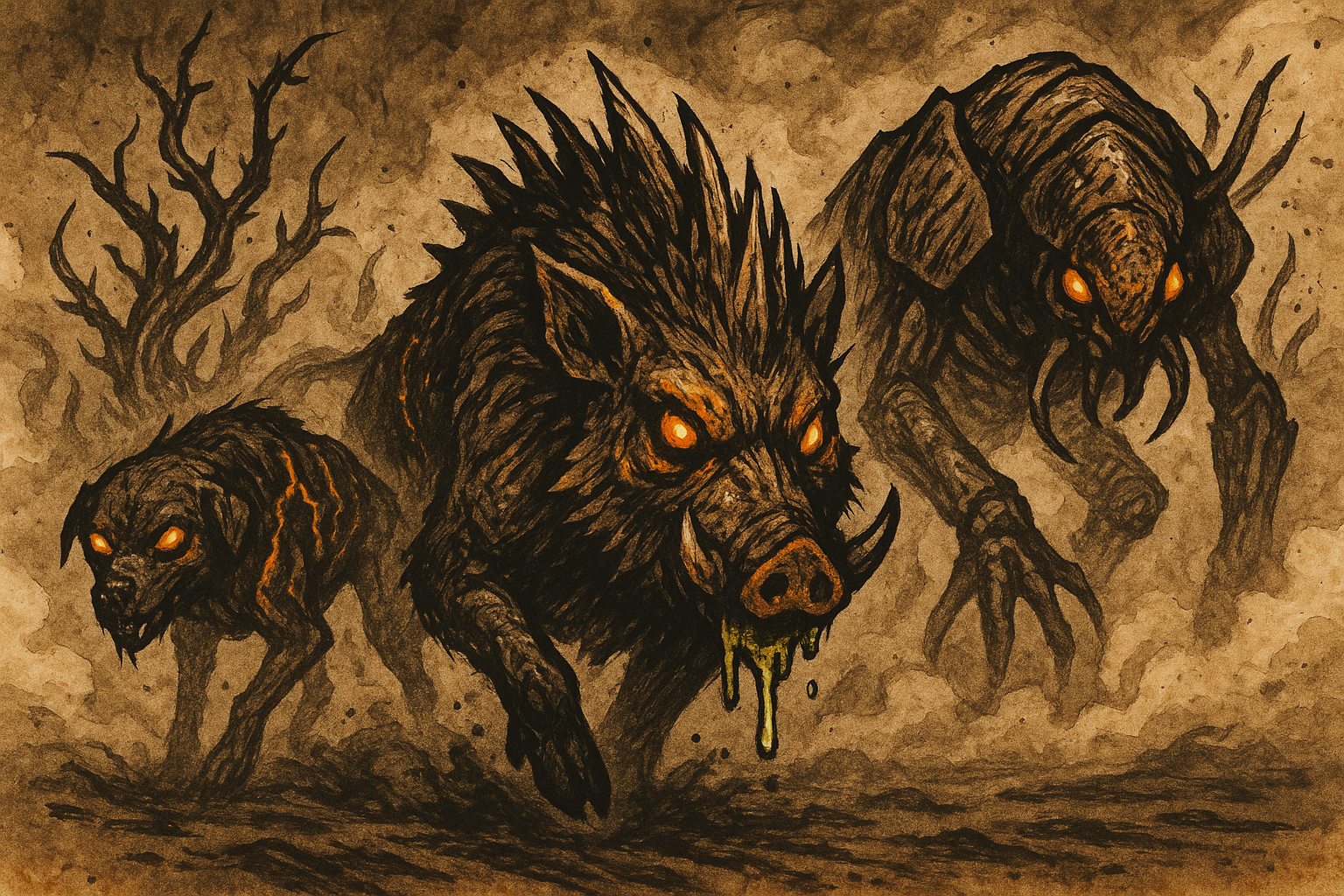
The Breach changed everything. When the dimensional rupture tore through reality 50-100 years ago, it didn't just bring magic to Earth—it twisted the world into something new. Radiation and arcane energy merged, creating an ecosystem that is both familiar and utterly alien. These creatures are the inheritors of the wasteland.
MUTANT FAUNA
Razorback
Medium Beast, Hostile CR 1/4
Feral hogs were already dangerous before the Breach. Now, with bony plates erupting from their spines and an insatiable hunger for anything that bleeds, they've become the most common deadly threat in the outer wastes. They travel in sounders of 6-12, and their squeals carry for miles.
HP: 18 (3d8+3) | DV: 12 | Speed: 40 ft
| MIG | AGI | END | INT | WIS | PRE |
|---|---|---|---|---|---|
| 13(+1) | 11(+0) | 13(+1) | 2(-4) | 9(-1) | 5(-3) |
Saves: FORT +3, REF +0, WILL -1 | Skills: Survival +1 | Senses: Darkvision 60 ft, passive Perception 9 Resistances/Immunities: None
Traits:
- Pack Tactics: Advantage on attack rolls against a creature if at least one ally is within 5 feet of the target.
- Relentless (1/day): If reduced to 0 HP, the razorback drops to 1 HP instead (unless the damage was radiant or psychic).
Actions:
- Gore: Melee weapon attack, +3 to hit, reach 5 ft, one target. Hit: 1d6+1 piercing damage (4 avg).
- Bony Slam: Melee weapon attack, +3 to hit, reach 5 ft, one target. Hit: 1d4+1 bludgeoning damage (3 avg), and target must succeed DC 11 MIG save or be knocked prone.
Reactions:
- Spine Rattle: When hit by a melee attack, attacker takes 1 piercing damage from razor-sharp spines.
Loot: Razorback hide (armor material), 1d4 bony plates (craft material), spoiled meat (inedible)
Encounter Notes: Found in packs of 6-12 around ruins and grasslands. Charge in waves. Sounders have 1-2 alpha males with 25 HP. Will eat their own dead.
Blighthound
Medium Beast, Neutral CR 1/2
Hairless and emaciated, blighthounds were once domestic dogs. Now they glow with sickly green bioluminescence along their veins and can track sources of magic like bloodhounds track scent. Some wanderers claim they're drawn to the Breach itself, following ley lines through the wasteland. Others use them as early warning systems for arcane anomalies.
HP: 27 (5d8+5) | DV: 12 | Speed: 50 ft
| MIG | AGI | END | INT | WIS | PRE |
|---|---|---|---|---|---|
| 12(+1) | 15(+2) | 12(+1) | 3(-4) | 14(+2) | 6(-2) |
Saves: FORT +3, REF +4, WILL +4 | Skills: Perception +4, Survival +4 | Senses: Darkvision 60 ft, Magsense 120 ft, passive Perception 14 Resistances/Immunities: Resistance to necrotic damage
Traits:
- Magsense: Can detect magical auras and effects within 120 feet as if under the effects of Detect Magic.
- Eerie Glow: Sheds dim green light in a 10-foot radius. Can suppress or activate as a free action.
- Pack Tactics: Advantage on attack rolls against a creature if at least one ally is within 5 feet.
Actions:
- Bite: Melee weapon attack, +4 to hit, reach 5 ft, one target. Hit: 1d8+2 piercing damage (6 avg), and target must succeed DC 11 END save or contract Blight Fever (minor disease, disadvantage on END checks for 24 hours).
Reactions: None
Loot: Bioluminescent gland (light source, 1 week), hound pelt (trade goods)
Encounter Notes: Travel in packs of 2-5. Non-hostile unless threatened or starving. Drawn to magic items, spellcasters, and Breach anomalies. Can be tamed with patience (DC 15 PRE check over 1 week). Wasteland scouts use them as magical early warning systems.
Carrion Crow
Small Beast, Neutral CR 1/4
Three-eyed crows circle every battlefield and mass grave in the wasteland. They've learned to mimic human speech—screaming the last words of the dying or repeating radio chatter they've overheard. Some say they remember the voices of everyone they've fed on. Swarms of them are an omen of death.
HP: 7 (2d6) | DV: 13 | Speed: 10 ft, fly 50 ft
| MIG | AGI | END | INT | WIS | PRE |
|---|---|---|---|---|---|
| 6(-2) | 16(+3) | 10(+0) | 6(-2) | 14(+2) | 8(-1) |
Saves: FORT +0, REF +5, WILL +2 | Skills: Perception +4, Mimicry +3 | Senses: Darkvision 120 ft, passive Perception 14 Resistances/Immunities: None
Traits:
- Third Eye: Can see invisible creatures and objects within 30 feet.
- Mimicry: Can perfectly replicate any sound or voice it has heard, including specific people. Listeners must succeed DC 11 WIS save to recognize it as a fake.
- Swarm Tactics: Carrion crows attack in murders of 10-40. Treat as a swarm: occupy the same space, resistance to physical damage, immunity to most conditions.
Actions:
- Beak: Melee weapon attack, +5 to hit, reach 5 ft, one target. Hit: 1d4+3 piercing damage (5 avg).
- Shriek (Recharge 5-6): All creatures within 15 feet must succeed DC 11 WIS save or become frightened for 1 round.
Reactions: None
Loot: Third eye (alchemical component, 10 scrap), iridescent feathers (decorative)
Encounter Notes: Fly in murders of 10-40. Use mimicry to lure victims into ambushes or sow confusion. Will mob lone targets (swarm attacks with advantage). Feed on the dying and dead. Some settlements train them as message carriers—they remember routes and voices.
Ashcrawler
Large Beast, Hostile CR 1
Six feet of segmented nightmare, ashcrawlers are mutant centipedes that nest in radioactive ruins and collapsed subway tunnels. Their chitin glows faintly in the dark, pulsing with absorbed radiation. They're ambush predators, dropping from ceilings or bursting from ash piles to inject paralyzing venom. The first sign is usually the clicking of their mandibles.
HP: 38 (7d10+7) | DV: 13 | Speed: 40 ft, climb 40 ft
| MIG | AGI | END | INT | WIS | PRE |
|---|---|---|---|---|---|
| 14(+2) | 16(+3) | 13(+1) | 2(-4) | 12(+1) | 3(-4) |
Saves: FORT +3, REF +5, WILL +1 | Skills: Stealth +5, Perception +3 | Senses: Darkvision 60 ft, Tremorsense 30 ft, passive Perception 13 Resistances/Immunities: Immunity to radiation damage
Traits:
- Spider Climb: Can climb difficult surfaces, including upside down on ceilings, without needing to make an ability check.
- Radioactive Chitin: Creatures that touch or make melee attacks against the ashcrawler take 1d4 radiation damage.
- Ambush Hunter: Has advantage on attack rolls against surprised creatures.
Actions:
- Bite: Melee weapon attack, +5 to hit, reach 5 ft, one target. Hit: 1d10+3 piercing damage (8 avg), and target must succeed DC 12 END save or take 1d6 poison damage and become paralyzed for 1 minute. Target can repeat the save at the end of each turn.
- Scuttle: The ashcrawler moves up to its speed without provoking opportunity attacks.
Reactions:
- Defensive Curl: When hit by a ranged attack, the ashcrawler gains +2 DV until the start of its next turn.
Loot: Radioactive chitin plates (armor material, 2d6 pieces, 5 scrap each), venom sac (paralytic toxin, 3 doses), glowpaste (light source, extracted from carapace)
Encounter Notes: Solitary ambush hunters. Found in hot zones, ruins, and collapsed structures. Prefer ceilings and walls for surprise attacks. Will retreat if heavily injured (below 15 HP). Nests contain 2-4 eggs (50 scrap each to collectors). Active at night.
Duskstag
Large Beast, Neutral CR 2
Mutant elk with antlers that crackle with stored electrical energy, duskstags roam the twilight hours between day and night. Their antlers glow like neon signs, pulsing in rhythm with their heartbeat. During mating season, males duel by discharging lightning at each other—the thunder echoes for miles. They're skittish but territorial, and a cornered stag can fry a person where they stand.
HP: 52 (8d10+8) | DV: 14 | Speed: 60 ft
| MIG | AGI | END | INT | WIS | PRE |
|---|---|---|---|---|---|
| 16(+3) | 14(+2) | 13(+1) | 4(-3) | 13(+1) | 10(+0) |
Saves: FORT +3, REF +4, WILL +3 | Skills: Perception +3, Athletics +5 | Senses: Darkvision 60 ft, passive Perception 13 Resistances/Immunities: Immunity to lightning damage
Traits:
- Charge: If the duskstag moves at least 20 feet straight toward a target and then hits with an antler attack on the same turn, the target takes an extra 2d6 bludgeoning damage. If the target is a creature, it must succeed DC 13 MIG save or be knocked prone.
- Electric Antlers: Shed bright blue light in a 15-foot radius, dim light for another 15 feet. Can be suppressed or activated as a free action.
- Reactive Discharge: When reduced to half HP or less, the stag's next antler attack deals an additional 1d8 lightning damage.
Actions:
- Antlers: Melee weapon attack, +5 to hit, reach 5 ft, one target. Hit: 2d8+3 bludgeoning damage plus 1d6 lightning damage (14 avg total).
- Lightning Discharge (Recharge 5-6): The stag releases stored energy in a 30-foot line that is 5 feet wide. Each creature in that line must make DC 13 AGI save, taking 3d8 lightning damage (13 avg) on a failed save, or half as much on a success.
- Hoof Stomp: Melee weapon attack, +5 to hit, reach 5 ft, one prone target. Hit: 2d6+3 bludgeoning damage (10 avg).
Reactions: None
Loot: Charged antlers (arcane component, 2d4 shards, 15 scrap each), venison (quality meat, 3d6 lbs), hide (leather, 25 scrap), bio-capacitor gland (energy cell equivalent, 40 scrap)
Encounter Notes: Travel in herds of 4-12 (mix of stags, does, and fawns). Stags patrol the perimeter. Will flee unless defending young or cornered. Males duel during mating season (late fall), creating electrical storms. Prized by hunters for meat and antlers. Does lack discharge abilities but still have electrified antlers.
Gulper
Huge Beast, Hostile CR 3
Car-sized amphibians with mouths that unhinge like a snake's, gulpers lurk in flooded ruins and toxic swamps. They can swallow a full-grown human whole and digest them over days. The Breach mutated their digestive systems to process almost anything—metal, plastic, even low-level radioactive material. Locals call them "living trash compactors."
HP: 68 (8d12+16) | DV: 14 | Speed: 20 ft, swim 40 ft
| MIG | AGI | END | INT | WIS | PRE |
|---|---|---|---|---|---|
| 18(+4) | 8(-1) | 15(+2) | 2(-4) | 12(+1) | 5(-3) |
Saves: FORT +5, REF +1, WILL +3 | Skills: Stealth +2 (in water +5), Perception +3 | Senses: Darkvision 60 ft, passive Perception 13 Resistances/Immunities: Resistance to acid and poison damage
Traits:
- Amphibious: Can breathe air and water.
- Swallow Whole: If the gulper hits a Medium or smaller creature with its bite and has no creature already swallowed, it can attempt to swallow the target. Target must succeed DC 14 MIG save or be swallowed. While swallowed, the creature is blinded and restrained, has total cover against attacks from outside, and takes 2d6 acid damage at the start of each of the gulper's turns. If the gulper takes 20 damage or more on a single turn from the swallowed creature, it must succeed DC 14 END save or regurgitate the creature (falls prone 10 feet away). If the gulper dies, swallowed creature can escape as an action.
- Hold Breath: Can hold its breath for 30 minutes.
Actions:
- Bite: Melee weapon attack, +6 to hit, reach 10 ft, one target. Hit: 2d10+4 piercing damage (15 avg), and target is grappled (escape DC 14). Until the grapple ends, target is restrained and the gulper cannot bite another target.
- Tongue Lash: Ranged weapon attack, +6 to hit, range 20 ft, one target. Hit: 1d8+4 bludgeoning damage (8 avg), and target must succeed DC 14 MIG save or be pulled 15 feet toward the gulper.
Reactions:
Loot: Gulper hide (waterproof leather, 50 scrap), acid gland (2d4 doses of acid, 10 scrap each), stomach contents (random scrap, roll 1d6: 1-2=junk, 3-4=10 scrap, 5=25 scrap, 6=intact gear)
Encounter Notes: Solitary ambush predators. Lurk in murky water with only eyes above surface. Patient—will wait hours for prey. Found in flooded basements, swamps, canals, and retention ponds. Territorial—marks area with distinctive croaking (audible 200 ft). Will swallow prey and retreat to digest. Mating season (spring) makes them aggressive; pairs will attack groups.
Stalker Cat
Medium Beast, Hostile CR 2
Mountain lions with chameleonic skin and an eerie silence, stalker cats are apex predators of the wasteland. They can blend into rubble, rust, and ruin so perfectly that victims never see them coming. The only warning is the faint shimmer when they move—and by then, it's usually too late. They hunt alone and leave nothing but blood trails.
HP: 49 (9d8+9) | DV: 15 | Speed: 50 ft, climb 40 ft
| MIG | AGI | END | INT | WIS | PRE |
|---|---|---|---|---|---|
| 16(+3) | 18(+4) | 13(+1) | 4(-3) | 15(+2) | 8(-1) |
Saves: FORT +3, REF +7, WILL +4 | Skills: Stealth +10, Perception +6, Athletics +6 | Senses: Darkvision 90 ft, passive Perception 16 Resistances/Immunities: None
Traits:
- Chameleon Hide: Has advantage on Stealth checks. Can become nearly invisible when motionless (creatures must succeed DC 15 WIS (Perception) check to spot it).
- Pounce: If the stalker cat moves at least 20 feet straight toward a creature and then hits with a claw attack on the same turn, the target must succeed DC 13 MIG save or be knocked prone. If the target is prone, the stalker cat can make one bite attack as a bonus action.
- Keen Smell: Has advantage on Perception checks that rely on smell.
- Silent Hunter: Makes no sound when moving. Advantage on Stealth checks to avoid being heard.
Actions:
- Multiattack: Makes two attacks: one with bite and one with claws.
- Bite: Melee weapon attack, +6 to hit, reach 5 ft, one target. Hit: 1d8+4 piercing damage (8 avg).
- Claws: Melee weapon attack, +6 to hit, reach 5 ft, one target. Hit: 2d6+4 slashing damage (11 avg).
- Throat Rip (Recharge 5-6): Melee weapon attack against a surprised or prone creature, +6 to hit, reach 5 ft, one target. Hit: 3d8+4 piercing damage (17 avg), and target must succeed DC 13 END save or suffer 1d6 bleeding damage at the start of each turn until stabilized.
Reactions:
- Fade: When hit by an attack, the stalker cat can use its reaction to move up to half its speed without provoking opportunity attacks. This movement breaks its chameleon camouflage until the end of its next turn.
Loot: Chameleonic hide (crafting material, 75 scrap), claws (5, trade goods, 5 scrap each), predator musk gland (repellent, 20 scrap)
Encounter Notes: Solitary apex predators. Stalk prey for hours before attacking. Prefer ambush from elevated positions (ruins, trees, cliffsides). Target stragglers and isolated victims. Will drag kills to hidden lairs. If injured below 15 HP, will disengage and vanish. Territories span 5-10 square miles. Mating pairs hunt together during spring. Cubs (1-3) den in secure ruins; mother is extremely aggressive (CR 3).
Thunderhoof
Huge Beast, Neutral CR 4
Mutant bison crackling with static electricity, thunderhoofs move in herds that generate their own weather systems. Storm clouds gather above them, and lightning follows their stampedes. Their fur stands on end with accumulated charge, and touching one ungloved is a death sentence. They're peaceful grazers—until they're not. When a herd stampedes, the earth shakes and the air burns with ozone.
HP: 82 (11d12+11) | DV: 15 | Speed: 50 ft
| MIG | AGI | END | INT | WIS | PRE |
|---|---|---|---|---|---|
| 20(+5) | 10(+0) | 14(+2) | 3(-4) | 13(+1) | 9(-1) |
Saves: FORT +6, REF +2, WILL +3 | Skills: Perception +3, Intimidation +3 | Senses: Darkvision 60 ft, passive Perception 13 Resistances/Immunities: Immunity to lightning damage
Traits:
- Static Aura: Any creature that starts its turn within 5 feet of the thunderhoof or touches it takes 1d6 lightning damage.
- Charge: If the thunderhoof moves at least 20 feet straight toward a target and then hits with a gore attack on the same turn, the target takes an extra 3d8 bludgeoning damage (13 avg). If the target is a creature, it must succeed DC 15 MIG save or be knocked prone.
- Stampede: When two or more thunderhoofs move in the same direction as a herd, they create a stampede. Each creature in a 10-foot-wide path must succeed DC 15 AGI save or take 4d10 bludgeoning damage (22 avg) and be knocked prone. Success deals half damage and creature isn't knocked prone.
- Storm Caller: Herds of 10+ thunderhoofs generate localized storm clouds within 500 feet (light rain, occasional lightning).
Actions:
- Gore: Melee weapon attack, +7 to hit, reach 5 ft, one target. Hit: 3d8+5 bludgeoning damage (18 avg) plus 1d8 lightning damage (4 avg).
- Trample: The thunderhoof moves up to its speed in a straight line and can move through the space of any Large or smaller creature. Each creature whose space it moves through must succeed DC 15 AGI save or take 3d10+5 bludgeoning damage (21 avg) and be knocked prone.
- Lightning Release (Recharge 5-6): The thunderhoof discharges stored electricity in a 20-foot cone. Each creature in the area must make DC 15 AGI save, taking 4d8 lightning damage (18 avg) on a failed save, or half on a success.
Reactions:
- Retaliatory Shock: When hit by a melee attack, the attacker takes 2d6 lightning damage.
Loot: Thunderhoof hide (insulated leather, 100 scrap), horns (crafting material, 50 scrap pair), static glands (bio-battery, 2d4, 25 scrap each), meat (6d6 lbs, quality)
Encounter Notes: Travel in herds of 10-50. Bulls and cows both have stats; calves are CR 2. Peaceful unless threatened or startled. Loud noises, predators, or fire trigger stampedes. When herd stampedes, all thunderhoofs move together (combine Stampede trait damage). Natural storms attract them. Some wastelanders follow herds for protection (predators avoid them). Can be domesticated with extreme patience (DC 20 PRE check over months).
Needle Rat
Tiny Beast, Hostile CR 1/4
Mutant rats covered in venomous quills, needle rats infest every ruin and sewer in the wasteland. They can launch their spines like darts and carry a cocktail of diseases that make plague look friendly. A single rat is a nuisance; a swarm is a death sentence. Their chittering fills the dark places, and where you find one, a hundred more are watching.
HP: 9 (2d4+4) | DV: 13 | Speed: 30 ft, climb 20 ft
| MIG | AGI | END | INT | WIS | PRE |
|---|---|---|---|---|---|
| 4(-3) | 16(+3) | 14(+2) | 2(-4) | 10(+0) | 4(-3) |
Saves: FORT +4, REF +5, WILL +0 | Skills: Stealth +5, Perception +2 | Senses: Darkvision 60 ft, passive Perception 12 Resistances/Immunities: Resistance to poison damage, immunity to disease
Traits:
- Keen Smell: Has advantage on Perception checks that rely on smell.
- Pack Tactics: Advantage on attack rolls if an ally is within 5 feet of target.
- Swarm Mentality: Needle rats operate in swarms of 20-100. When 10+ occupy the same space, treat as a Swarm (Medium): resistance to bludgeoning, piercing, slashing; immunity to most conditions; occupies other creatures' spaces.
Actions:
- Bite: Melee weapon attack, +5 to hit, reach 5 ft, one target. Hit: 1d4+3 piercing damage (5 avg), and target must succeed DC 11 END save or contract Rat Plague (incubation 1d4 days; disadvantage on all rolls, 1d6 necrotic damage per day until cured with medicine or magic).
- Quill Launch (Recharge 5-6): Ranged weapon attack, +5 to hit, range 20 ft, one target. Hit: 1d6+3 piercing damage (6 avg), and target must succeed DC 12 END save or take 1d4 poison damage and become poisoned for 1 hour.
Reactions: None
Loot: Quills (2d6, poisonous, 1 scrap each), disease sample (bioweapon component, 15 scrap—requires containment)
Encounter Notes: Found everywhere—sewers, ruins, basements, warehouses. Attack in swarms of 20-100. Prefer hit-and-run tactics, launching quills then closing for bites. Will flee if 50% casualties. Nests are biohazards—walls lined with quills, disease pools, corpses. Queen rats (CR 1/2, 30 HP, birthing 2d6 young per week) control nests. Fire is most effective deterrent. Some wasteland alchemists farm them for venom.
Venom Maw
Huge Beast, Hostile CR 5
Alligators infused with Breach-warped magic, venom maws are 20-foot nightmares with fangs that drip corrosive arcane venom. They can spit streams of the stuff 30 feet with perfect accuracy, melting through metal and flesh alike. They lurk in irradiated bayous and flooded cities, and their bellowing roars carry a magical compulsion that freezes prey in place. Old-timers say they're intelligent—cruel and patient.
HP: 97 (13d12+13) | DV: 15 | Speed: 30 ft, swim 50 ft
| MIG | AGI | END | INT | WIS | PRE |
|---|---|---|---|---|---|
| 19(+4) | 12(+1) | 15(+2) | 6(-2) | 14(+2) | 9(-1) |
Saves: FORT +6, REF +3, WILL +5 | Skills: Stealth +5 (in water +8), Perception +5 | Senses: Darkvision 90 ft, passive Perception 15 Resistances/Immunities: Resistance to acid and poison damage, immunity to poison condition
Traits:
- Hold Breath: Can hold breath for 1 hour.
- Arcane Venom: Venom deals both acid and poison damage and ignores resistance to acid.
- Ambush Predator: Has advantage on attack rolls against creatures that haven't taken a turn in combat yet.
- Territorial Roar (Recharge 5-6): As an action, the venom maw releases a magically-enhanced bellow. All creatures within 60 feet that can hear it must succeed DC 16 WIS save or become frightened for 1 minute. Frightened creatures can repeat the save at the end of each turn.
Actions:
- Multiattack: Makes two attacks: one bite and one tail slap, OR one bite and one venom spit.
- Bite: Melee weapon attack, +7 to hit, reach 10 ft, one target. Hit: 3d10+4 piercing damage (20 avg) plus 1d8 acid damage (4 avg), and target is grappled (escape DC 16). Until the grapple ends, target is restrained and the venom maw cannot bite another target.
- Tail Slap: Melee weapon attack, +7 to hit, reach 10 ft, one target. Hit: 2d8+4 bludgeoning damage (13 avg), and target must succeed DC 16 MIG save or be knocked prone.
- Venom Spit: Ranged weapon attack, +5 to hit, range 30 ft, one target. Hit: 4d8 acid damage plus 2d6 poison damage (26 avg total), and target must succeed DC 16 END save or become poisoned for 1 minute. Poisoned target takes 1d6 acid damage at the start of each turn (can wash off with action + water source).
- Death Roll: If the venom maw has a creature grappled, it can roll violently. Target must succeed DC 16 MIG save or take 4d10+4 bludgeoning damage (26 avg) and become stunned until the end of the venom maw's next turn.
Reactions:
- Lunge: When a creature moves within 15 feet, the venom maw can move up to 15 feet toward it without provoking opportunity attacks.
Loot: Venom sacs (2d6 doses, each deals 3d8 acid+poison, 40 scrap per dose), armored hide (heavy armor material, 150 scrap), fangs (crafting material, 4, 25 scrap each), arcane gall stone (rare alchemical component, 200 scrap)
Encounter Notes: Solitary apex predators. Claim territories of 5-10 square miles (bayous, flooded ruins, toxic rivers). Attack from ambush—submerged with only nostrils visible. Patient; will stalk prey for hours. Territorial Roar freezes prey before attack. If reduced below 30 HP, will retreat to water and hide. Lairs are flooded caves/basements littered with bones and corroded metal. Mating season (summer) makes pairs hunt together—double the danger. Prized by big game hunters; bounties reach 1000+ scrap.
Sky Ripper
Large Beast, Hostile CR 6
Golden eagles with 20-foot wingspans and talons that crackle with lightning, sky rippers are the undisputed rulers of the wasteland skies. They nest on radio towers and skyscraper peaks, dive-bombing at 200 mph with thunder in their wake. A single strike can kill a horse. They're territorial, intelligent, and utterly fearless—attacking anything that enters their airspace, from scavenger planes to other sky rippers.
HP: 112 (15d10+30) | DV: 16 | Speed: 20 ft, fly 120 ft
| MIG | AGI | END | INT | WIS | PRE |
|---|---|---|---|---|---|
| 16(+3) | 20(+5) | 15(+2) | 8(-1) | 16(+3) | 12(+1) |
Saves: FORT +6, REF +9, WILL +7 | Skills: Perception +11, Acrobatics +9 | Senses: Darkvision 120 ft, passive Perception 21 Resistances/Immunities: Immunity to lightning damage
Traits:
- Keen Sight: Has advantage on Perception checks that rely on sight. Can see up to 5 miles in clear conditions.
- Flyby: Doesn't provoke opportunity attacks when flying out of an enemy's reach.
- Dive Attack: If the sky ripper flies at least 30 feet straight toward a target and then hits with a talon attack on the same turn, the attack deals an extra 3d10 damage (16 avg). If the target is a creature, it must succeed DC 17 MIG save or be knocked prone and stunned until the end of its next turn.
- Lightning Talons: Talon attacks deal an additional 2d6 lightning damage.
Actions:
- Multiattack: Makes three attacks: one beak and two talons.
- Beak: Melee weapon attack, +9 to hit, reach 5 ft, one target. Hit: 2d8+5 piercing damage (14 avg).
- Talons: Melee weapon attack, +9 to hit, reach 5 ft, one target. Hit: 2d10+5 slashing damage plus 2d6 lightning damage (22 avg total), and target is grappled (escape DC 17). Sky ripper can grapple one Large or two Medium creatures.
- Lightning Shriek (Recharge 5-6): The sky ripper releases a piercing cry charged with electrical energy. Each creature within 30 feet must succeed DC 17 END save or take 5d8 lightning damage (22 avg) and become stunned until the end of the sky ripper's next turn. Success deals half damage and no stun.
- Aerial Snatch: While flying, the sky ripper attempts to grapple one creature. If successful, it can fly up to half its speed, carrying the target. At the end of the movement, it can drop the target (falling damage applies).
Reactions:
- Thunderclap Escape: When hit by a ranged attack, the sky ripper releases a burst of lightning in a 10-foot radius. All creatures in the area take 2d6 lightning damage (no save) and the sky ripper can fly up to 30 feet without provoking opportunity attacks.
Loot: Lightning-charged talons (4, powerful melee weapon components, 75 scrap each), sky ripper feathers (insulation material, 3d6, 10 scrap each), storm gland (rare bio-battery, 250 scrap), beak (crafting material, 50 scrap)
Encounter Notes: Solitary or mated pairs. Nest on highest structures—radio towers, skyscrapers, mountains. Territories span 20+ miles; aggressively defend airspace. Hunt from altitude (500+ feet), diving at prey with devastating speed. Favorite prey: large mammals, vehicles, other aerial predators. Nesting season (spring) makes them hyper-aggressive—attack anything within 1 mile of nest. Eggs (1-2) worth 500 scrap each to collectors. Chicks fledge at 6 months (CR 3). Some warlords train them as aerial mounts (DC 25 PRE, months of effort, extreme danger).
Burrower Queen
Huge Beast, Hostile CR 7
Massive mole-rat matriarchs the size of a van, burrower queens rule underground colonies of hundreds. They're blind but sense vibrations through 120 feet of earth and stone. Their psionic commands control their colonies like a hive mind, sending waves of workers and soldiers to defend or attack. When a queen dies, her colony collapses into chaos—but not before they try to avenge her. Colonies are underground fortresses of tunnels, traps, and endless teeth.
HP: 127 (15d12+30) | DV: 16 | Speed: 40 ft, burrow 30 ft
| MIG | AGI | END | INT | WIS | PRE |
|---|---|---|---|---|---|
| 20(+5) | 10(+0) | 15(+2) | 10(+0) | 16(+3) | 14(+2) |
Saves: FORT +7, REF +3, WILL +8 | Skills: Perception +8 (tremorsense), Survival +8 | Senses: Blindsight 30 ft, Tremorsense 120 ft, passive Perception 18 Resistances/Immunities: Resistance to bludgeoning damage from non-magical sources, immunity to blinded condition
Traits:
- Tremorsense (120 ft): Can detect and pinpoint the location of creatures and objects in contact with the ground within 120 feet.
- Colony Mind: The queen maintains a psionic link with all mole-rats within 500 feet. She can command them telepathically and share sensory information. Colony members have advantage on attack rolls while within 60 feet of the queen.
- Burrow Master: Can burrow through solid rock, leaving a 10-foot diameter tunnel. Doesn't disturb the material it moves through.
- Summon Colony (1/day): As an action, the queen sends out a psionic call. 2d6 mole-rat soldiers (CR 1, 35 HP each) and 4d6 workers (CR 1/4, 15 HP each) arrive in 1d4 rounds from nearby tunnels.
Actions:
- Multiattack: Makes three attacks: two claws and one bite.
- Bite: Melee weapon attack, +9 to hit, reach 10 ft, one target. Hit: 3d10+5 piercing damage (21 avg).
- Claws: Melee weapon attack, +9 to hit, reach 10 ft, one target. Hit: 2d8+5 slashing damage (14 avg).
- Crushing Charge: The queen moves up to her speed in a straight line and can move through the space of Large or smaller creatures. Each creature in her path must succeed DC 18 AGI save or take 4d10+5 bludgeoning damage (27 avg) and be knocked prone. Success deals half damage.
- Psionic Scream (Recharge 5-6): The queen releases a psychic wail. All creatures within 60 feet that aren't mole-rats must succeed DC 18 WIS save or take 5d8 psychic damage (22 avg) and become frightened for 1 minute. Frightened creatures can repeat the save at the end of each turn. Success deals half damage and no fear.
Reactions:
- Protective Swarm: When the queen is hit by an attack, 1d4 mole-rat workers leap to intercept, absorbing the damage. The workers die.
Loot: Queen's brain (rare psionic component, 400 scrap), claws (4, crafting material, 50 scrap each), hide (tough leather, 200 scrap), colony stores (2d6×10 scrap worth of salvaged metal, wiring, gear)
Encounter Notes: Found in vast underground colonies beneath ruins, hills, and industrial zones. Queen never leaves colony core. Defended by soldiers and workers in concentric rings. Tunnels are cramped (5-10 ft diameter), maze-like, and trapped (collapses, spike pits). Colony members fight to the death defending the queen. If queen dies, colony fractures—members flee or fight each other. Colony size: 100-500 members. Soldiers (CR 1): 35 HP, +5 to hit, 1d8+3 bite. Workers (CR 1/4): 15 HP, +3 to hit, 1d6+1 bite. Queens can live 50+ years; oldest colonies are legendary. Some have learned to avoid human settlements; others undermine them deliberately.
Glowbear
Large Beast, Hostile CR 4
Grizzly bears saturated with radiation, glowbears are walking nuclear meltdowns. Their fur glows sickly green, and being near them is like standing beside an exposed reactor core. They're stronger, faster, and angrier than their ancestors, and radiation seems to fuel their rage. They feed on anything and anyone, drawn to high-radiation zones like moths to flame. Killing one creates a temporary hot zone.
HP: 79 (11d10+22) | DV: 14 | Speed: 40 ft, climb 30 ft
| MIG | AGI | END | INT | WIS | PRE |
|---|---|---|---|---|---|
| 19(+4) | 12(+1) | 16(+3) | 3(-4) | 13(+1) | 8(-1) |
Saves: FORT +7, REF +3, WILL +3 | Skills: Perception +3, Athletics +7 | Senses: Darkvision 60 ft, passive Perception 13 Resistances/Immunities: Immunity to radiation damage, resistance to poison damage
Traits:
- Radiation Aura: Any creature that starts its turn within 10 feet of the glowbear takes 1d8 radiation damage. Non-mutant plants and animals within the aura wither and die over 1d4 days.
- Radioactive Blood: When the glowbear takes piercing or slashing damage, each creature within 5 feet takes 1d6 radiation damage (spray of radioactive blood).
- Radiation Sense: Can detect sources of radiation within 1 mile.
- Rage (Recharge 5-6): As a bonus action, the glowbear enters a rage for 1 minute. While raging: +2 damage on melee attacks, resistance to all physical damage, disadvantage on AGI checks, cannot cast spells or use actions requiring concentration. Rage ends early if knocked unconscious.
Actions:
- Multiattack: Makes two attacks: one bite and one claws.
- Bite: Melee weapon attack, +7 to hit, reach 5 ft, one target. Hit: 2d8+4 piercing damage (13 avg) plus 1d6 radiation damage (3 avg).
- Claws: Melee weapon attack, +7 to hit, reach 10 ft, one target. Hit: 2d10+4 slashing damage (15 avg) plus 1d6 radiation damage (3 avg).
- Maul: If the glowbear hits the same creature with both claw attacks in the same turn, the target must succeed DC 15 MIG save or be knocked prone and grappled. The glowbear can then use its bite attack as a bonus action.
Reactions:
- Retaliatory Swipe: When hit by a melee attack, the glowbear can make one claw attack against the attacker.
Loot: Glowbear hide (shielded leather, 100 scrap), radioactive claws (5, dangerous crafting material, 30 scrap each, requires containment), isotope gland (power source, 150 scrap, hazardous), meat (inedible—lethal radiation levels)
Encounter Notes: Solitary or mother + 1-2 cubs (CR 2, 45 HP, smaller aura). Found in hot zones, nuclear facilities, crashed reactors. Extremely territorial and aggressive. Drawn to radioactive waste sites to feed (absorbs radiation to sustain rage). Will chase prey for miles when enraged. Cubs are orphaned if mother killed—dangerous even at young age. Kill zone: When glowbear dies, leaves radioactive corpse (10-ft radius hot zone, 1d6 radiation damage per round, lasts 1d4 days). Some settlements offer bounties but require proof from distance (photos, tracking collars). Wasteland legend: "Old Atom," an ancient glowbear the size of a bus, CR 10, rules the Dead Zone.
Silt Serpent
Large Beast, Hostile CR 3
Sand-swimming snakes the thickness of a telephone pole, silt serpents glide through loose earth like water. They sense vibrations from hundreds of feet away and strike from below, dragging victims into suffocating earth. Their scales are covered in microscopic hooks that grip soil and flesh alike. Deserts, ash plains, and loose-fill wastelands are their hunting grounds. The only warning is a ripple in the sand.
HP: 65 (10d10+10) | DV: 14 | Speed: 30 ft, burrow 30 ft (sand/loose earth only)
| MIG | AGI | END | INT | WIS | PRE |
|---|---|---|---|---|---|
| 17(+3) | 16(+3) | 13(+1) | 2(-4) | 14(+2) | 5(-3) |
Saves: FORT +3, REF +5, WILL +4 | Skills: Stealth +7 (in sand/silt +10), Perception +4 | Senses: Blindsight 10 ft, Tremorsense 60 ft, passive Perception 14 Resistances/Immunities: Resistance to fire damage
Traits:
- Sand Swimmer: Can burrow through sand, ash, silt, or loose earth at full speed, leaving no tunnel or trace. Cannot burrow through solid rock or hard-packed soil.
- Ambush Predator: Has advantage on attack rolls against creatures that haven't taken a turn in combat yet.
- Constrict: Creatures grappled by the silt serpent are restrained and take 2d6+3 bludgeoning damage (10 avg) at the start of each of the serpent's turns.
Actions:
- Bite: Melee weapon attack, +6 to hit, reach 10 ft, one target. Hit: 2d10+3 piercing damage (14 avg), and target is grappled (escape DC 14).
- Drag Under: If the silt serpent has a creature grappled and is in sand/loose earth, it can burrow up to 15 feet, dragging the grappled creature with it. The creature is buried and begins suffocating (END×1 minutes of air, then 1+END rounds of consciousness, then unconsciousness and 1d4 rounds until death). Escaping the grapple allows creature to dig to surface (action, DC 12 Athletics check if conscious).
- Coiling Strike (Recharge 5-6): The serpent makes a bite attack. On a hit, if the target is Large or smaller, it becomes grappled and the serpent immediately wraps around it. Target takes 3d6+3 bludgeoning damage (13 avg) and is restrained.
Reactions:
Loot: Silt serpent hide (flexible armor material, 75 scrap), scales (crafting material, 2d6, 5 scrap each), hook-scales (grip material, 20 scrap), fangs (2, 15 scrap each)
Encounter Notes: Solitary ambush predators. Hunt in deserts, ash wastes, sandy ruins, dried lakebeds. Strike from below, dragging prey underground to suffocate. Patient—can wait motionless for hours beneath sand. Tremorsense alerts them to prey 60 feet away. Prefer lone targets. If prey escapes underground grapple, serpent will surface and pursue. Nests are underground chambers lined with bones. Eggs (1d4) hatch in warm sand; hatchlings (CR 1/2) are aggressive. Some caravans use "thumpers" (stakes driven into sand rhythmically) to lure serpents away. Hide is prized for its grip—climbers and thieves pay premium.
Chimera Swarm
Large Aberration, Chaotic CR 5
The Breach doesn't just mutate—it fuses. Chimera swarms are dozens of small animals (rats, birds, cats, snakes) melted together into a writhing gestalt horror. They share a single distributed consciousness and move as one organism, flowing like liquid over obstacles. Eyes, mouths, and limbs protrude at random. They hunger endlessly, absorbing more creatures into their mass. They're proof that the Breach is still changing the world—and not for the better.
HP: 95 (14d10+21) | DV: 15 | Speed: 40 ft, climb 40 ft
| MIG | AGI | END | INT | WIS | PRE |
|---|---|---|---|---|---|
| 14(+2) | 18(+4) | 14(+2) | 8(-1) | 13(+1) | 6(-2) |
Saves: FORT +5, REF +7, WILL +4 | Skills: Stealth +7, Perception +4 | Senses: Darkvision 120 ft (many eyes), passive Perception 14 Resistances/Immunities: Resistance to bludgeoning, piercing, slashing; immunity to charm, frighten, paralysis, petrification
Traits:
- Swarm Form: Can occupy another creature's space and vice versa. Can move through any opening large enough for a Tiny creature. Cannot regain HP or gain temporary HP.
- Distributed Consciousness: Cannot be surprised. Immune to effects that target a single creature (charm, sleep, etc.).
- Absorb the Fallen: When a Small or smaller creature dies within 10 feet, the swarm can absorb its corpse as a bonus action, regaining 2d8 HP.
- Horrifying Visage: Any creature that starts its turn within 10 feet of the swarm and can see it must succeed DC 16 WIS save or become frightened for 1 minute. Creature can repeat save at end of each turn. Success makes creature immune for 24 hours.
Actions:
- Multiattack: Makes two Flailing Mass attacks.
- Flailing Mass: Melee weapon attack, +7 to hit, reach 5 ft (or any creature in its space), one target. Hit: 3d8+4 slashing/piercing/bludgeoning damage (17 avg). If the target is a creature, it must succeed DC 16 END save or become infected with Chimera Rot (see below).
- Engulf (Recharge 5-6): The swarm flows over up to two Medium or smaller creatures in its space. Each target must succeed DC 16 AGI save or become engulfed (blinded, restrained, unable to breathe, takes 3d8 damage at start of each of swarm's turns). An engulfed creature can attempt to escape as an action (DC 16 MIG or AGI check). If creature dies while engulfed, swarm absorbs it.
- Breach Echo (1/day): The swarm channels raw Breach energy in a 20-foot radius. All creatures in the area must succeed DC 16 WIS save or take 4d10 psychic damage (22 avg) and become confused for 1 minute (as spell). Success deals half damage and no confusion.
Reactions:
- Split Swarm: When reduced to 50 HP or less, the swarm can split into two separate swarms (each with half remaining HP, rounded down, CR 3 each). Both act on the same initiative.
Loot: Chimera tissue sample (bioweapon/research material, 250 scrap, biohazard), fused relics (random small items absorbed by swarm—jewelry, tools, keys—2d6 items, 5-25 scrap each), Breach residue (alchemical component, 100 scrap)
Encounter Notes: Found in areas of high Breach activity—rift zones, hotspots, corrupted ruins. Begins as a few fused animals, grows by absorbing corpses and living prey. Highly aggressive and unpredictable. Attacks with overwhelming numbers and horror. Fire is very effective (vulnerability not stated in stats, but narrative weakness). If reduced below 25 HP and split is unavailable, will attempt to flee and absorb corpses to heal. Chimera Rot disease: Infected creature develops growths of fused tissue. After 1d6 days, must succeed DC 16 END save or lose 1d4 MIG, AGI, or END permanently. Three failed saves: creature dies and rises as a chimera spawn (CR 2, mindless). Cure requires magical healing or advanced medicine. Some scientists study them to understand the Breach; extremely dangerous research.
WASTELAND FLORA
Snare Vine
Large Plant, Neutral CR 1/2
Camouflaged creeper vines that blend perfectly with rubble and ruins, snare vines lie dormant for months until vibrations wake them. They lash out with prehensile tendrils, grappling and crushing prey before draining nutrients through thorn-covered suckers. Victims are left as desiccated husks wrapped in greenery. Common in overgrown ruins, they're the reason wasteland scouts never relax.
HP: 28 (5d10) | DV: 12 | Speed: 5 ft (rooted)
| MIG | AGI | END | INT | WIS | PRE |
|---|---|---|---|---|---|
| 15(+2) | 8(-1) | 11(+0) | 1(-5) | 10(+0) | 3(-4) |
Saves: FORT +2, REF -1, WILL +0 | Skills: Stealth +5 (when motionless) | Senses: Blindsight 30 ft (vibration), passive Perception 10 Resistances/Immunities: Resistance to bludgeoning damage, vulnerability to fire
Traits:
- False Appearance: While motionless, indistinguishable from normal vines and debris. Creatures must succeed DC 15 Perception check to notice.
- Grasping Tendrils: Has reach of 15 feet with tendril attacks.
- Root Network: If rooted in the ground, gains +2 DV and advantage on saves against being knocked prone or moved.
Actions:
- Multiattack: Makes two Tendril attacks.
- Tendril: Melee weapon attack, +4 to hit, reach 15 ft, one target. Hit: 1d6+2 bludgeoning damage (5 avg), and target is grappled (escape DC 12). Snare vine can grapple up to two creatures at once.
- Crushing Embrace: One creature grappled by the snare vine takes 2d6+2 bludgeoning damage (9 avg) and must succeed DC 12 END save or begin suffocating (thorn-covered tendrils constrict throat).
- Nutrient Drain: One creature grappled by the snare vine takes 1d8 necrotic damage (4 avg) as thorny suckers drain bodily fluids. Snare vine regains HP equal to damage dealt.
Reactions: None
Loot: Fibrous tendrils (rope material, 3d6 ft, 5 scrap per 10 ft), thorn suckers (alchemical component, 1d4, 10 scrap each)
Encounter Notes: Solitary or patches of 2-4 vines. Found in overgrown ruins, collapsed buildings, junk heaps. Waits for vibrations (footsteps, movement) then strikes. Can attack multiple targets simultaneously. Will release prey if set on fire (vulnerability) or reduced below 10 HP. Dried husks of previous victims often nearby—warning sign if noticed. Slow-moving, so ranged attacks from outside 15 ft range are safe. Some wasteland survivalists harvest fibers for rope and nets.
Spore Puffer
Medium Plant, Neutral CR 1
Bulbous fungi the size of beach balls, spore puffers grow in damp ruins and toxic swamps. When disturbed, they release clouds of spores—some toxic, some hallucinogenic, some both. The Breach mutated hundreds of varieties, each with different effects. Scavengers learn to give them wide berth, but desperate chemists harvest them for their psychoactive properties. Popping one is like playing Russian roulette with your lungs.
HP: 32 (5d8+10) | DV: 13 | Speed: 5 ft (rooted)
| MIG | AGI | END | INT | WIS | PRE |
|---|---|---|---|---|---|
| 8(-1) | 6(-2) | 14(+2) | 1(-5) | 11(+0) | 5(-3) |
Saves: FORT +4, REF -2, WILL +0 | Skills: None | Senses: Blindsight 10 ft (vibration), passive Perception 10 Resistances/Immunities: Resistance to poison damage, immunity to poison condition, vulnerability to fire
Traits:
- Reactive Spores: When the spore puffer takes damage, it releases spores in a 10-foot radius (see Spore Cloud action). This is automatic and doesn't use an action.
- Spore Varieties: Roll 1d6 to determine spore type when encountered: 1-2=Toxic, 3-4=Hallucinogenic, 5=Paralytic, 6=Enraging.
Actions:
- Spore Cloud (Recharge 5-6): The puffer releases a 15-foot radius cloud of spores. All creatures in the area must succeed DC 12 END save or suffer effects based on spore type:
- Toxic: 2d8 poison damage (9 avg) and poisoned for 1 hour. Success: half damage, no condition.
- Hallucinogenic: Creature becomes confused for 1 minute (acts randomly each turn). Can repeat save at end of each turn. Success: no effect.
- Paralytic: Creature becomes paralyzed for 1 minute. Can repeat save at end of each turn. Success: no effect.
- Enraging: Creature must use its action each turn to attack the nearest creature (ally or enemy) for 1 minute. Can repeat save at end of each turn. Success: no effect.
Reactions:
- Death Burst: When reduced to 0 HP, releases one final Spore Cloud (no recharge needed).
Loot: Spore samples (2d6 doses matching type, alchemical/drug component, 20 scrap per dose), puffball membrane (water container material, 10 scrap), mycological specimen (research material, 30 scrap)
Encounter Notes: Found in clusters of 1d6 in damp, dark areas—basements, sewers, swamps, caves. Immobile. Attack is defensive—spore release when disturbed. Clever scavengers use long poles or ranged attacks from outside cloud radius. Fire causes immediate spore release + death burst (double cloud). Spore clouds dissipate after 1d4 rounds (wind speeds this up). Harvesting requires gas masks/filtration and careful cutting. Black market values: Hallucinogenic (party drug, 50 scrap/dose), Toxic (poison, 30 scrap/dose), Enraging (combat stim, 40 scrap/dose), Paralytic (medical/criminal, 60 scarp/dose). Wasteland chemists cultivate them in hidden grow ops.
Corpse Bloom
Medium Plant, Hostile CR 2
Beautiful flowers that sprout from corpses, corpse blooms have translucent petals that shimmer with rainbow colors. They release a euphoric pollen that draws victims closer—then, once they're entranced, the paralytic secondary pollen drops them where they stand. The plant then grows roots into the fresh corpse, feeding for weeks. Battlefields and mass graves bloom with them after a few weeks, creating deadly gardens.
HP: 48 (8d8+8) | DV: 14 | Speed: 0 ft (rooted)
| MIG | AGI | END | INT | WIS | PRE |
|---|---|---|---|---|---|
| 10(+0) | 8(-1) | 13(+1) | 4(-3) | 12(+1) | 16(+3) |
Saves: FORT +3, REF -1, WILL +3 | Skills: Deception +5 (via pheromones) | Senses: Blindsight 30 ft (chemical sensors), passive Perception 11 Resistances/Immunities: Resistance to necrotic and poison damage, immunity to charm
Traits:
- Lure Pollen (Aura): The corpse bloom constantly emits euphoric pollen in a 30-foot radius. Any creature that starts its turn in the aura must succeed DC 13 WIS save or become charmed for 1 minute. Charmed creatures feel compelled to move closer and smell the flower. Creatures can repeat the save at the end of each turn when not in the aura. Success makes creature immune for 24 hours.
- Corpse Dependency: Grows from a corpse (Medium or larger). If the corpse is removed or destroyed, the bloom dies in 1d4 days.
- Alluring Beauty: Has advantage on PRE checks to attract creatures.
Actions:
- Paralytic Pollen (Recharge 5-6): The bloom releases a dense cloud of paralytic pollen in a 15-foot radius. All creatures in the area must succeed DC 13 END save or become paralyzed for 1d4 rounds. Paralyzed creatures fall prone. Creatures already charmed by Lure Pollen have disadvantage on this save.
- Root Drain: If a paralyzed or unconscious creature is within 5 feet, the bloom extends roots into them. Target takes 2d6 necrotic damage (7 avg) per round and bloom regains HP equal to damage dealt. Creature must be freed (action, DC 13 MIG check to pull away) or roots severed (5 HP damage to roots).
- Pollen Burst (1/day): Releases both Lure and Paralytic pollens simultaneously in a 20-foot radius. Creatures must save against both effects.
Reactions: None
Loot: Rainbow petals (alchemical/cosmetic component, 2d6, 15 scrap each), pollen samples (euphoric drug, 1d4 doses, 40 scrap each; paralytic agent, 1d4 doses, 50 scrap each), root system (necromantic component, 30 scrap)
Encounter Notes: Found at sites of death—battlefields, execution grounds, mass graves, plague houses. 1d4 blooms per site. Blooms appear 2-4 weeks after corpses are left unburied. Lure Pollen draws scavengers, animals, and the curious. Once victim is paralyzed, bloom feeds until they die, then uses corpse as soil for seeds (1-2 new blooms grow in 1d4 weeks). Gas masks grant advantage on END saves vs pollen. Fire destroys blooms easily (vulnerability to fire). Some cults deliberately plant them as guards or execution methods. Pollen is valuable—euphoric dose creates 1-hour high with no addiction (popular party drug); paralytic is used by assassins and surgeons. Harvesting requires care (gas mask, long tools, container). Disturbed blooms release Pollen Burst reflexively.
Razorgrass Field
Large Swarm (Plant), Hostile CR 1
Knee-high grass with blade-sharp edges, razorgrass fields are living minefields. Each blade is serrated like a saw and sways toward vibrations—footsteps, voices, movement. Walking through a field results in hundreds of cuts, death by a thousand slices. The grass feeds on blood soaked into the soil. Smart travelers go around; desperate ones crawl on boards or burn a path through. The rustling of a razorgrass field at night sounds like whispering.
HP: 38 (7d10) | DV: 13 | Speed: 0 ft (rooted, but blades sway up to 5 ft)
| MIG | AGI | END | INT | WIS | PRE |
|---|---|---|---|---|---|
| 10(+0) | 14(+2) | 11(+0) | 1(-5) | 13(+1) | 3(-4) |
Saves: FORT +2, REF +4, WILL +1 | Skills: Perception +3 (vibration) | Senses: Blindsight 30 ft (vibration), passive Perception 13 Resistances/Immunities: Resistance to bludgeoning damage, vulnerability to fire
Traits:
- Swarm Field: The field occupies a 20×20 ft area (400 sq ft). Treats entire area as difficult terrain for creatures that aren't hovering. Field has resistance to bludgeoning, piercing, slashing from single-target attacks; vulnerability to area-of-effect fire damage.
- Cutting Blades: Any creature that enters or starts its turn in the field takes 2d6 slashing damage automatically (no attack roll). Moving at half speed (treating as difficult terrain) reduces this to 1d6.
- Blood Feeding: When a creature takes damage from the field, the razorgrass regains 1d4 HP.
- Reactive Sway: Blades sway toward sources of vibration within 30 feet, rustling ominously (audible 60 ft).
Actions:
- Blade Storm (Recharge 5-6): The field whips into a cutting frenzy for 6 seconds. All creatures in or within 5 feet of the field must succeed DC 12 AGI save or take 3d8 slashing damage (13 avg) and suffer bleeding (1d4 damage at start of each turn until healed or action to bandage). Success deals half damage and no bleed.
Reactions:
- Grasping Blades: When a creature tries to leave the field, it can make a reaction to grab them. Target must succeed DC 12 AGI save or be restrained until the start of its next turn (blades wrapped around legs/body, takes 1d6 slashing damage).
Loot: Razorgrass blades (crafting material for traps/caltrops, 3d6 blades, 5 scrap per 10 blades), blood-soaked soil (fertilizer/alchemical, 20 scrap per bag)
Encounter Notes: Fields range from 400 sq ft to several acres. Found in open areas with exposed soil—plains, vacant lots, abandoned farmland. Extremely dangerous to traverse. Recommended tactics: burn path with fire (vulnerable), lay boards/planks to walk on, go around (adds time). Crawling on belly or armored vehicles (vehicles take damage too but can power through). Some raiders plant razorgrass as defensive perimeters. Fields "feed" on corpses—bones scattered throughout. Animals learn to avoid them. Rustling sound warns travelers. Nighttime fields are especially deadly—can't see blades, disadvantage on saves. Fire spreads quickly through fields (environmental hazard).
The Creep
Huge Swarm (Plant/Aberration), Chaotic CR 4
A city-block-spanning fungal network with a singular intelligence, The Creep is what happens when the Breach infects a mushroom colony. It spreads through basements, sewers, and streets, consuming organic matter and assimilating corpses into spore-bloated zombie slaves. The mycelium network pulses with alien thought, and its fruiting bodies whisper in a thousand voices. Each instance of The Creep is unique, but all are hungry, patient, and utterly inhuman.
HP: 81 (10d12+20) | DV: 15 | Speed: 10 ft (spreading growth)
| MIG | AGI | END | INT | WIS | PRE |
|---|---|---|---|---|---|
| 14(+2) | 8(-1) | 15(+2) | 14(+2) | 16(+3) | 10(+0) |
Saves: FORT +5, REF +1, WILL +6 | Skills: Perception +6, Stealth +5 (in dim light/darkness) | Senses: Blindsight 60 ft (through mycelium), Tremorsense 120 ft, passive Perception 16 Resistances/Immunities: Resistance to bludgeoning, piercing, slashing; immunity to poison, charm, fear; vulnerability to fire and radiant damage
Traits:
- Mycelium Network: The Creep consists of fungal growth covering 400+ sq ft (expandable). Entire network shares HP and senses. Damage to one section damages the whole.
- Spore Zombies: The Creep can animate corpses within its network as zombie minions (1d4 present at any time, stats below). Zombies are extensions of The Creep's will.
- Psychic Whispers: Any creature that starts its turn within 30 feet of The Creep hears unsettling whispers. Must succeed DC 15 WIS save or take 1d6 psychic damage and have disadvantage on Perception checks for 1 round.
- Spread: The Creep expands 10 feet per day in all directions (if moisture and organic matter are available). Stopping its spread requires fire, salt, or removal of all fungal material.
Actions:
- Multiattack: The Creep makes two Tendril attacks and can command spore zombies to attack.
- Fungal Tendril: Melee weapon attack, +5 to hit, reach 15 ft, one target. Hit: 2d8+2 bludgeoning damage (11 avg), and target must succeed DC 15 END save or become infected with Creep Spores (see below).
- Spore Burst (Recharge 5-6): The Creep releases a 30-foot radius cloud of spores from all fruiting bodies. All creatures in the area must succeed DC 15 END save or take 3d8 poison damage (13 avg) and become poisoned for 1 minute. Creatures that fail by 5+ also become infected with Creep Spores.
- Animate Dead (At Will): The Creep animates a corpse within its network. The corpse rises as a spore zombie under The Creep's control.
- Assimilate: If a creature dies within The Creep's network, it is rapidly consumed over 1d4 rounds. At the end, it rises as a spore zombie or is absorbed (The Creep regains 2d10 HP).
Reactions:
- Defensive Bloom: When The Creep takes fire or radiant damage, it can release a retaliatory Spore Burst (no recharge needed) centered on the source of damage.
Loot: Fruiting bodies (hallucinogenic/poisonous, 2d6, 30 scrap each), mycelium samples (research material, 100 scrap), Creep core (fist-sized fungal brain, 250 scrap, rare alchemical component), zombie loot (whatever corpses carried)
Encounter Notes: Found in abandoned urban zones, subterranean networks, damp ruins. Covers entire buildings over weeks/months. Central "core" (Large fruiting body cluster, 30 HP, destroying it weakens entire network—disadvantage on attacks). Spore zombies (CR 1/2): 20 HP, +3 to hit, 1d6+1 bludgeoning, slow (20 ft speed). The Creep is intelligent—lures victims with whispers, false promises, voices of the dead. Uses zombies as scouts and shock troops. Prefers to infect and assimilate rather than kill outright. Creep Spores infection: Incubation 1d4 days. Infected creature feels euphoria, hears whispers. Must succeed DC 15 END save each day or suffer 1 level of exhaustion. Three failed saves: creature dies and rises as spore zombie in 1d4 hours. Cure: anti-fungal treatment (DC 15 Medicine check with proper drugs) or magical healing. Fire is best weapon—vulnerable, spreads to all connected growth. Some factions study The Creep for bioweapons; others seek to eradicate all instances.
Spore Zombie Stats (CR 1/2):
- HP: 20 | DV: 11 | Speed: 20 ft
- MIG 13 (+1), AGI 6 (-2), END 16 (+3), INT 3 (-4), WIS 6 (-2), PRE 3 (-4)
- Slam: +3 to hit, 1d6+1 bludgeoning
- Traits: Undead Fortitude (if reduced to 0 HP, make END save vs damage taken; success = 1 HP instead), Spore Cloud (when destroyed, releases 10-ft radius spore cloud, DC 12 END save or poisoned for 1 round)
Thornmother
Huge Plant, Hostile CR 6
A 20-foot warped oak tree that walks on root-legs, the Thornmother is a mobile fortress of wood and malice. Her barbed branches impale and crush, and she can hurl thorn-spears like javelins. The Breach didn't just animate her—it gave her a hunger for meat and a territory to defend. She's slow but relentless, and her howling screech (yes, trees can scream) freezes prey in place. Ancient, intelligent, and cruel.
HP: 110 (13d12+26) | DV: 16 | Speed: 30 ft
| MIG | AGI | END | INT | WIS | PRE |
|---|---|---|---|---|---|
| 20(+5) | 8(-1) | 15(+2) | 10(+0) | 16(+3) | 12(+1) |
Saves: FORT +6, REF +2, WILL +7 | Skills: Perception +7, Nature +4 | Senses: Blindsight 60 ft (vibration), passive Perception 17 Resistances/Immunities: Resistance to bludgeoning and piercing damage, vulnerability to fire, immunity to poison
Traits:
- Tree Form: While motionless, indistinguishable from a gnarled, dead tree (DC 20 Perception to notice).
- Barbed Branches: Creatures grappled by the Thornmother take 2d6 piercing damage at the start of their turn.
- Magic Resistance: Has advantage on saves against spells and magical effects.
- Root Anchor: As a bonus action, can root herself into the ground, becoming immobile but gaining +3 DV and resistance to all damage until she unroots (bonus action).
Actions:
- Multiattack: Makes three Branch Slam attacks or two Branch Slam and one Thorn Spear.
- Branch Slam: Melee weapon attack, +9 to hit, reach 15 ft, one target. Hit: 2d10+5 bludgeoning damage plus 1d8 piercing damage (barbs) (17 avg total), and target is grappled (escape DC 17, up to two creatures).
- Thorn Spear: Ranged weapon attack, +9 to hit, range 60 ft, one target. Hit: 3d8+5 piercing damage (18 avg), and target must succeed DC 17 END save or suffer 1d6 bleeding damage at the start of each turn until healed or bandaged (action).
- Impale (Recharge 5-6): The Thornmother targets one grappled creature. Target must succeed DC 17 MIG save or take 6d10 piercing damage (33 avg) as the Thornmother drives barbed branches through them. On a success, target takes half damage and is released from grapple.
- Screech of the Woods (1/day): The Thornmother releases a psychic/sonic howl in a 60-foot radius. All creatures in the area must succeed DC 17 WIS save or become frightened and stunned for 1 minute. Creatures can repeat the save at the end of each turn.
Reactions:
Loot: Thornmother heartwood (rare crafting material, 300 scrap), barbed branches (weapon components, 2d6, 40 scrap each), sap (healing/poisonous, 1d4 vials, 60 scrap each), seeds (grow into thornlings after months, 100 scrap each to collectors)
Encounter Notes: Solitary. Territorial—claims 1-2 square miles of forest, ruins, or overgrown areas. Attacks anything that enters territory. Moves slowly but deliberately. Prefer to root down in advantageous positions (high ground, chokepoints) and use ranged Thorn Spears. Once prey is close, grapples and impales. Extremely dangerous in melee. Fire is effective but enrages her (attacks recklessly, ignores weaker targets). Intelligent—can be reasoned with (DC 20 PRE check, offering tribute or promise to leave). Some claim Thornmothers remember the world before the Breach and mourn it. Others say they're extensions of the Breach itself, corrupted nature spirits. Killing one causes saplings (thornlings, CR 2) to sprout from her corpse over weeks—territorial revenge. Some druids and eco-cultists revere them; most people just avoid their territories.
Gloom Cap Colony
Large Swarm (Plant), Neutral CR 3
Bioluminescent mushrooms that glow with soft blue light, gloom caps seem harmless—even beautiful. But their glow is a lure. They emit sleep-inducing spores in pulses, synchronized across the entire colony. Victims feel drowsy, sit down to rest, and never wake up. The mushrooms feed on the slowly decomposing bodies. Entire caravans have been found asleep in gloom cap fields, dead from exposure or predation while unconscious.
HP: 62 (9d10+9) | DV: 14 | Speed: 0 ft (rooted)
| MIG | AGI | END | INT | WIS | PRE |
|---|---|---|---|---|---|
| 8(-1) | 6(-2) | 13(+1) | 3(-4) | 14(+2) | 12(+1) |
Saves: FORT +4, REF -2, WILL +5 | Skills: None | Senses: Blindsight 20 ft (chemical sensors), passive Perception 12 Resistances/Immunities: Resistance to cold and poison damage, immunity to sleep
Traits:
- Colony Network: Colony consists of 3d6 individual gloom caps spread over 30×30 ft area. Entire colony shares HP pool. Destroying individual caps doesn't reduce HP significantly (1 HP per cap).
- Hypnotic Glow: The colony sheds dim blue light in a 40-foot radius. Creatures that can see the glow and start their turn within 30 feet must succeed DC 14 WIS save or become charmed for 1 minute (feel calm and drowsy, speed halved, disadvantage on Perception checks). Charmed creatures are drawn to sit or lie down near the caps. Creatures can repeat save at end of each turn when outside the glow.
- Sleep Spores (Aura): Any creature that starts its turn within 15 feet of the colony must succeed DC 14 END save or fall unconscious for 1 hour. Unconscious creatures can be awakened with an action (shaking, loud noise) but must immediately save again or fall back asleep. Creatures immune to sleep or wearing gas masks are immune.
- Symbiotic Decomposition: Unconscious creatures within the colony's area take 1d4 necrotic damage per hour as the mushrooms slowly feed. Colony regains 1d4 HP per creature affected this way.
Actions:
- Spore Pulse (Recharge 5-6): The entire colony releases a concentrated burst of sleep spores in a 30-foot radius. All creatures in the area must succeed DC 14 END save or immediately fall unconscious for 10 minutes. Creatures already affected by Sleep Spores aura have disadvantage on this save.
Reactions: None
Loot: Gloom caps (2d10 mushrooms, sleep-inducing drug, 25 scrap each), bioluminescent extract (light source, 3d6 vials, 15 scrap each), spore samples (sedative/anesthetic, 1d6 doses, 50 scrap each)
Encounter Notes: Found in dark, damp areas—caves, ruins, forests, basements. Colonies spread over 30-90 sq ft. Glow is visible from 100+ feet at night—attracts curious travelers. Victims are lured in by light, charmed by glow, then knocked out by spores. Bodies decompose slowly over days/weeks, feeding colony. Gas masks or air filtration grant immunity to spores. Destroying light source (covering caps, magic darkness) prevents Hypnotic Glow but not spores. Fire is effective but low visibility in caves makes targeting hard. Some wasteland medics harvest gloom caps for anesthetics (valuable but dangerous collection). Raiders use them as traps—lead enemies into colony fields. Colonies near settlements are burned out; remote ones are left alone (marked on maps with warnings). Bodies found in colonies are often picked clean by scavengers (clothes, gear intact but corpses partially dissolved).
Whispering Moss
Medium Swarm (Plant), Neutral CR 1/2
Psychically active moss that grows on ruins and graves, whispering moss absorbs and broadcasts the last thoughts of the dead. Walking through a patch means hearing echoes of final moments—screams, prayers, confessions, curses. It's not malicious, just a psychic recorder, but the experience is deeply disturbing. Some seek it out to commune with the dead; most avoid it. Prolonged exposure can cause madness.
HP: 26 (4d8+8) | DV: 12 | Speed: 0 ft (rooted)
| MIG | AGI | END | INT | WIS | PRE |
|---|---|---|---|---|---|
| 3(-4) | 6(-2) | 14(+2) | 6(-2) | 16(+3) | 10(+0) |
Saves: FORT +4, REF -2, WILL +5 | Skills: Perception +5 | Senses: Blindsight 10 ft, passive Perception 15 Resistances/Immunities: Resistance to psychic damage, immunity to charm and fear
Traits:
- Psychic Recorder: The moss absorbs and stores psychic impressions of creatures that die within 30 feet. These impressions last indefinitely.
- Whispers of the Dead (Aura): Any creature that starts its turn within 10 feet of the moss hears telepathic whispers—last words, thoughts, emotions of the dead. Must succeed DC 11 WIS save or take 1d6 psychic damage and become distracted (disadvantage on Perception and Investigation checks for 1 round).
- Psychic Feedback: When the moss takes psychic damage, all creatures within 10 feet must succeed DC 11 WIS save or take half the damage as psychic feedback.
Actions:
- Psychic Broadcast (Recharge 5-6): The moss amplifies its whispers in a 30-foot radius. All creatures in the area must succeed DC 11 WIS save or take 2d6 psychic damage (7 avg) and become frightened for 1 minute (overwhelmed by death-echoes). Creatures can repeat save at end of each turn.
- Memory Echo (1/day): The moss projects a vivid psychic vision of a creature's death—visual, auditory, emotional. One target within 30 feet must succeed DC 11 WIS save or become stunned for 1 round and take 2d8 psychic damage (9 avg) as they experience the death firsthand. Success deals half damage and no stun.
Reactions: None
Loot: Whispering moss samples (necromantic/psychic component, 3d6 patches, 20 scrap each), absorbed memories (can be extracted with INT check, used for séances/investigations, 50 scrap per memory)
Encounter Notes: Found in patches (10×10 to 50×50 ft) on ruins, graves, battlefields, execution sites. Grows where many died—plague houses, massacre sites, war zones. Not hostile—doesn't attack, just broadcasts. However, prolonged exposure (10+ minutes within aura) causes WIS save (DC 11) or suffer short-term madness (GM choice: paranoia, hallucinations, catatonia, 1d4 hours). Mediums, necromancers, and investigators seek it to communicate with the dead. Memory Echo can provide clues about past events. Removing moss doesn't destroy memories—they linger in area for weeks. Some cultures consider whispering moss sacred (memory of ancestors); others burn it (disturbs the dead). No effective way to "turn off" broadcasts except leaving area. Earplugs/deafness don't help (telepathic, not auditory). Some wasteland shrines incorporate whispering moss—pilgrims come to hear voices of lost loved ones.
Gulch Maw
Gargantuan Plant, Hostile CR 8
A ravine-filling pitcher plant the size of a building, the Gulch Maw is a living trap. Its "mouth" (60+ feet across) is camouflaged as a gully or ravine entrance, and its interior walls secrete powerful digestive acid. Victims don't realize they're inside a plant until they've descended 30 feet and the walls start closing. It can digest vehicles, animals, and entire groups of travelers over days. Some are ancient—hundreds of years old—and their interiors are bone gardens.
HP: 142 (11d20+33) | DV: 17 | Speed: 0 ft (rooted)
| MIG | AGI | END | INT | WIS | PRE |
|---|---|---|---|---|---|
| 22(+6) | 3(-4) | 16(+3) | 5(-3) | 14(+2) | 6(-2) |
Saves: FORT +8, REF -1, WILL +5 | Skills: Stealth +6 (when disguised as terrain) | Senses: Blindsight 60 ft (vibration), Tremorsense 120 ft, passive Perception 12 Resistances/Immunities: Resistance to bludgeoning damage, immunity to acid, vulnerability to fire
Traits:
- False Terrain: While motionless, the Gulch Maw's opening is indistinguishable from a natural ravine, gully, or canyon entrance (DC 20 Survival or Nature check to identify as plant).
- Enormous Gullet: The Gulch Maw's interior is a 60-foot-diameter, 100-foot-deep chamber. Entering counts as entering difficult terrain (slopes downward). Once inside, walls begin secreting acid.
- Acidic Interior: Any creature that starts its turn inside the Gulch Maw takes 4d6 acid damage (14 avg). Objects take the same damage. Non-magical organic material dissolves completely in 1 hour.
- Constricting Walls: As a bonus action, the Gulch Maw can constrict its interior. All creatures inside must succeed DC 19 MIG save or be restrained (escape DC 19) and take an additional 2d10 bludgeoning damage (11 avg).
Actions:
- Digestive Surge (Recharge 5-6): The Gulch Maw floods its interior with concentrated acid. All creatures inside take 6d6 acid damage (21 avg), DC 19 AGI save for half. Additionally, all equipment and nonmagical objects must save (DC 19) or be destroyed.
- Lure Vines (Reach 30 ft): The Gulch Maw extends camouflaged vines from its rim to drag prey inside. Melee weapon attack, +11 to hit, reach 30 ft, one target. Hit: 2d8+6 bludgeoning damage (15 avg), and target is grappled (escape DC 19). As a bonus action, the Maw can pull grappled creature 15 feet closer or into its gullet.
- Snap Shut (1/day): If creatures are inside, the Gulch Maw's rim snaps partially closed, sealing the entrance. Escaping requires climbing 100 feet up slick, acid-coated walls (DC 20 Athletics check, takes 4d6 acid damage each round while climbing). Opening from outside requires destroying rim section (30 HP, same stats as main body).
Reactions:
- Retaliatory Spray: When the Gulch Maw takes fire damage, it expels a gout of acid in a 30-foot cone from its rim. All creatures in the area must succeed DC 19 AGI save or take 4d6 acid damage (14 avg). Success deals half.
Loot: Acid glands (4d6 liters of industrial-strength acid, 100 scrap per liter), digestive enzymes (alchemical/industrial, 2d6 doses, 75 scrap each), bones of previous victims (random salvage: 1d10×10 scrap, occasionally intact weapons/armor), plant fiber (extremely tough material, 250 scrap)
Encounter Notes: Solitary. Found in canyons, ravines, dried riverbeds, and gulches in arid regions. Opening spans 60+ feet across, descends 100 feet. Victims enter unknowingly (looks like natural terrain). Once inside, walls secrete acid and begin constricting. Escape options: climb out (DC 20 Athletics, acid damage each round), destroy wall section to create exit (50 HP, breaches interior), kill the Maw (cease acid/constriction). Interior is littered with bones, gear, vehicles, etc.—decades/centuries of prey. Some intact salvage possible (equipment in good condition, protected by containers). Scouts learn to recognize Gulch Maws (unnatural symmetry, faint chemical smell, suspiciously smooth "rocks"). Regional legends warn of them. Fire is effective (vulnerability) but must be massive scale to threaten CR 8 plant. Some caravans carry acids or flamethrowers as countermeasures. Very old Gulch Maws (200+ years) may have treasure hoards in their depths—worth the risk for desperate salvagers.
Ash Lotus
Small Plant, Neutral CR 2
Breathtaking flowers with silver petals that shimmer like moonlight, ash lotuses grow in radioactive hot zones. They absorb and neutralize radiation—a single bloom can purify a person's body in minutes. But there's a cost: while the flower heals radiation sickness, it drains life force in exchange. Users feel euphoric as they're cured, only to realize hours later that they're dying. It's a devil's bargain, but desperate people make desperate choices.
HP: 45 (10d6+10) | DV: 14 | Speed: 0 ft (rooted)
| MIG | AGI | END | INT | WIS | PRE |
|---|---|---|---|---|---|
| 6(-2) | 10(+0) | 12(+1) | 4(-3) | 14(+2) | 18(+4) |
Saves: FORT +3, REF +2, WILL +4 | Skills: None | Senses: Blindsight 10 ft, passive Perception 12 Resistances/Immunities: Immunity to radiation damage
Traits:
- Radiation Sink: The ash lotus absorbs radiation in a 30-foot radius, reducing ambient radiation levels by one step (deadly→severe→moderate→low→none) over 1 hour. Living creatures in the aura have advantage on saves vs radiation.
- Alluring Beauty: Creatures that can see the ash lotus must succeed DC 13 WIS save or become charmed for 1 minute (compelled to approach and touch/smell). Success makes creature immune for 24 hours.
- Life Drain Pollen: Any creature that touches or smells the ash lotus is exposed to its pollen. Target feels euphoric and any radiation sickness is immediately cured (negates all radiation damage and effects). However, target must succeed DC 13 END save or suffer life drain: reduce max HP by 2d10 (11 avg). This reduction lasts until the target completes a long rest and receives magical healing or advanced medical treatment. If max HP is reduced to 0, target dies (withers into a husk).
Actions:
- Pollen Burst (Recharge 5-6): The ash lotus releases a 20-foot radius cloud of shimmering pollen. All creatures in the area are cured of radiation sickness (as per Life Drain Pollen trait) but must make DC 13 END save or suffer life drain (2d10 max HP reduction).
- Enthralling Fragrance (1/day): The ash lotus emits an overpowering scent in a 30-foot radius. All creatures in the area must succeed DC 13 WIS save or become charmed for 10 minutes. Charmed creatures will defend the lotus from harm and resist leaving its presence.
Reactions: None
Loot: Ash lotus petals (cure radiation but drain life, 1d6 petals, 100 scrap each—highly sought by desperate/dying), pollen (rare alchemical component, 1 dose, 200 scarp), roots (crafting material, 50 scrap)
Encounter Notes: Found singly or in small groups (1-3) in radioactive zones—hot zones, reactor ruins, irradiated battlefields, fallout craters. Grows only in areas of high radiation (feeds on it). Alluring—silver petals shimmer, sweet scent carries 60+ feet. Desperate radiation victims seek them out, knowing the cost. Trade-off: cure radiation now, die slowly later (or get healing). Black market for petals is huge—100+ scrap per petal (enough for one cure). Unethical traders sell them without explaining life drain effect. Medics debate ethics (is temporary life extension worth it?). Some factions cultivate ash lotuses in controlled hot zones for emergency medical use. Harvesting is dangerous (requires entering hot zone, radiation exposure). Petals retain potency for 1 week after picking. Crushing petals and inhaling releases pollen (same effect). Some wasteland healers use them as last-resort treatments for terminal radiation cases (patient will die anyway, lotus buys time). Others view them as cursed. Rumors of "pure" ash lotuses that cure without draining life (worth thousands of scrap, possibly mythical).
End of Document
The wasteland is alive—more alive than it has any right to be. These creatures are just the beginning. The Breach keeps changing the world, and every day brings new horrors and wonders. Survive long enough, and you'll see them all.
Designer Notes
CR Scaling Reference:
- CR 1/4: ~18 HP, DV 12, +3 atk, ~4 dmg/rnd, DC 11
- CR 1/2: ~26 HP, DV 12, +4 atk, ~6 dmg/rnd, DC 11-12
- CR 1: 32-38 HP, DV 13, +4-5 atk, ~7 dmg/rnd, DC 12
- CR 2: 45-52 HP, DV 14, +5-6 atk, ~11 dmg/rnd, DC 13
- CR 3: 62-68 HP, DV 14, +6 atk, ~15 dmg/rnd, DC 14
- CR 4: 79-82 HP, DV 15, +7 atk, ~19 dmg/rnd, DC 15
- CR 5: 95-97 HP, DV 15, +7-8 atk, ~23 dmg/rnd, DC 16
- CR 6: 110-112 HP, DV 16, +9 atk, ~27 dmg/rnd, DC 17
- CR 7: 127 HP, DV 16, +10 atk, ~31 dmg/rnd, DC 18
- CR 8: 142 HP, DV 17, +11 atk, ~35 dmg/rnd, DC 19
3-action economy assumed: standard action + movement + bonus/reaction where applicable
Multiattack accounts for multiple actions per turn
Loot values are approximate in scrap currency (1 scrap = ~$1 pre-Breach)
Encounter notes include typical group sizes, tactics, and habitat
All mechanics include specific DCs, damage dice, and conditions